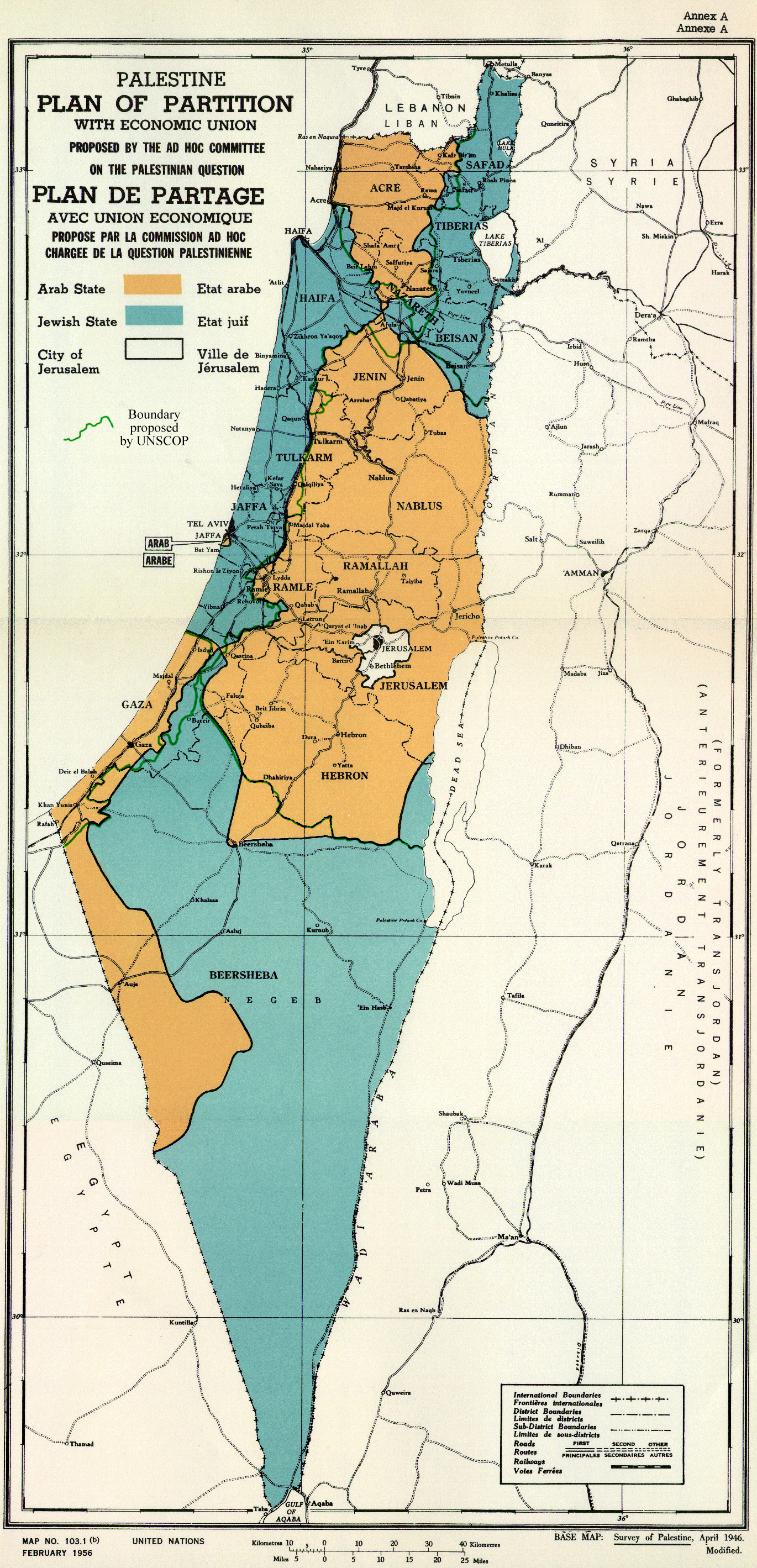
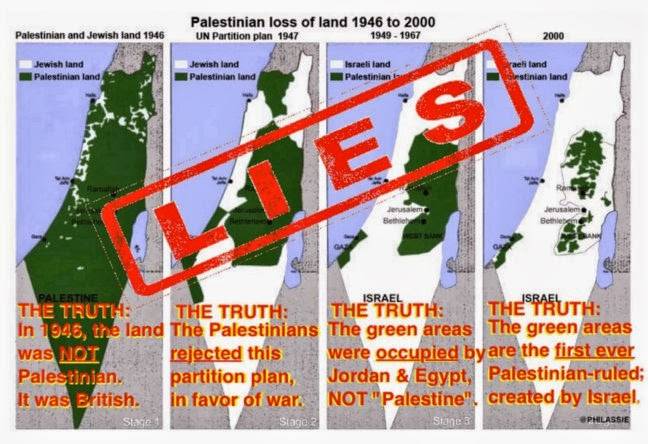
You post a map drawn by some Ziofascist in 2008, and make absurd claims. Trans Jordan was never intended as Palestine nor was it ever called Arab Palestine as can be discerned from the record in many of the Reports of the Mandaory. For example the 1st JULY, 1920--30th JUNE, 1921 Report. TransJordania is reported on separately and has no relationship with Palestine except for trade, between the two separate entities as confirmed by the British administrators. Stop bullshitting, I leave for a few eeks and you repeat your bullshit and I have to post the source documents that prove you are an ignorant Ziofascist posting propaganda and lies.
"When Palestine west of the Jordan was occupied by the British Army and placed under a British military administration, over Trans-Jordania and a large part of Syria there was established an Arab administration, with its capital at Damascus. The ruler was His Highness the Emir Feisal, the third son of H.M. King Hussein, the King of the Hejaz. When Damascus was occupied by French troops in July, 1920, and the Emir Feisal withdrew, it was necessary to adopt fresh measures in Trans-Jordania. I proceeded to the central town of Salt on August 20th, and, at an assembly of notables and sheikhs of the district, announced that His Majesty's Government favoured the establishment of a system of local self- government, assisted by a small number of British officers as advisers.
Local councils were accordingly formed in the various districts, the people not being ready to unite in any form of combined government for Trans-Jordania as a whole. Five British officers were appointed to assist the councils and their officials and to aid in organising a gendarmerie. No British troops were stationed in the district.
It cannot be claimed that the system of administration so set up was satisfactory. The authority of the councils was flouted by large sections of the population; taxes were collected with difficulty; the funds at the disposal of the local authorities were insufficient to ensure the maintenance of order, still less to defray the cost of roads, schools, hospitals, or other improvements for the benefit of the people.
Some progress was beginning, however, to be made when, in the month of November, H.H. the Emir Abdallah, the second son of King Hussein, arrived from the Hejaz at Ma'an, to the south of Trans-Jordania. His purpose was declared to be to restore a Shereefian government in Damascus. His arrival caused much disturbance in the minds of the people of Trans- Jordania and further impaired the authority, already slight, of the local authorities. From Ma'an the Emir proceeded on March 2nd to Amman, a town on the Hejaz Railway to the east of Salt, and there established his headquarters.
The Secretary of State for the Colonies being in Palestine in the month of March, a Conference was held with the Emir, who came to Jerusalem for the purpose. An arrangement was reached by which the Emir undertook to carry on the administration of Trans-Jordania, under the general direction of the High Commissioner of Palestine, as representing the Mandatory Power, and with the assistance of a small number of British officers, for a period of six months pending a definite settlement. Order and public security were to be maintained and there were to be no attacks against Syria.
Since that time a close connection has continued between Palestine and Trans-Jordania. British representatives remain in the principal centres.
I paid a visit to Amman on April 18th as the guest of the Emir and explained in an address to the sheikhs and notables the arrangement that had been made. The Emir came to Palestine again in the month of May.
The political and technical officers of the Palestine Administration have made frequent visits to Trans-Jordania and have assisted the local officials with their advice. The difficulties of local finance have continued. Order and security are still lacking. A grant-in-aid of £180,000 was, however, voted by Parliament in July for the assistance of Trans-Jordania, and it is hoped that this assistance will enable an effective reserve force of gendarmerie to be established, revenue to be collected and the government of the district to be placed on a sounder footing. The district possesses great agricultural wealth, and the local revenue, if it were collected, would fully meet the local expenditure.
The political and economic connection between Palestine and Trans-Jordania is very close. Trade is active; communications are constant; disturbance in the one area cannot fail to be of detriment to the other; the prevention of raids from east of the Jordan and the preservation of order there are of no small importance to the population on the west. Syria, too, has a close interest in the security of her southern border. If Trans-Jordania became a prey to anarchy, not only her own inhabitants, but also the neighbouring territories, would be sufferers. All of them look to the Mandatory Power to prevent an eventuality which, in default of her influence and authority, might prove not remote."
- See more at:
Mandate for Palestine - Interim report of the Mandatory to the League of Nations Balfour Declaration text 30 July 1921