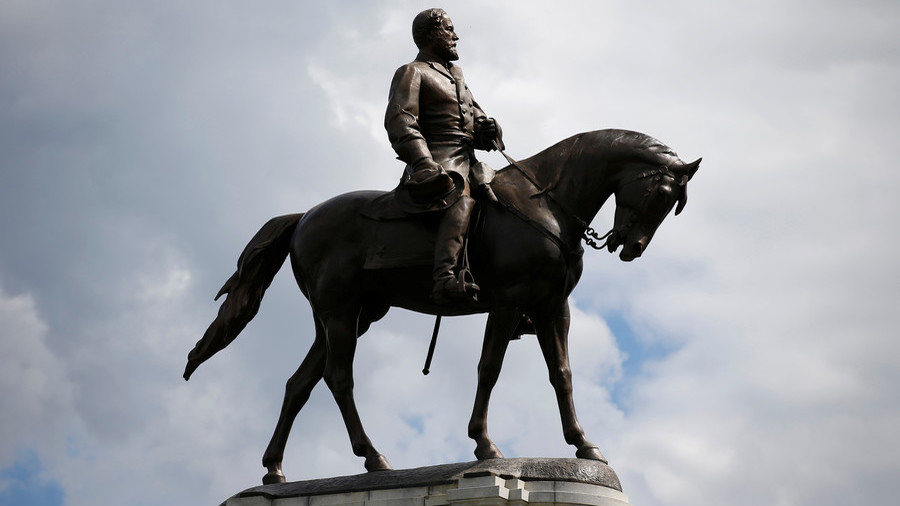
President Trump says ‘Lee was a great general’
So, when the hell is speaking the truth wrong?
In the era of Confederate statues and monuments being removed due to the South’s history of slavery, Robert E. Lee isn’t often talked about in a good light. But President Donald Trump managed to bring him up at a rally in Lebanon, Ohio on Friday.
“
So Robert E. Lee was a great general. And Abraham Lincoln developed a phobia. He couldn’t beat Robert E. Lee,” Trump said.
He went on to explain that Lee was “winning battle after battle after battle” in the Civil War, and that Lincoln came home and said “I can’t beat Robert E. Lee.”
At that point, Trump explained, Lincoln looked to Ulysses S. Grant to save the day – even though he was told Grant had a drinking problem.
“
And he went in and knocked the hell out of everyone,” Trump said of Grant.
The Left has gone so out of it that they can’t tolerate the truth from our president.
More @
‘Lee was a great general’: Trump’s Civil War remarks spark Twitter row
Did the moron in the WH mention Lee was also a great slave trader?? And the idiot was appealing for blacks to vote for him ? A truly idiot President A republican ,,,but I repeat myself
Have YOU really studied history? Or are you simply a butthurt Snowflake who mouths anti-Trump trash without knowing what you're talking about?
Read the following - with an open mind, if you can:
Lee's views on race and slavery
Several historians have noted the paradoxical nature of Lee's beliefs and actions concerning race and slavery. While Lee protested he had sympathetic feelings for blacks, they were subordinate to his own racial identity.
[76] While Lee held slavery to be an evil institution, he also saw some benefit to blacks held in slavery.
[77] While Lee helped assist individual slaves to freedom in Liberia, and provided for their emancipation in his own will,
[78] he believed the enslaved should be eventually freed in a general way only at some unspecified future date as a part of God's purpose.
[76] Slavery for Lee was a moral and religious issue, and not one that would yield to political solutions.
[79] Emancipation would sooner come from Christian impulse among slave masters before "storms and tempests of fiery controversy" such as was occurring in "Bleeding Kansas".
[76] Countering southerners who argued for slavery as a positive good, Lee in his well known analysis of slavery from an 1856 letter called it a moral and political evil. While both Robert and his wife Mary Lee were disgusted with slavery, they also defended it against Abolitionist demands for immediate emancipation for all enslaved.
[80]
Like Washington, Lee's father-in-law
G. W. Parke Custis freed his slaves in his will.
[81] In the same tradition, before leaving to serve in Mexico, Lee had written a will providing for the manumission of the only slaves he owned.
[82] Parke Custis was a member of the American Colonization Society established to gradually end slavery by establishing a free republic in Liberia for African-Americans, and Lee assisted several ex-slaves to emigrate there. But according to historian Richard B. McCaslin, Lee was a gradual emancipationist, denouncing extremist proposals for immediate abolition of slavery. Lee rejected what he called evilly motivated political passion, fearing a civil and servile war from precipitous emancipation.
[83]
Historian Elizabeth Brown Pryor offered an alternative interpretation of Lee's voluntary manumission of slaves in his will, and assisting slaves to a life of freedom in Liberia, seeing Lee as conforming to a "primacy of slave law". She wrote that Lee's private views on race and slavery "which today seem startling, were entirely unremarkable in Lee's world. No visionary, Lee nearly always tried to conform to accepted opinions. His assessment of black inferiority, of the necessity of racial stratification, the primacy of slave law, and even a divine sanction for it all, was in keeping with the prevailing views of other moderate slaveholders and a good many prominent Northerners."
[84]
On taking on the role of administrator for the Parke Custis will, Lee used a provision to retain them in slavery to produce income for the estate to retire debt.
[81] Lee did not welcome the role of planter while administering the Custis properties at Romancoke, another nearby the Pamunkey River and Arlington; he rented the estate's mill. While all the estates prospered under his administration, Lee was unhappy at direct participation in slavery as a hated institution.
[82]
Even before what Michael Fellman called a "sorry involvement in actual slave management", Lee judged the experience of white mastery to be a greater moral evil to the white man than blacks suffering under the "painful discipline" of slavery which introduced Christianity, literacy and a work ethic to the "heathen African".
[85] Columbia University historian
Eric Foner notes that Lee "was not a pro-slavery ideologue. But I think equally important is that, unlike some white southerners, he never spoke out against slavery."
[86] By the time of Lee's career in the U.S. Army, officers of West Point stood aloof from party and sectional strife on such issues as slavery as a matter of principle and Lee adhered to the principle.
[87][88] He considered it his patriotic duty to be apolitical while in active Army service,
[89][90][91] and Lee did not speak out publicly on the subject of slavery prior to the Civil War.
[92][93] Before the outbreak of the War, in 1860, Lee voted for
John C. Breckinridge, who was the extreme pro-slavery candidate in the 1860 presidential election, not John Bell, the more moderate Southerner who won Virginia.
[94]
Lee himself owned a small number of slaves in his lifetime and considered himself a paternalistic master.
[94] There are various historical and newspaper hearsay accounts of Lee personally whipping a slave, but they are not direct eyewitness accounts. He was definitely involved in administering the day-to-day operations of a plantation and was involved in the recapture of runaway slaves.
[95] One historian noted that Lee separated slave families, something that prominent slave-holding families in Virginia such as Washington and Custis did not do.
[96] In 1862, Lee freed the slaves that his wife inherited, but that was in accordance with his father-in-law's will.
[97]
Lee claimed that he found slavery bothersome and time-consuming as an everyday institution to run. In an 1856 letter to his wife he maintained that slavery was a great evil, but primarily due to adverse impact that it had on white people:
[98]
In this enlightened age, there are few I believe, but what will acknowledge, that slavery as an institution, is a moral & political evil in any Country. It is useless to expatiate on its disadvantages. I think it however a greater evil to the white man than to the black race, & while my feelings are strongly enlisted in behalf of the latter, my sympathies are more strong for the former. The blacks are immeasurably better off here than in Africa, morally, socially & physically. The painful discipline they are undergoing, is necessary for their instruction as a race, & I hope will prepare & lead them to better things. How long their subjugation may be necessary is known & ordered by a wise Merciful Providence.
[99]
Foner writes that "Lee's code of gentlemanly conduct did not seem to apply to blacks" during the War, as he did not stop his soldiers from kidnapping free black farmers and selling them into slavery.
[86] Princeton University historian
James M. McPherson noted that Lee rejected a
prisoner exchange between the Confederacy and the Union when the Union demanded that black Union soldiers be included.
[96] Lee did not accept the swap until a few months before the Confederacy's surrender.
[96]
In December 1864 Lee was shown a letter by Louisiana Senator
Edward Sparrow, written by General
St. John R. Liddell, which noted Lee would be hard-pressed in the interior of Virginia by spring, and the need to consider
Patrick Cleburne's plan to emancipate the slaves and put all men in the army who were willing to join. Lee was said to have agreed on all points and desired to get black soldiers, saying "he could make soldiers out of any human being that had arms and legs."
[100]
After the War, Lee told a congressional committee that blacks were "not disposed to work", and did not possess the intellectual capacity to vote and participate in politics.
[97] Lee also said to the committee that he hoped that Virginia could "get rid of them," referring to blacks.
[97] While not politically active, Lee defended Lincoln's successor
Andrew Johnson's approach to Reconstruction, which according to Foner, "abandoned the former slaves to the mercy of governments controlled by their former owners."
[101] According to Foner, "A word from Lee might have encouraged white Southerners to accord blacks equal rights and inhibited the violence against the freed people that swept the region during Reconstruction, but he chose to remain silent."
[97] Lee was also urged to condemn the white supremacy terrorist
[102] organization
Ku Klux Klan, but opted to remain silent.
[94]
In the generation following the war, Lee, though he died just a few years later, became a central figure in the
Lost Cause interpretation of the war. The argument that Lee had always somehow opposed slavery helped maintain his stature as a symbol of Southern honor and national reconciliation.
[94] Douglas Southall Freeman's Pulitzer prize-winning four-volume
R. E. Lee: A Biography (1936), which was for a long period considered the definitive work on Lee, downplayed his involvement in slavery and emphasized Lee as a virtuous person. Eric Foner, who describes Freeman's volume as a "
hagiography", notes that on the whole, Freeman "displayed little interest in Lee's relationship to slavery. The index to his four volumes contained 22 entries for 'devotion to duty', 19 for 'kindness', 53 for Lee's celebrated horse, Traveller. But 'slavery', 'slave emancipation' and 'slave insurrection' together received five. Freeman observed, without offering details, that slavery in Virginia represented the system 'at its best'. He ignored the postwar testimony of Lee's former slave Wesley Norris about the brutal treatment to which he had been subjected."
[94]
A man of his time who did his best according to his beliefs from birth.