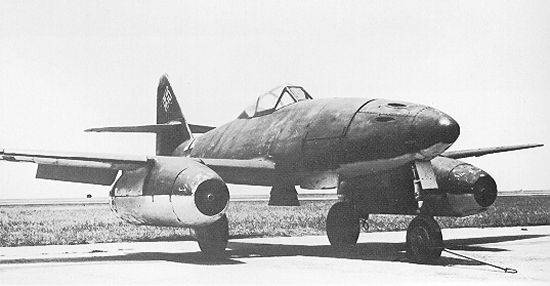
That only worked AFTER the Allies established air,
The Me-262 wasn't fielded into combat until mid to late 1944.
By then the Allies basically controlled the skies. And the tactic of shooting down the german jet during both take-off and landing was a well established tactic. ....

There were over 1000 262s made that wasn't destroyed on the ground. But just over 300 actually made it into service. They didn't lack 262s, they lacked experienced pilots. The Germans could churn out fighters by the thousands out of barns, root cellars and more. But could only field X number of Expertines (aces) at any given time and slowly lost almost all of them. They used quite a few of their "Hitler Youth" for fighter pilots who could barely get the high performance fighter off the ground. They relied on the Expertines they had left to navigate and lead flights. This was slowly not working out even for the massing of fighters.
The 262 didn't have nearly the duration to mass like that so they flew them solo. The problem there was, it took an experienced hand to get it from point A (take off) to point B (attacking the Bombers) and then to point C (getting home without getting lost). Like I said, over 1000 262s were at their disposal but only a little over 300 could actually fly. Had they been able to field the over 1000 262s the bombers would have been wiped out.
They had no fuel. The "Experten" (not expertine) for the most part survived quite well. The 262 was a dog in a dogfight, but could outrun anything in level flight. 1,000 262's would have been a problem, but there is no way they could alter the course of the war. The Brits had the Gloster Meteor in numbers so the 262's speed advantage was going to be very short lived, and the Hawker Tempest could stalk them as they were landing, and there were 1,700 of those and with their greater reliability, and good speed in a dive, they were everywhere.
No fuel at the very end. Even after we destroyed the Rumanian Oil Operations, they were making synthetic fuels. Until those were heavily bombed, they had the fuel. We didn't completely shut that tap off even then but did turn the knob down quite a bit.
The Gloster Meteor had a top speed of only 460 mph. It wasn't really any better than the XP-59 which the 262 would eat it's lunch. Neither was really production but lead to better AC later.
Add to that the Junkers Jumo engine was notoriously unreliable, and the aforementioned lack of fuel for training and the 262 could never be anything more than an annoyance at the strategic level, and a sought after trophy on the tactical.
What it lacked was the material for the turbine section. The engine was actually better but the turbine section was the weakpoint. The Tungsten from Africa was captured and they had a shortage of it.
You are under the impression that they had an endless supply of experienced pilots. There is only one way to become an experienced pilot during war. Kill the other guy first. Or you can have a decent training period. In the last 2 years of the war, the Luftwaffe extremely shortened their training period. They pulled experienced pilots from Russia, put in the Hitler Youth almost directly into combat, pulled cargo and bomber pilots directly into the 190s and 109s. In a flight of 50, you would see ONE Experten pilot as flight leader. The rest of them were sent to the 262 units. In the end, the 190 and the 109 became almost turkey shoots. The bad part is, you had no idea if it was a cream puff or an experten pilot you faced. The allies started to chalk up quite a long list of Aces during that time.
They had the gas for the 262 but their supply lines to get it to where it would do the greatest was interrupted on a regular basis by Navy, Grunt and AF. Oftentimes, we forget about the other players.