so, there is no bls calculation ......this 100.000 number is a number you are calculating for jobs now opened due to retiree turn over and an employment of a here to fore unemployed person? And the BLS doesn't capture that?
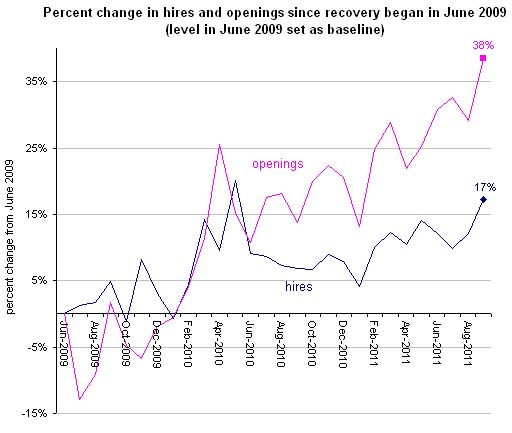
what do you think of this chart btw-
and I didn't make anything up ed, I have asked you the same questions based on the same argument. you know it, I know it.
You are saying that there are folks who are unemployed, who then become employed, and they come off "a" unemployed count/number, but cannot surface a bls document with numbers saying- there has been such and such number of openings,
due to separation (ex; retirees) and such a number of hires that gets captured here______ for a number. I find it very difficult to believe the bls et all does not capture this, it seems a bit crazy for an agency that seems to quantify ( or attempt to quantify) everything....so, I have to say this all seems like a mish mash.
If I produced this for you as back up to a claim of mine, you would not accept it and I would not expect you to.
your ability to read what I write is, well, not good.
I didn't claim a thing.
I said-
You are saying that there are folks who are unemployed, .....yada yada yada...
And for your information, according to BLS, separations includes a lot more than just retirees. Retirees are part of "other" separations, but BLS does not break down totals for each of the "others." Clearly there are enough "others" to support the numbers I use for retirees, so I am at least feasibly in the ball park even though BLS does not track retirees. At the very least, nothing the BLS provides directly contradicts my approximations!
Table 6. Other separations levels and rates by industry and region, seasonally adjusted
Job Openings and Labor Turnover Summary
Separations The total separations figure includes quits, layoffs and discharges, and other separations. Total separations also is referred to as turnover. Quits are generally voluntary separations initiated by the employee. Therefore, the quits rate can serve as a measure of workers’ willingness or ability to leave jobs. Layoffs and discharges are involuntary separations initiated by the employer. Other separations include separations due to retirement, death, and disability, as well as transfers to other locations of the same firm.
yes indeed that page and tables are very interesting.
see my bold above as to your comment-
And for your information, according to BLS, separations includes a lot more than just retirees.
yes, I see that, which means that
your argument as to retirees being a very large set and one of the largest drivers of the lower lpr and that that has led to pick ups in employment/ pick ups/new hires for those positions doesn't appear to be verifiable.
I am glad you feel that you were not contradicted, last I checked though, not being contradicted because there is no data to disprove ( or prove) your claim doesn't equate to anything but supposition.