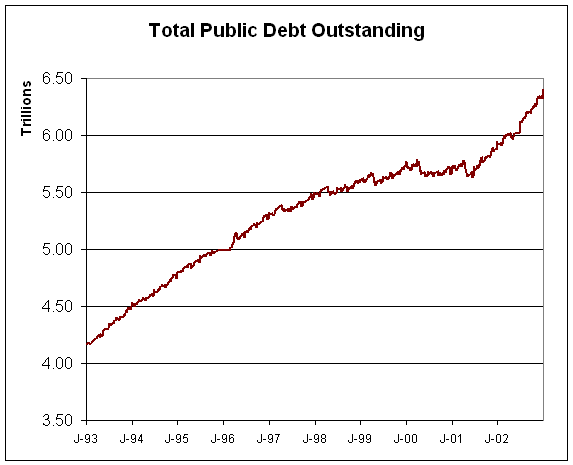
Nor was the budget really balanced during Clinton's term--Democrats are so fond on saying how Bush erased a substantial surplus--but the debt clock was still running rapidly at the end of the Clinton administration, just at a somewhat slower pace than it would have been running.
You need to look at the actual budget. It is available from a couple of places including the budget office.…… I don't know what debt clock you were looking at, but whichever, they are not connected to anything. They estimate the rate of change based on something. It doesn't actually track the debt. That would be cool, the Treasury department does report the daily receipts and outlays.
Year…………Signing Pres…………Total Receipts……Total Outlays…………Total Surplus
1994…………Bill Clinton…………1,258,566……………………1,461,753……………………- 203,186
1995…………Bill Clinton…………1,351,790……………………1,515,742……………………- 163,952
1996…………Bill Clinton…………1,453,053……………………1,560,484……………………- 107,431
1997…………Bill Clinton…………1,579,232……………………1,601,116……………………- 21,884
1998…………Bill Clinton…………1,721,728……………………1,652,458……………………………69,270
1999…………Bill Clinton…………1,827,452……………………1,701,842…………………………125,610
2000…………Bill Clinton…………2,025,191……………………1,788,950…………………………236,241
2001…………Bill Clinton…………1,991,082……………………1,862,846…………………………128,236
The Clinton budget was not only balance, it had a surplus.
This is verifiable. You can get the budget from a couple of sources. The Treasury department has a daily balance sheet by department.
The*President's*Budget for*Fiscal Year 2013 | The White House
Historical Tables | The White House
FDsys - Browse BUDGET
Maybe the interest payments offset the surpuls
I went back and looked and the record does seem to show that the national debt actually went down a small bit in 2000. So I stand corrected that the budget was never balanced. It was balanced that one year. Again, whatever graphs or charts you use, if that debt clock is still running, the budget is not balanced and any surplus shown is not including all the outlays.
Also, though the Bush administration and Congress were in no way as restrained as the reform minded Congress that Clinton was blessed with, in spite of 9/11 and Katrina, economic growth was steadily bringing down the deficit during the last years of Bush 43's administration; and, if the housing bubble collapse had not happened in 2008, Obama could very well have also inherited a balanced budget.
I wasn't so generous as to say the debt went down. It has this kind of seasonal/cyclical looking thing going on and doesn't get credit for that kind of thing. The GDP goes up and down seasonally, so an up in March compared to February doesn't really count for much. It's more like from seasonal peak to seasonal peak.
I can't argue whether Obama could have inherited a balanced budget or Bush got stuck with a housing bubble. Maybe Clinton got lucky with a bubble. That's the ***** of it. It's a circular reasoning argument that assumes the a priori knowledge of whether supply or demand side works. I know that Obama got stuck with a recession because the demand side stimulus should have worked better. So, that it didn't get worse proves that demand side works. I know that the debt would have been paid down if not for the housing crash because supply side works. So that the debt not being paid down was not the failure of supply side. If I make either statement, I'm presenting a bias.
I know this teenager who, when he first got his license, kept getting in accidents. It was never "his fault", just that the guy looked like he was going straight then suddenly cut into a driveway. He couldn't get that other drivers don't do "what they are suppose to do". Like Congress, they do what they do.
But we can say that the GDP, debt, deficit, unemployment, etc was at such and such a level at the beginning of their term, if we care. I don't think we care. All we care about is what the performance indicators did. The economy doesn't react to what Congress thinks, they react to what congress does. And what Congress does is change taxes and spend money. So it's the change in taxes and spending that counts.
There is an interesting stock market performance that demonstrates something. It happened at the debt crisis. Congress bitched and moaned. Then they did something, then the market started to oscillate. Then the credit rating was changed. Then the stock market dropped and oscillated like hell. That's a thing.
The obvious, and meaningless stuff is like when unemployment is at it's lowest point, it always went up. But that's only because we can look backwards in time.
We can say that unemployment was below normal and there was a tax cut and it went up, though we don't know if it's causal or coincident.
If we are lucky, we may find enough instances where a decrease in taxes was followed by an increase in receipts and GDP. Or an increase in spending was followed by an increase in GDP and receipts with increased employment. That's what were looking for, that's the hypothesis.
Here is the thing. Congress is tied to the performance of the GDP. They are, for sure, tied to the performance of their State and constituents.
What people say they are going to do and what people do is not connected. People say what they need to say to get what they need when they need it then do what they need to do to get what they need to get when the do it. That's proven psychology. We can train people to say one thing then do another. We know people that say one thing and do another.
Congress, as individuals and as a collective, along with the Presidency, will do what they need to do to get what they need to get, economic performance. Any and all of them will raise/lower taxes/spending if that's what they feel in needed to get the effect that they need. They have their ideals, they have outcome, and finally they invariably do what they got to do. I'm not sure that even one of them really knows what they are going to do until they do it.
The only thing that we might hope for is if an increase/decrease in spending/taxes leads or lags the other. Then maybe we can determine causality.
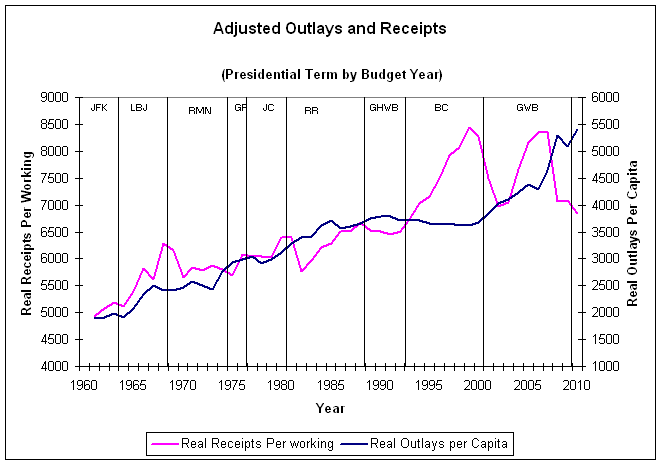
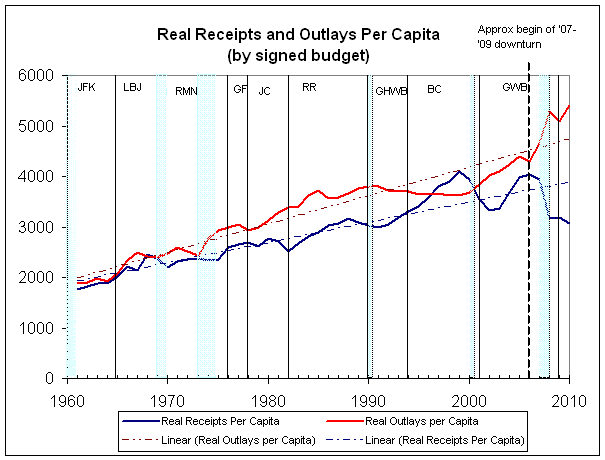
This is the budget in real dollars per capita. Terms are lined up by the budget year. Each president inherits the budget signed by his predecessor.
I prefer the receipts per working person. It provides a sense of the receipts given the existing workforce. If either the workforce increases or productivity increases, then it increases. Per capita makes it less pronounced. Never the less, a per capita view will suffice for both.
"Real" means the CPI data per the BEA. "per capita" means population data per the Census Bureau. "Receipts" and "Outlays" are budget data per the Treasury Department and available on the White House website in a nice format. Any blogs or articles that talk about the budget comes from this data. The author either read the tables or made a similar graph.
The difficulty with differentiating supply and demand side is that tax cuts are nearly always combined with increased spending. The 2001 and 2003 tax cuts were preceded by increased spending, starting in about 2000.
It appears as if the 2003 cuts were followed by growth but a) it is only one example and b) it also included an increase in spending.
The Clinton admin is conflagrated though it has the necessary cutback on outlays with the increase in receipts.
As we go backward, the JC and RR period has this whole period of tax changes in one year increments. And that outlays is higher then receipts again.
Even the JFK-LBJ period had an increase in outlays both synchronous to and preceding an increase in receipts. The synchronous increase in outlays and receipts following the tax cut makes it just impossible to draw a conclusion.
One thing that we can hope for is that it's the percentage that counts, not absolute value.
What one hopes is for the level of confidence that is afforded something like psychology, like 80%.
There is always the possibility that there simply isn't enough information to be able to tell. Eventually, over the decades, enough data will be available. That's the trouble with economics, there is only one example to work with.
At some point, you gotta vote what you gotta vote.
Here is my full consideration;
It has been suggested that the "recession" of 2000 was caused by the debt pay down. It's an interesting consideration as MMT suggests that there is no savings except that there is debt so the government debt then accounts for savings in the private sector. Paying off the debt then depletes private savings. And, of course, it is private savings as well as the modern monetary system that provides the "fiat" capital for growth.
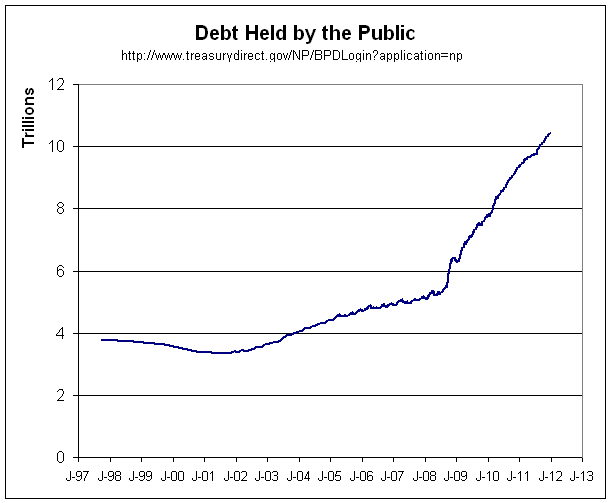
What is notable is how the per capita trend in spending just keeps going up. The balanced budget was followed by decline in the GDP upward trajectory and necessitated further decrease in receipts and increase in spending. It was, unfortunately, too little too late. It gives a sense that it is neither supply side or demand side, but rather it is the rate of change of both. As long as one, the other, or both are changing such that the Debt Held by the Public is increasing, then there is an increase in GDP. Otherwise, GDP falls below some "preferred level" in which case a threshold is crossed and it reverses direction. In the worst case, it reverses direction into a balance sheet recession. This threshold effect is similar to a deflationary spiral except, in this case, it is a recessionary spiral.
If anything, Congress is good at acting in a manner that has little to do what any individual may say. Ultimately, the self interest of the Congress is tied to the self interest of the nation and the national GDP. If business begins to fall off, Congress will increase spending and decrease taxes in whatever manner it can to get GDP back on an upward trend. And the behavior of Congress has been, in the end, both spending and tax cuts.
At some point, increasing standard of living must become non-existent. At some point, consumption is satisfied on a per person basis. What we would hope is that we would have a larger number of choices, with businesses in competitive markets finding their nitch. At some point, GDP growth is limited to cost of living and population growth. We can only hope that this level shows a sufficient amount of increase such that GDP doesn't cross the recession threshold.
I have to look at what is. And I believe what I see. What I see is a constant long upward trend of spending with increased deficit.
I think the reason we have a debt is because we must. Congress doesn't get rid of it, not collectively, because whether they fail to cut taxes or do reduce spending, some place in the economy goes to shit and they can't. I'll bet ten to one that we won't ever see it paid down. Clinton did and Bush was forced to increase it. Reagan tried, and forced himself.
It may be that we've tapped out that natural growth. We may have tapped out that peak per capita consumption natural growth a decade ago. The economy wants to run at 10%, or something, unemployment.
The problem is, we can't know, not with the way it all has been going, boom and bust. And that's not supply or demand, conservative or liberal. It's both and neither. It's pessimistically saying "It just doesn't work, no matter what we do". In the short run, we can tweak it. In the long run, were screwed.
This remains, though, hypothetical. It requires being able to demonstrate both demand and supply side effect. It is, though, a better approach as it takes both as being valid hypothesis. It also hypothesizes that supply and demand side are temporary. In the end, both must be demonstrated as true or false. The proof of one does not disprove the other. The proof of an impulse effect will reveal any long term changes. If we can find the impulse, we can find the medium and long term affect.