A
New York Times reporter and photographer go into a car. They travel across one of the world’s happiest countries—and find only anger, alienation, and regret.
The opening paragraph is phrased like a joke because
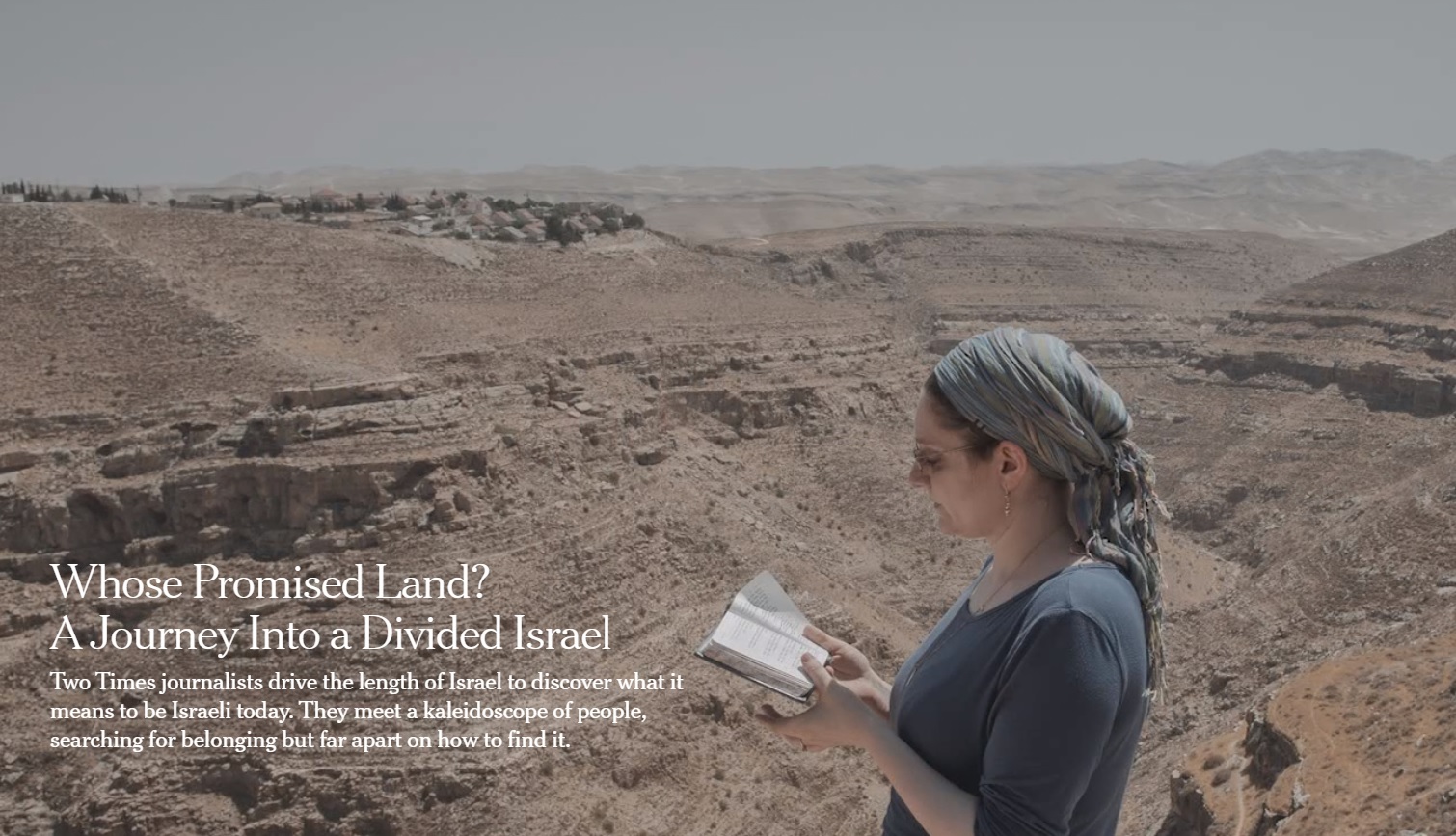
New York Timescoverage of Israel—its efforts to curate, conceal, and contrive the faraway land for its American readers—has descended into hilarity. Indeed, yesterday’s front-page story by Jerusalem bureau chief Patrick Kingsley, which promises to help readers “discover what it means to be Israeli today,” is a comical caricature of the paper’s own biases, exposing much more about the
New York Times than about the country it is supposedly covering.
Israel’s place in the World Happiness Report’s index is marked by a red arrow.
To understand why, it helps to first understand a couple of facts about that country: Israel has consistently ranked at the top of measures of global happiness. The 2021
World Happiness Report, for example, found Israelis to be among
the happiest in the world, and ranked their country as 12th happiest out of 149 countries over the past three years.
In other words,
if you were to ask random Israelis to “think of a ladder, with the best possible life for them being a 10, and the worst possible life being a 0,” then ask them to “rate their own current lives on that 0 to 10 scale,” chances are you’d find them saying that they are living close to the best possible life. That’s what pollsters found.
According to other
polling, by Israel’s Central Bureau of Statistics, over 88 percent of Israelis, including 76 percent of the country’s Arab citizens, were satisfied with their lives.
Nearly two in five said they were “very” satisfied.
It was this country that Kingsley set out to explore, meandering from the northern border to the southern tip over ten days to “discover” Israelis and duly report back to readers of the
New York Times.
And finally, a happy non-Zionist to show us where the problem lies.
It is a cartoon. And whatever thoughtful insights Kingsley might offer are buried in this avalanche of cartoonish negativity. Yes, societies all have some darkness, not least one forced into decades of conflict and war. One would expect an appropriate share of the above adjectives in an honest exploration of any country. Israelis will certainly recognize some the themes Kingsley dwells on.
But this is over the top. In a country whose history of conflict makes all the more remarkable its resilience, vibrancy, and happiness, the
New York Times, whose reputation of anti-Israel advocacy has grown in recent years, bends itself out of shape to curate malcontent. It isn’t following where the Israeli roads leads, letting chance encounters eventually paint an accurate picture. Rather, it’s flipping a two-headed coin to get the intended result. The cheating is apparent to those familiar with the country. It looks desperate. The desperation is clumsy. And the clumsiness is funny.
But it’s also sad, because a newspaper’s reporting isn’t meant to be funny. So the joke is on readers.
(full article online)
The New York Times promises to show readers what it means to be Israeli. Instead, it curates, conceals, and contrives an ugly land of

www.camera.org

 www.counterpunch.org