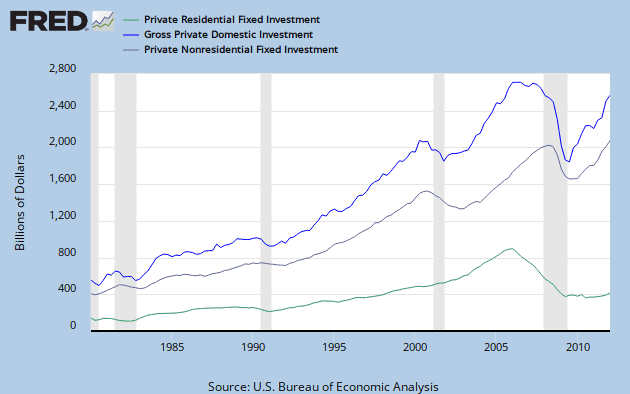
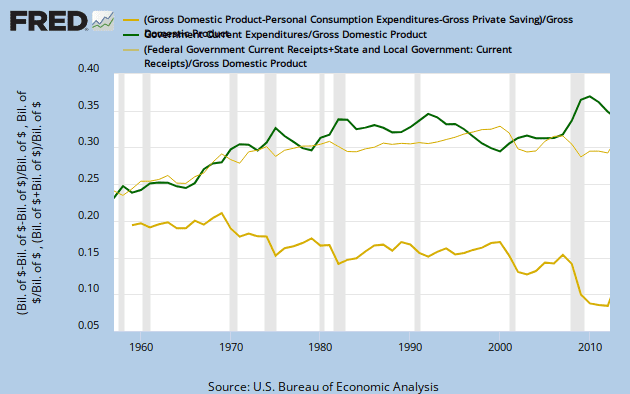
What ever are you talking about?
Bush II did a great job with it, lowering taxes and increasing spending which drove investments in MBS and a housing bubble.
Fiscal stimulus means Government, or Public,
investment, by
borrowing money (G-T > 0). Did Government borrow, to invest into housing markets?
Fannie-Mae, backed by the US Government (and low centrally-set interest-rates),
lent into housing markets; and then was bailed out. Even if you accept that the bail-out represents, ultimately, the US Government borrowing, into deficits, to dump money into mortgage markets; then, even so, that would be Government
speculating, not Government
investing.
Fiscal stimulus = Public
investing,
!= Public
speculation (on asset price bubbles)
At the end of this post are a number of articles and presentations on fiscal multipliers.
As I am to understand this, the underlying basis of Keynesian theory is that changes in government fiscal policy have an effect on national output that is a multiple (not necessarily greater than one) of the dollars introduced by the fiscal policy. There are two basic fiscal policy categories, the tax multiplier and the spending multiplier. Of course, there is more than one tax and more than one type of spending type.
"An initial increase in government spending, decrease in taxes, or an increase in transfer payments, causes a multiplier effect as it moves through the economy." -
http://academic.kellogg.edu/mckayg/macro/presentations/MacroPresentation11top5revised.ppt
The nature of fiscal multipliers can be used to restore the economy to full employment. Direct government spending in investment is one way. It is not the only way.
Another way is simply to lower taxes and let the markets do what they may with the monies. An increase in government discretionary spending also falls under the heading of fiscal policy and has a multiplier effect. Government defense spending has been shown to have a multiplier of as high as 1.5.
At the end of the Clinton admin, the US economy saw a slight recession. Also, employment began to fall off. In 2001, the US government implemented a phase in of lower taxes. At the same time, the government increased spending. In 2003, the 2001 tax policy was accelerated. The combination of increased spending and lower taxes resulted in a budget deficit. The Treasury department covers the deficit by selling t-bills. GDP increased, primarily on the housing market as demand for MBSs drove the mortgage market and real estate investment.
I've got lots of graphs for these. The government revenues and outlays, the housing average price, employment, and the investment portion of the GDP all line up nicely. It is possible that they are all coincidental and it would be nice to be able to differentiate out the details of where the funds flowed in terms of the components of the taxes, outlays, GDP, MBSs, and the housing market.
Curiously, this was a global process, not isolated to the US, with Ireland and other countries experiencing their own housing and MBS booms. This is, of course, not uncommon, for "separate" country markets and economies to all follow the same economic boom simultaneously. The word gets around.
Never the less, and I am pretty sure about this, the ideas behind Keynesian theory of government fiscal multipliers is not limited to just direct government spending on investments. It covers all fiscal policy changes that increase or decrease monies in the economy such that aggregate demand is shifted.
---------------
These are the two fiscal policy presentations that I like the best;
MEASURING_THE_OUTPUT_RESPONSES_TO_FISCAL_POLICY
http://emlab.berkeley.edu/~auerbach/measuringtheoutput.pdf
http://academic.kellogg.edu/mckayg/macro/presentations/MacroPresentation11top5revised.ppt
-------------------------
There is also the following;
Fiscal_Stimulus_in_a_Monetary_Union_Evidence_from_US_Regions
http://www.columbia.edu/~en2198/papers/fiscal.pdf
IMF_Fiscal_Multipliers.pdf_spn0911.pdf
http://www.imf.org/external/pubs/ft/spn/2009/spn0911.pdf
--------------------
(I'm not sure about the three Power Point presentations but have included them anyways.)
http://www.ega.edu/facweb/jwhirl/Fiscal Multipliers.ppt
http://www.markville.ss.yrdsb.edu.on.ca/economics/Fiscal Policy ppt(1).ppt
http://www.uwlax.edu/faculty/brooks/eco120/mod8/fiscal.ppt