
I'm not certain how Reiny see that that though. He seems to be saying something else. Which as near as I can tell is totally irrelevant to the discussion of the ocean storing heat.I was mainly making a joke, however the high specific heat of water is thanks to the strong hydrogen bonds in the water molecule.
Soooooo, the "force" holding the heat in the oceans is the strong force of the hydrogen bond.
Navigation
Install the app
How to install the app on iOS
Follow along with the video below to see how to install our site as a web app on your home screen.
Note: This feature may not be available in some browsers.
More options
Style variation
You are using an out of date browser. It may not display this or other websites correctly.
You should upgrade or use an alternative browser.
You should upgrade or use an alternative browser.
Sea levels rise by 'unexpected' amount in 2024: NASA
- Thread starter 1srelluc
- Start date

Correct. That's why I said he reminds me of SSDD.I'm not certain how Reiny see that that though. He seems to be saying something else. Which as near as I can tell is totally irrelevant to the discussion of the ocean storing heat.
Isn't EVERYTHING technically energy?So where's you energy getting stored ... liquid water or water vapor ...
e=mc^2
Temperature is a measure of energy, specifically the average kinetic energy of the particles within a substance. However, it's not a measure of the total energy, but rather the average energy of the particles' movement.
While temperature is related to kinetic energy, it's important to distinguish it from heat and internal energy. Heat is the transfer of thermal energy from a higher temperature body to a lower temperature body. This energy transfer occurs when there is a temperature difference, and it can happen through conduction, convection, and radiation.
Maybe this plot of the thermal gradient of the ocean will help.

ReinyDays
Platinum Member
Water has well more than 4X the heat capacity of the atmosphere. On top of that, even as the water gives back some of its heat to the air, some of that is replaced from deep below, from the rock of the Earth and the heat therein.
We measure 1.8 W/m^2 (±0.5) of climate forcing ... we receive slightly more energy than we re-radiate back out into space ... of that, only 0.1 W/m^2 is thought to be from the Earth's own internal heat ... volcanoes, mud pots, black smokers, etc etc etc ... we generally ignore this energy in climate discussions, though it will effect weather locally and over short time periods ... 700ºC at 700 mph doesn't last long ... an hour long event doesn't effect the 100-year average much ...
Climate models consider the Earth as a ideal blackbody radiator ... energy in = energy out ... energy isn't stored ... so we can use Stefan-Boltzmann's Law to predict surface temperature ...
From "Atmosphere and ocean":
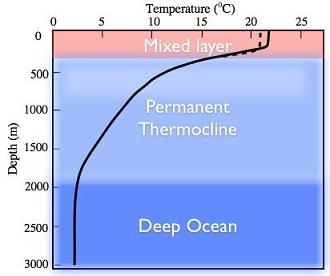
This graph demostrated what meteorologists call "positive tilt" ... convection is complete inhibited in this "thermal inversion" state ... i.e. temperatures increase with height, the opposite of the atmosphere ...
Further:
The dominant processes that heat or cool the ocean are associated with radiative exchanges, evaporation and conduction from or into the ocean surface. Practically, all solar radiation reaching the sea will be absorbed in a thin layer of water, which will heat surface waters. Similarly condensation of water vapour as dew near the surface and conduction of heat from the overlaying warm atmospheric layer will heat the ocean. The ocean cooling primarily happens as a result of evaporation and conduction of heat from the ocean surface. The wind-induced evaporation is a very dominant cooling mechanism of the sea surface. For calculating the heat budget of the ocean, it is required to calculate the fluxes of sensible, latent and radiative heating to and from the ocean surface. [td]The ocean surface is influenced by the climate, which is apparent in the ocean by the presence of sea ice, balance of evaporation and precipitation and the distribution of salinity and temperature at the surface affecting seawater density. The gentle gradient of temperature from equator to pole suggest that there is a thermally direct convective cell driven by heat and density gradient that takes warm waters poleward at the surface and cold waters equatorward at depth. This simple conveyor belt concept has changed as a result of studies by Stommel on the mechanism of meridional exchange in the ocean that emphasizes the role of wind stress at the ocean surface in achieving planetary heat balance. The ocean climates are thus largely determined by the response of the ocean to the atmospheric forcing in which both ocean and atmosphere respond to the global solar heating as a coupled system.[/td]

toobfreak
Tungsten/Glass Member
- Apr 29, 2017
- 102,915
- 110,223
- 3,615
Climate models consider the Earth as a ideal blackbody radiator ... energy in = energy out ... energy isn't stored ...
Well, I'm no climate scientist and a poor man's earth scientist, but physics taught me that there are never any ideal radiators nor perfect situations--- energy is always stored, if only via hysteresis, then time becomes a new factor.
Hysteresis and time combine to move energy from location to location, perhaps change it in form, and often, that alone is enough to drive some new mechanism which becomes a new consideration that must be accounted for.
If models cannot take that into account due to economy of design then their predictions become more generalized.
ReinyDays
Platinum Member
Well, I'm no climate scientist and a poor man's earth scientist, but physics taught me that there are never any ideal radiators nor perfect situations--- energy is always stored, if only via hysteresis, then time becomes a new factor.
Hysteresis and time combine to move energy from location to location, perhaps change it in form, and often, that alone is enough to drive some new mechanism which becomes a new consideration that must be accounted for.
I don't think I've ever seen the term "hysteresis" used in fluid mechanics ... but what do I know ...
There is a delay between the time the photon is absorbed by our surface and when the energy is re-emitted ... the energy exists as kinetic energy during this time ... this is what we read on our thermometers ...
Stefan-Boltzmann says this temperature is proportional to the fourth root of irradiation ... or irradiation is proportional to temperature raised to the fourth power ... meaning we have to raise energy A LOT just to get temperature up a little ... simple math ...
If models cannot take that into account due to economy of design then their predictions become more generalized.
Are you speaking to the computer simulations based on these theoretical models? ... these can only provide predictions if they are programmed to do so ...
echo "We're all gonna DIE"; ... honest results are distributions, and how the scientist interprets these distributions ... not perfect at 72 hours but good enough to be useful ...
toobfreak
Tungsten/Glass Member
- Apr 29, 2017
- 102,915
- 110,223
- 3,615
Well sure, there is hysteresis everywhere in any system that has a history. Hysteresis is at its most basic level the tendency of a system at one state in time to retain memory of that state and resist changing into a new future state.I don't think I've ever seen the term "hysteresis" used in fluid mechanics ... but what do I know ...
Well sure, there has to be. The photon is delayed because it has been forced into changing form.There is a delay between the time the photon is absorbed by our surface and when the energy is re-emitted ...
There are two flaws in all models:Are you speaking to the computer simulations based on these theoretical models? ... these can only provide predictions if they are programmed to do so ...
- They are designed to fit observation, so try best to resolve observation. When they don't, they are continually changed until they do that job perfectly or best they can, so become self-fulfilling.
- They can only be designed around those observations we observe. Anything else is seen as spurious noise or random error.
ReinyDays
Platinum Member
Well sure, there is hysteresis everywhere in any system that has a history. Hysteresis is at its most basic level the tendency of a system at one state in time to retain memory of that state and resist changing into a new future state.
Well sure, there has to be. The photon is delayed because it has been forced into changing form.
How do photons have memory? ... they are destroyed upon their energy being absorbed ... consider the 600 nm photon striking a water molecule ... this is re-emitted as two 1200 nm photons ... these have no rest-mass, so mass is conserved, and the 2 eV of energy is equal so energy is conserved ... the photons themselves need not be conserved and are destroyed when the radiative energy is converted into kinetic energy ... or sensible heat if you like ... remember your basic physics, work requires the passage of time and it requires work to convert energy from one form to another ...
"In the International System of Units (SI), work is measured in joules (symbol J). The rate at which work is performed is power, measured in joules per second, and denoted with the unit watt (W)." -- Work (thermodynamics) - Wikipedia
There are two flaws in all models:
- They are designed to fit observation, so try best to resolve observation. When they don't, they are continually changed until they do that job perfectly or best they can, so become self-fulfilling.
- They can only be designed around those observations we observe. Anything else is seen as spurious noise or random error.
This is easy to falsify ... Michael Faraday observed "fields of force" ... and then James Maxwell provided mathematical proof ... but this proof also indicated that EM travels at the speed of light, therefore light is a form of EM, and this conjecture was made without any observations ... not until Heinrich Hertz demonstrated EM waves in 1886 ...
The Higgs Boson is another example of theory leading to observation ... the Standard Model was well entrenched in scientific thought before all the predicted particles were found ... and this model stands as robust at this time, there doesn't seem to be any more particles to be found ... and folks are trying ... they're just not finding anything ... yet ...
It's considered a Gambler's Fallacy to think dice have memory ... "Hard 10" isn't overdue, your $100 bet is lost ...
toobfreak
Tungsten/Glass Member
- Apr 29, 2017
- 102,915
- 110,223
- 3,615
How do photons have memory? ...
A photon is a not a system, but there is still a type of memory in its being absorbed because it initiates further interactions as a result.
ReinyDays
Platinum Member
A photon is a not a system, but there is still a type of memory in its being absorbed because it initiates further interactions as a result.
Memory ... or just simple process ... rolling double fives pays 7 to 1 ... we could call it memory ... but not usually ... it's better viewed as cause-and-effect ...
The important point is the ocean and atmosphere are a coupled system ... and will always work towards thermal equilibrium ... any storage of energy is shared between the two, 4 parts in the ocean for every part in the air ... roughly ...
toobfreak
Tungsten/Glass Member
- Apr 29, 2017
- 102,915
- 110,223
- 3,615
Your choice. I was just talking about the effect of hysteresis in any physical system.Memory ... or just simple process ... rolling double fives pays 7 to 1 ... we could call it memory ... but not usually ... it's better viewed as cause-and-effect ...
How could they not be? They are really both part of the SAME system.The important point is the ocean and atmosphere are a coupled system ...
That is the point--- it is that effort to always try to work to that end that drives the dynamic details in the first place.and will always work towards thermal equilibrium ...
ReinyDays
Platinum Member
That is the point--- it is that effort to always try to work to that end that drives the dynamic details in the first place.
Then why are you arguing hysteresis ... maybe you should explain what you mean because the sea surface has no memory ... again, I've never seen that term used in fluid mechanics ... so maybe a definition in terms of fluid mechanics is in order ...
If you don't mind ...
In fluid mechanics, hysteresis refers to a situation where the output of a system (like flow or pressure) does not immediately respond to changes in input, leading to a delay and a "memory" of the system's previous state. This means that the system's response is not solely determined by its current input, but also by its history.I've never seen that term used in fluid mechanics ...
toobfreak
Tungsten/Glass Member
- Apr 29, 2017
- 102,915
- 110,223
- 3,615
Then why are you arguing hysteresis ... maybe you should explain what you mean because the sea surface has no memory ... again, I've never seen that term used in fluid mechanics ...
I already explained that, the sea surface is not a system, and the term is used all of the time.
ReinyDays
Platinum Member
In fluid mechanics, hysteresis refers to a situation where the output of a system (like flow or pressure) does not immediately respond to changes in input, leading to a delay and a "memory" of the system's previous state. This means that the system's response is not solely determined by its current input, but also by its history.
I get that part ... but does this relate to temperature? ... none of y'all's links discuss that ... what is it exactly about the liquid water molecule's history that changes how it absorbs a photon? ... it's just the molecule's environment that determines whether it sheds the energy back out ... for a blackbody radiator, we don't care what the material is ... just that it re-radiates all the energy it receives ... no storage allowed ...
How does hysteresis store energy in the oceans over climatological time frames ... 100 years or so ...
toobfreak
Tungsten/Glass Member
- Apr 29, 2017
- 102,915
- 110,223
- 3,615
... no storage allowed ...
Last time... of course energy is stored in the oceans, that is what having more than 4X the heat capacity as the air means...
I'm going to have to say that that has to be the IPCC's belief, right? I mean isn't that the basis behind their made up term "climate sensitivity?"I get that part ... but does this relate to temperature? ... none of y'all's links discuss that ... what is it exactly about the liquid water molecule's history that changes how it absorbs a photon? ... it's just the molecule's environment that determines whether it sheds the energy back out ... for a blackbody radiator, we don't care what the material is ... just that it re-radiates all the energy it receives ... no storage allowed ...
How does hysteresis store energy in the oceans over climatological time frames ... 100 years or so ...
Why should they? They can't model what they don't understand. Neither can you. And even if you or them did understand it, it's way to complex of a system to model. Arguing models is for fools.none of y'all's links discuss that

When you are already near or at sea level, 6 inches is A LOT!Six inches ... makes my head hurt ...

Natural, or man made, matters not to me....
I just want us to be smarter on our coastlines and start preparing in indirect ways...
-after hurricane destruction, don't allow homes to be rebuilt in the same spot...even with increased hurricane specs and standards....just buy them out...that way the city or town or FEMA or whatever, does not have to worry about water, electric, natural gas pipelines, and tree and branch removal and cleaning up the city or town roads to get to waterfront, hurricane destroyed districts, year after year, hurricane after hurricane....
When rebuilding or expanding special highways near the ocean edge like A1A, detour the new road extension inward, away from the ocean, or on much higher ground....
Start relocating waterfront businesses inland....
Much more can be done little by little by little over the next 100 or more years that could better prepare us for the sea level rise.
I just want us to be smarter on our coastlines and start preparing in indirect ways...
-after hurricane destruction, don't allow homes to be rebuilt in the same spot...even with increased hurricane specs and standards....just buy them out...that way the city or town or FEMA or whatever, does not have to worry about water, electric, natural gas pipelines, and tree and branch removal and cleaning up the city or town roads to get to waterfront, hurricane destroyed districts, year after year, hurricane after hurricane....
When rebuilding or expanding special highways near the ocean edge like A1A, detour the new road extension inward, away from the ocean, or on much higher ground....
Start relocating waterfront businesses inland....
Much more can be done little by little by little over the next 100 or more years that could better prepare us for the sea level rise.
Similar threads

- Replies
- 11
- Views
- 452

- Replies
- 218
- Views
- 3K


- Replies
- 0
- Views
- 201

- Replies
- 42
- Views
- 2K

New Topics
-
 Argentina‘s new Messi statue is taking the Internet by storm
- Started by Dont Taz Me Bro
- Replies: 0
-
 Question for those on the Left who constantly speak of Israeli Genocide against Gazans
- Started by Yarddog
- Replies: 0
-
 Dem civil war: Nazi thugs torment Scott Wiener in public
- Started by marvin martian
- Replies: 2
-


