Public University President retires on pension of $76,000 PER MONTH!!!
And the point is???
You do realize what it is primarily that university presidents do, don't you?
Tell us.
One can't really employ someone to do that and not pay that person handsomely.
Why do you think people pursue advanced degrees and take on complex career paths? It's certainly not to make $150K/year.
150K/year is more than plenty.
The few I know, overwhelmingly, what they do is fundraising. Surely you didn't think folks and corporation managers/boards wake up one day and say to themselves "hmm, I feel like writing a check for $5 million dollars to the 'U. of God of Knows Who?' or their dear old alma mater." Let me assure you, by and large, wild hairs like that do not just appear in folks' asses. Someone has to plant the seed, nurture it and see it grow into a big fat donation.
For example,
Loyola Marymount University President David W. Burcham spent 60 to 70 percent of his time fundraising . Almost literally, they are a one-person sales force for a college/university, constantly extolling the benefits of their institution to past, current and potential future big-money donors who write checks, define bequests, or setup annuities that do things like build new facilities, fund academic chairs, fund major scholarships, fund research institutes that are part of the university, and so on. Simply put, university presidents' main job is to get individuals and companies to provide the school with endowments. [1]
“Increased fund raising from private sources is the No. 1 strategy that both public and private institutions are employing in the hunt for new funds."
View attachment 188530
Just as workers in the commercial sector -- general/managing parternes in large law firms, investment banks, medical partnerships/LLCs, accounting firms, architectural and engineering firms, and management/business consultancies come immediately to mind -- who, in one way or another, work seven days a week to generate tens to hundreds of millions in revenue for their firms, get paid quite well ($750K+), so too do university presidents. And frankly, almost none of the noted private sector firms' (LLCs and partnerships) senior execs run organizations that are as large or as complex as are universities, to say nothing of even medium sized public universities like U. of OR.
Then there's the matter that unlike commercial sector principals who at least have a service or product they will deliver to their clients from whom they collect revenue, university presidents have little other than a small plaque to offer in return for a few million dollars. To wit,
at UT Dallas:
What is an endowed chair or professorship?
It is the highest academic award that the University can bestow on a faculty member, and it lasts as long as the University exists. Thus, it is both an honor to the named holder of the appointment and also an enduring tribute to the donor who establishes it.
The Benefits:
TO THE UNIVERSITY
Endowed faculty professorships and chairs are crucial for recruiting and retaining the highest-quality faculty. The greatest institutions have the best minds, the most-creative researchers and the most-engaged teachers. Building a mighty base of faculty talent enriches the academic environment, which attracts the brightest students.
TO THE PROFESSORS
Recognizing the continued contributions of senior-level faculty as well as providing funds to push the frontiers of their scholarship are key functions of the endowed positions. The funds can propel research, help pay student workers or create opportunities for collaboration with scholars around the world.
TO THE STUDENTS
One professor or chair can touch hundreds of lives through the courses they teach, the students they mentor, or through their own academic work. Having endowed faculty means students get to rub elbows with the most talented scholars in the world. Students have the opportunity to work in research labs, for example. They do not learn only from textbooks, but from the real world of innovation and discovery.
TO BUSINESSES AND CORPORATIONS
In a rapidly changing world, corporations realize the pace is often driven by the private sector, but much of the long-term thinking, basic research and most fundamental discoveries occur inside universities. Corporations support endowed chairs to give back to institutions that provide them with creative talent. The relationship also connects corporations with professors, researchers and students who can inspire innovation and creative ideas in a competitive environment.
TO PRIVATE DONORS
Donors provide funds for the overall improvement of the University, but some have personal interests in specific areas of study. By funding endowed chairs, donors can convene the brightest minds to focus on particular problems or issues and spur advances in those areas.
How much does it cost to endow a chair, not get one's name emblazoned on institute, or a laboratory, or a sports field, or a pavillion, or lounge, or dorm, or academic building, or telescope, but just get a plaque affixed to a door (or the wall next to/above it) in a hallway somewhere in an academic department? Well, it varies, but at Duke:
The Duke Board of Trustees has set different minimum funding levels for different
types of endowments:
- $50,000 will establish an unrestricted endowment for a particular school or division, such as the Pratt School of Engineering or the University Libraries.
- $100,000 will establish an endowment restricted to a specific purpose, such as faculty support within Arts & Sciences. (Undergraduate alumni who have graduated in the past ten years may establish a restricted endowment with a minimum gift of $50,000.)
Financial Aid
- $100,000 will establish an unrestricted financial aid endowment, such as a scholarship supporting undergraduates or medical students.
- $250,000 will establish a restricted financial aid endowment, such as a scholarship that gives preference to biology majors or international students or soccer players.
Faculty Chairs
- $1,000,000 will establish an endowed chair to support a visiting professor.
- $1,500,000 will establish an endowed chair to support an assistant or associate professor.
- $1,500,000 will establish an endowed chair to support a professor of the practice.
- $2,500,000 will establish an endowed chair to support a full professor.
- $3,000,000 will establish an endowed chair to support a university professor with appointments in more than one discipline.
- $5,000,000 will establish an endowed chair to support a faculty member holding the distinguished designation of dean.
Athletics
- $1,000,000 will establish an endowment supporting an associate or assistant coach.
- $2,000,000 will establish an endowment supporting a head coach in a sport other than football or basketball.
- $5,000,000 will establish an endowment supporting the head coach of football, men’s basketball, or women’s basketball.
- $5,000,000 will establish an endowment supporting the athletic director.
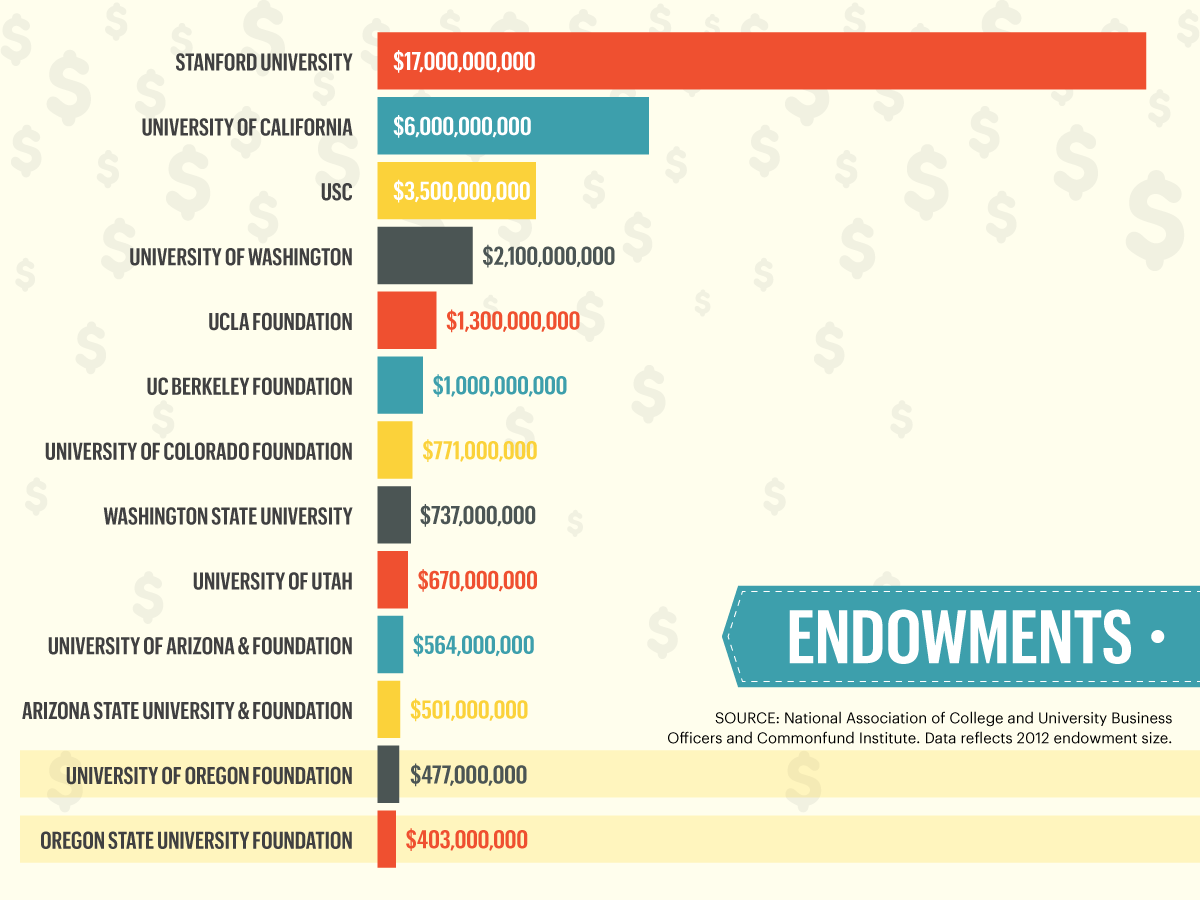
U of OR doesn't appear to publish similar figures, but from what they do publish their president has been busy. The university has some
$700M in endowments, which is four times what it had in 2002, and yet it's really not much at all in the scheme of things, and yet it's a huge advancement ($525M worth) from where the school was not that long ago.
As you can see, about a third of that $700M was generated in the past six years. [2] Accordingly, were Dr. Robertson to have worked for 33 in a private sector organization and generating that kind of revenue, he'd be retiring with an executive pension package that's not terribly different in extent.
Having explained all that, however, Robertson's pension is a function of PERS', pension program he signed into 33 years ago (1985), munificence, not the university's. How or why PERS calculates pensions the way it does (or did when he joined, because the applicable PERS terms when he joined it are the terms under which he's receiving his pension) I cannot say. If you want to do the digging to find out, here are some good places to start:
If I had to guess, I'd say it's because the pension plan he belongs to pays out based on market returns earned on contributions over the years. Seeing as that mans' been paying into the plan since 1985, his payout, given the increase in the market value of the investments in his plan, isn't at all surprising.
Note:
- I don't know if you understand how an endowment works but in a nutshell, but usually, someone writes a fat check that the school deposits into some sort of account (typically an investment account of some stripe). The investment provides a return and the return is what the school uses to fund (sometimes wholly, sometimes partially) something. The principal -- and if the schools investment managers are doing a decent job, some portion of the investment returns -- remains in the investment account so that the endowment can accommodate price increases (such as professor's salary, or the cost of maintenance and maintenance staff for a building, or telescope, or laboratory, etc.) over time.
- Just to give you a general frame of reference, newly minted partners in my firm are required to generate/sell $10M/year in gross revenue (their unit allocations depend in part on meeting their sales goals). That figure increases until partners rise into administrative management levels of the firm at which point the qualifier becomes managed and/or assisted revenue. That change basically reflects a senior partner's role in (1) helping the partners below him/her successfully sell and deliver projects, (2) developing relationships that generate leads that lower level partners pursue and that senior partners oversee and "grease" along as need, and (3) publishing and speaking so as to develop renown for the firm.