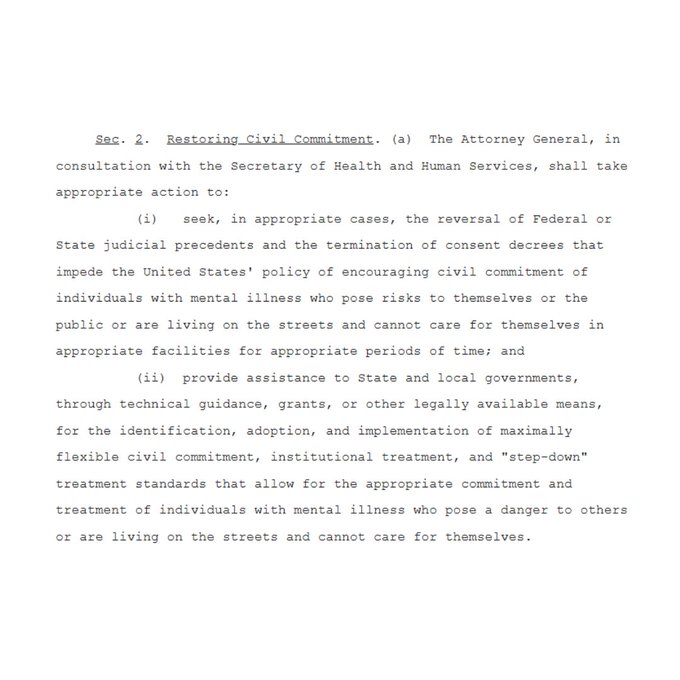
President Trump's latest executive order to bring back Asylums

In that case, the courts assign a guardian and that person is now the equivalent of a minor with very limited rights.
Not true as rule only in cases of chronic cognitive decline not mental illness which is often treatable
 
Whenever documented instances of abuse occured, there was always someone INSIDE the system that just didn't see any abuses.

:rolleyes: :rolleyes:

There are well-documented cases across the world illustrating abuse of mental health patients in psychiatric institutions, as well as systemic studies confirming such incidents are not isolated.

Major Documented Cases​

  • Edenfield Centre, UK (2022): Undercover filming by the BBC exposed a "toxic culture" where mental health patients endured humiliation, verbal and physical abuse, bullying, inappropriate restraint, prolonged and unjust isolation, and staff falsifying safety records. Staff were seen mocking, assaulting, and sexually harassing patients, as well as withholding basic comforts and showing indifference to self-harming behaviors. Multiple staff were suspended and a criminal investigation was launched12.
  • Federico Mora Hospital, Guatemala: A Disability Rights International (DRI) report found sexual abuse and severe mistreatment to be widespread. Female patients described being raped while sedated, with staff, other patients, and even police involved. Patients were denied medical care and exposed to dangerous conditions including risk of HIV, with some patients kept in the facility for years under inhumane circumstances3.
  • Twin Valley Behavioral Healthcare, Ohio, USA (2022): A patient died from blunt-force head trauma after being beaten by another patient. Several staff, including psychiatric assistants and a nurse, were indicted for involuntary manslaughter and patient abuse/neglect, revealing risky conditions and failures in supervision at this forensic psychiatric facility4.
  • Central State Hospital, USA (2023): Federal investigation reports reveal high levels of patient injury due to self-harm and assaults by other patients, often preventable, reflecting institutional failings in staffing and oversight5.
  • Historical Cases (e.g., Bedlam, 1940s USA): Testimonies and records describe attendants routinely beating, kicking, and humiliating psychiatric patients, with some kept in handcuffs for days, and serious injuries inflicted for minor provocations6.

Systematic Studies and Reports​

  • Recent surveys in Europe and North America indicate that within psychiatric institutions, 10-40% of patients report victimization:
    • Theft (40%), physical assaults (17% by other patients, 10% by staff), and sexual assaults (over 10% by staff or patients) are regularly cited.
    • Women are especially vulnerable to sexual advances and harassment within mental health care, while men more often report threats or physical violence78.
  • Global human rights watchdogs continue to expose human rights violations in psychiatric facilities, including forced restraint, unwanted medication, seclusion, and denial of dignity and care910.

Key Themes Across Reports​

  • Abuse takes many forms: physical violence, sexual exploitation, verbal humiliation, forced restraint, unjust isolation, and systemic neglect.
  • Institutional failures include inadequate staff training, poor patient supervision, lack of proper oversight, and cultures that perpetuate abuse.
  • Women, people with lengthy hospitalizations, and those with psychotic disorders are particularly at risk7.
These findings, from undercover journalism, government reports, and academic reviews, confirm that abuse of mental health patients is an international and ongoing problem, demanding transparency, reform, and robust independent oversight.
  1. 'Toxic culture' of abuse at mental health hospital revealed by BBC secret filming
  2. I went undercover to expose abuse at a mental health hospital
  3. Inside the 'world's most dangerous' hospital
  4. Patient and 3 staffers charged in another patient's beating death at mental health facility
  5. CRIPA Investigation Of Central State Hospital
  6. Bedlam 1946 | American Experience | PBS
  7. Frontiers | Victimization of People With Severe Mental Illness Outside and Within the Mental Health Care System: Results on Prevalence and Risk Factors From a Multicenter Study
  8. Patient Safety In Inpatient Psychiatry: A Remaining Frontier For Health Policy - PMC
  9. 'Tied Up, Forcibly Medicated': Human Rights Abuses ‘Far Too Common’ In Mental Health Care - Health Policy Watch
  10. “STUCK”: Los Angeles County’s Abuse and Neglect of People on Mental Health Conservatorships in Jail and Locked Psychiatric Facilities. | Disability Rights California
  11. https://psychiatryonline.org/doi/10.1176/ps.49.3.355
  12. Patients' reports of traumatic or harmful experiences within the psychiatric setting - PubMed
  13. Violent victimization of adult patients with severe mental illness: a systematic review - PMC
  14. https://www.apa.org/monitor/2021/04/ce-mental-illness
  15. Political abuse of psychiatry - Wikipedia
  16. Stigma, Prejudice and Discrimination Against People with Mental Illness
  17. Violent victimisation of psychiatric patients: a Swedish case–control study - PMC
  18. Data | SAMHSA
  19. https://psychiatryonline.org/doi/10.1176/ps.50.1.62
  20. Reducing violence in severe mental illness: randomised controlled trial of intensive case management compared with standard care - PMC
A few cases from all over the world dont define Americas current system. Many are severely dated and irrelevant. So what is your diagnosis
 
Not true as rule only in cases of chronic cognitive decline not mental illness which is often treatable

Often isn't always.

I responded to this:

You must understand that people can be in positions where their judgment is so impaired they cant make safe choices.
 
.

Towards the end of the documentary video I posted, they discuss a program in Rhode Island that seems like it might be working. Worth a look.

Absent that, prison for life, where they can't hurt innocent people.


.

We need more mental asylum's for those who won't stop or help themselves.
And for the working poor more affordable places to live.
The society has changed and so has the laws and those making the laws.
Trump is going back on his promises of deporting millions of illegals. We are now a minority in the nation and I don't see any positive change happening.
No nation can take in the third worlds indigent cultures and survive.
 
A few cases from all over the world dont define Americas current system. Many are severely dated and irrelevant. So what is your diagnosis
I am beginning to question your authenticity.

I am not making that argument. I am not opposed to involuntary commitment to the worst offenders.

I am simply making a statement that if they do go this route, then there better be systems in place to protect these people.

There is historical proof of past abuses, and to say they don't exist today is a deliberate blind spot.

These are MY requirements for such a program to go forward. It is NOT a debate.
 
We need more mental asylum's for those who won't stop or help themselves.
And for the working poor more affordable places to live.
The society has changed and so has the laws and those making the laws.
Trump is going back on his promises of deporting millions of illegals. We are now a minority in the nation and I don't see any positive change happening.
No nation can take in the third worlds indigent cultures and survive.
.

Some yes, some no.

I agree with everything but your opinion about Trump.


.
 
.

Some yes, some no.

I agree with everything but your opinion about Trump.


.


I can see I need to get back to my music,lol. And stay out of politics.
I was going to put up a thread on famous quotes, but it would turn political.

" Nether a wise man nor a brave man lays down on the tracks for the train of the future to run over him".
 
Ok, WHO makes that determination? Is the "person" involved able to fight it in court? Do they get due process or are they just involuntarily committed without due process?

If this person CHOOSES to go into treatment, great, but to be FORCED should be something that can be challenged in front of a judge. Otherwise this is like Russia.
There are different levels of psychological issues. Some may be housed permanently as they cannot survive in society and/or they are dangerous to others. Some may be discharged and return multiple times as they periodically go off and can be dangerous to others. Many people who have issues are not dangerous and can survive outside.
 
There are different levels of psychological issues. Some may be housed permanently as they cannot survive in society and/or they are dangerous to others. Some may be discharged and return multiple times as they periodically go off and can be dangerous to others. Many people who have issues are not dangerous and can survive outside.

Ok, but none of that answers the question I asked.
 
Ok, WHO makes that determination? Is the "person" involved able to fight it in court? Do they get due process or are thetsey just involuntarily committed without due process?

If this person CHOOSES to go into treatment, great, but to be FORCED should be something that can be challenged in front of a judge. Otherwise this is like Russia.
In California it's Health and Safety Code 5150. A person appearing to be a danger to themselves or others is held for 72 hours. If a medical provider thinks this isn't enough they can ask for a hearing. That's not what the concern over civil committment is. What changed was putting people in facilities with no release date. At the time, the concern was family getting elderly family members committed so their assets can be taken.
 
In California it's Health and Safety Code 5150. A person appearing to be a danger to themselves or others is held for 72 hours. If a medical provider thinks this isn't enough they can ask for a hearing. That's not what the concern over civil committment is. What changed was putting people in facilities with no release date. At the time, the concern was family getting elderly family members committed so their assets can be taken.

Ok, so this 5150 thing you speak of, can the person challenge it? Or is it against their will? If the latter, I have a VERY serious problem with it. Short of committing a crime, I tend to be VERY AGAINST the gov't locking up its citizens (not illegals, I don't give a rats ass about those people) without due process.
 
There are different levels of psychological issues. Some may be housed permanently as they cannot survive in society and/or they are dangerous to others. Some may be discharged and return multiple times as they periodically go off and can be dangerous to others. Many people who have issues are not dangerous and can survive outside.
.

Ordered into confinement by a court would work for me.


.
 
Ok, so this 5150 thing you speak of, can the person challenge it? Or is it against their will? If the latter, I have a VERY serious problem with it. Short of committing a crime, I tend to be VERY AGAINST the gov't locking up its citizens (not illegals, I don't give a rats ass about those people) without due process.
If a person been hospitalized under 5150, they are held for 72 hours. If the treating providers feel that more treatment would be necessary, they can get a hearing. The default is just let them go. The hearing is before a panel of doctors at that facility. The patient, at this point, cannot challenge the decision because it is a medical decision based on immediate need. The panel of doctors will make a recommendation as to the length and scope of additional treatment.

If the patient is deemed seriously impaired the facility notifies the family that the condition is If not permanent, at least long term. They must file, in court, for Guardianship/Conservatorship. This means a full blown hearing with attorneys, witnesses and all kinds of opportunity to be heard. If family cannot be found or isn't interested, the Court can appoint a state representative and the state will be appointed.
In practice, it works out for people that are seriously mentally ill that the state will get a conservatories over the finances of the ill person only. That way no one can get them to sign a bogus contract and take their disability payment. They will not get a guardianship over the health and safety of the person, leaving them to overdose in the streets.

This should answer your questions.
 
In California it's Health and Safety Code 5150. A person appearing to be a danger to themselves or others is held for 72 hours. If a medical provider thinks this isn't enough they can ask for a hearing. That's not what the concern over civil committment is. What changed was putting people in facilities with no release date. At the time, the concern was family getting elderly family members committed so their assets can be taken.

Hotel California's.
 
If a person been hospitalized under 5150, they are held for 72 hours. If the treating providers feel that more treatment would be necessary, they can get a hearing. The default is just let them go. The hearing is before a panel of doctors at that facility. The patient, at this point, cannot challenge the decision because it is a medical decision based on immediate need. The panel of doctors will make a recommendation as to the length and scope of additional treatment.

If the patient is deemed seriously impaired the facility notifies the family that the condition is If not permanent, at least long term. They must file, in court, for Guardianship/Conservatorship. This means a full blown hearing with attorneys, witnesses and all kinds of opportunity to be heard. If family cannot be found or isn't interested, the Court can appoint a state representative and the state will be appointed.
In practice, it works out for people that are seriously mentally ill that the state will get a conservatories over the finances of the ill person only. That way no one can get them to sign a bogus contract and take their disability payment. They will not get a guardianship over the health and safety of the person, leaving them to overdose in the streets.

This should answer your questions.

Ok, so they are held against their will for AT LEAST 72 hours.

Thanks for clarifying that. Commifornia makes you proud.
 
15th post
Ok, so they are held against their will for AT LEAST 72 hours.

Thanks for clarifying that. Commifornia makes you proud.
Yes. To get to that point it has to be pretty serious. I had to have my dad and a good friend each taken in on a 5150. Both were very unpleasant. My friend was held a total of six months.
 
I’m for it. Good state government jobs for a one of nurses
 
Ok, so this 5150 thing you speak of, can the person challenge it? Or is it against their will? If the latter, I have a VERY serious problem with it. Short of committing a crime, I tend to be VERY AGAINST the gov't locking up its citizens (not illegals, I don't give a rats ass about those people) without due process.
The whole point of being involuntarily committed is that the person being committed is unfit to make their own decisions and presents a danger to themselves and/or others
 
This is what I voted for. Make padded rooms great again!

That is the one thing Reagan messed-up on. A lot cheaper in the long run to have state hospitals than wasting money on free drugs, and other feel good money wasting programs that just end-up being grift streams for the dems.

For decades, libs have blamed the nation’s mental illness issues on Reagan’s closing of mental institutions. Now those same people are going to reeee about reopening them because it’s a Trump initiative.

BTW....Said institutions should be given the same legal protections that Big Pharma was given with the clot shots.


Gws_2-RXwAA_sBp


These are very desperately needed, and especially for very mentally ill, violent teens and children. These homes need good oversight though, obviously
 
Back
Top Bottom