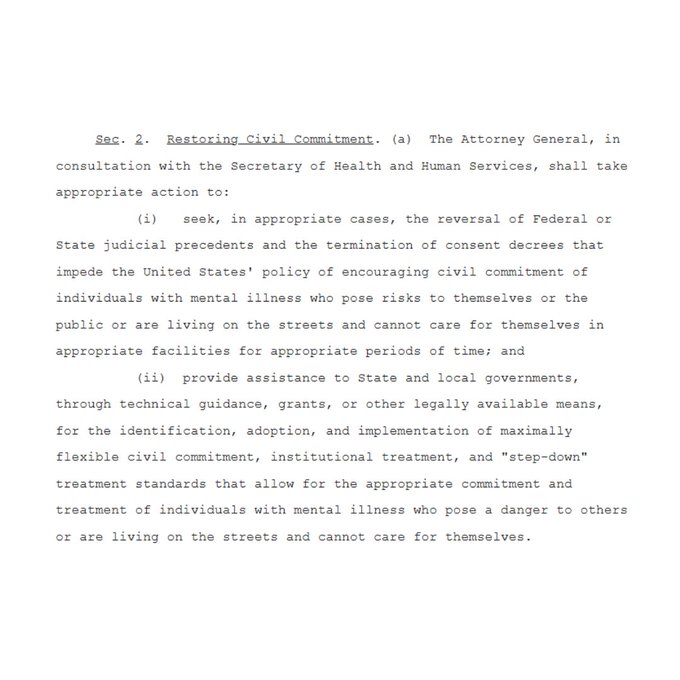
President Trump's latest executive order to bring back Asylums

This is what I voted for. Make padded rooms great again!

That is the one thing Reagan messed-up on. A lot cheaper in the long run to have state hospitals than wasting money on free drugs, and other feel good money wasting programs that just end-up being grift streams for the dems.

For decades, libs have blamed the nation’s mental illness issues on Reagan’s closing of mental institutions. Now those same people are going to reeee about reopening them because it’s a Trump initiative.

BTW....Said institutions should be given the same legal protections that Big Pharma was given with the clot shots.


Gws_2-RXwAA_sBp


Reagan signed a bi partisan Bill that that gave block grants to states to build community mental health centers. They were never built.
The homeless were created when JFK shutdown the mental institutions in 1963. The Community Behavioral Health Act never created the local mental health systems that were supposed to result.
We have criteria today for an involuntary commitment that work well.
 
My issue is how do we determine WHO has to live in one of these places? I mean if you're homeless you MUST go? How does that work?
When a persons behavior for the past 30 days will cause serious ham in the next 30 days they can be committed for inpatient treatment after examination by an MD or clinical psychologist. It varies from each state but this is essentially how it works. They spend 5 days for observation and diagnosis and will be released or held until stable. Then they often relapse and start over. You can look up PA 302 for an example of the law
 
The ACLU ended civil commitment by claiming that locking innocent people up against their will was inhumane. The effect was to criminalize mental illness and medical conditions like drug addiction.

Is the answer to say the situation is so bad and so out of control thar no one cares anymore?
False we can still commit people against their will I have started the process myself many times.
 
When a persons behavior for the past 30 days will cause serious ham in the next 30 days they can be committed for inpatient treatment after examination by an MD or clinical psychologist. It varies from each state but this is essentially how it works. They spend 5 days for observation and diagnosis and will be released or held until stable. Then they often relapse and start over. You can look up PA 302 for an example of the law

Ok, WHO makes that determination? Is the "person" involved able to fight it in court? Do they get due process or are they just involuntarily committed without due process?

If this person CHOOSES to go into treatment, great, but to be FORCED should be something that can be challenged in front of a judge. Otherwise this is like Russia.
 
Certainly tremendous news for designers of strait jackets as well as construction contractors needed to build all of the new rubber rooms.

The producers of Haldol will also enjoy a surge in business.
 
We have so many safeguards we cant give them the treatment they need.
The homeless were created when JFK shutdown the mental institutions in 1963. The Community Behavioral Health Act never created the local mental health systems that were supposed to result.
We have criteria today for an involuntary commitment that work well.
Didn't answer My assertion.

I have zero problem with committing people who are a danger to themselves and others, but that is NOT a license to abuse them while they are incarcerated and receiving care.

There are far to many instances of said abuses in the past.

Assurances MUST be made and consequences enacted and enforced against those who abuse patients.

Far to many American's paint a crazy stigma and think that gives them license to enact their own pathologies.

So many people relate to the men who freed the Holocaust victims, and none with the prison guards. That is, until they were given some small modicum of power and then became the prison guards and the abusers.

Just look at the people during the pandemic who actually relished their newfound power regarding shots and masks.

I'll all for helping the mentally ill, but I will not tolerate abuse on My dime.
 
.

There is at least one in Washington State that could possibly hold the worst offenders, very secure because it's on an island, surrounded by wicked Puget Sound currents. Heck, Charles Manson used to live there!

Make Seattle Safe Again!


View attachment 1141517


.

Something has to be done, and most drug addicts don't just quit drugs.
As long as they don't put them on long term prescription drugs which in many cases are just as bad.
 
Didn't answer My assertion.

I have zero problem with committing people who are a danger to themselves and others, but that is NOT a license to abuse them while they are incarcerated and receiving care.

There are far to many instances of said abuses in the past.

Assurances MUST be made and consequences enacted and enforced against those who abuse patients.

Far to many American's paint a crazy stigma and think that gives them license to enact their own pathologies.

So many people relate to the men who freed the Holocaust victims, and none with the prison guards. That is, until they were given some small modicum of power and then became the prison guards and the abusers.

Just look at the people during the pandemic who actually relished their newfound power regarding shots and masks.

I'll all for helping the mentally ill, but I will not tolerate abuse on My dime.
I worked in 4 mental hospitals and never saw any abuse. The laws are very strict. We can only restrain in specific ways. Straight jackets are never used. Most of the abuse is by patients against staff.
So how many hospitals have you worked in. You cant even define what abuse is. Your just virtue signaling without any real knowledge .
Abuse is letting them deny treatment they need
 
Ok, WHO makes that determination? Is the "person" involved able to fight it in court? Do they get due process or are they just involuntarily committed without due process?

If this person CHOOSES to go into treatment, great, but to be FORCED should be something that can be challenged in front of a judge. Otherwise this is like Russia.
I have done this many times. When I see a credible threat to harm self or others I refer them to the police, ChildLine, or social services for investigation. I document everything. The person will be brought to a hospital ER for a second evaluation by a Clinical psychologist or psychiatrist. If confirmed they will spend 5-7 days for observation. At that point they will go to a mental health court and a decision will be made based on the recommendation for discharge or longer stay usually two weeks. The process then repeats.
You must understand that people can be in positions where their judgment is so impaired they cant make safe choices. Under law I am a mandatory reporter so I must make the report.
 
When a persons behavior for the past 30 days will cause serious ham in the next 30 days they can be committed for inpatient treatment after examination by an MD or clinical psychologist. It varies from each state but this is essentially how it works. They spend 5 days for observation and diagnosis and will be released or held until stable. Then they often relapse and start over. You can look up PA 302 for an example of the law
I'm pretty sure you can't hold a person against their will without a determination from the court's. Even that has limitations.
 
I'm pretty sure you can't hold a person against their will without a determination from the court's. Even that has limitations.
IN PA we have special mental health court that examines the case on a regular basis
 
Reagan signed a bi partisan Bill that that gave block grants to states to build community mental health centers. They were never built.
The homeless were created when JFK shutdown the mental institutions in 1963. The Community Behavioral Health Act never created the local mental health systems that were supposed to result.
We have criteria today for an involuntary commitment that work well.

These " Mental Health Clinic's were on every corner back in the 1970s, the drugs they " prescribed " were no better than street drugs.
Institutions are best if operated right.
 
I have done this many times. When I see a credible threat to harm self or others I refer them to the police, ChildLine, or social services for investigation. I document everything. The person will be brought to a hospital ER for a second evaluation by a Clinical psychologist or psychiatrist. If confirmed they will spend 5-7 days for observation. At that point they will go to a mental health court and a decision will be made based on the recommendation for discharge or longer stay usually two weeks. The process then repeats.
You must understand that people can be in positions where their judgment is so impaired they cant make safe choices. Under law I am a mandatory reporter so I must make the report.
 
I worked in 4 mental hospitals and never saw any abuse. The laws are very strict. We can only restrain in specific ways. Straight jackets are never used. Most of the abuse is by patients against staff.
So how many hospitals have you worked in. You cant even define what abuse is. Your just virtue signaling without any real knowledge .
Abuse is letting them deny treatment they need
Whenever documented instances of abuse occured, there was always someone INSIDE the system that just didn't see any abuses.

:rolleyes: :rolleyes:

There are well-documented cases across the world illustrating abuse of mental health patients in psychiatric institutions, as well as systemic studies confirming such incidents are not isolated.

Major Documented Cases​

  • Edenfield Centre, UK (2022): Undercover filming by the BBC exposed a "toxic culture" where mental health patients endured humiliation, verbal and physical abuse, bullying, inappropriate restraint, prolonged and unjust isolation, and staff falsifying safety records. Staff were seen mocking, assaulting, and sexually harassing patients, as well as withholding basic comforts and showing indifference to self-harming behaviors. Multiple staff were suspended and a criminal investigation was launched12.
  • Federico Mora Hospital, Guatemala: A Disability Rights International (DRI) report found sexual abuse and severe mistreatment to be widespread. Female patients described being raped while sedated, with staff, other patients, and even police involved. Patients were denied medical care and exposed to dangerous conditions including risk of HIV, with some patients kept in the facility for years under inhumane circumstances3.
  • Twin Valley Behavioral Healthcare, Ohio, USA (2022): A patient died from blunt-force head trauma after being beaten by another patient. Several staff, including psychiatric assistants and a nurse, were indicted for involuntary manslaughter and patient abuse/neglect, revealing risky conditions and failures in supervision at this forensic psychiatric facility4.
  • Central State Hospital, USA (2023): Federal investigation reports reveal high levels of patient injury due to self-harm and assaults by other patients, often preventable, reflecting institutional failings in staffing and oversight5.
  • Historical Cases (e.g., Bedlam, 1940s USA): Testimonies and records describe attendants routinely beating, kicking, and humiliating psychiatric patients, with some kept in handcuffs for days, and serious injuries inflicted for minor provocations6.

Systematic Studies and Reports​

  • Recent surveys in Europe and North America indicate that within psychiatric institutions, 10-40% of patients report victimization:
    • Theft (40%), physical assaults (17% by other patients, 10% by staff), and sexual assaults (over 10% by staff or patients) are regularly cited.
    • Women are especially vulnerable to sexual advances and harassment within mental health care, while men more often report threats or physical violence78.
  • Global human rights watchdogs continue to expose human rights violations in psychiatric facilities, including forced restraint, unwanted medication, seclusion, and denial of dignity and care910.

Key Themes Across Reports​

  • Abuse takes many forms: physical violence, sexual exploitation, verbal humiliation, forced restraint, unjust isolation, and systemic neglect.
  • Institutional failures include inadequate staff training, poor patient supervision, lack of proper oversight, and cultures that perpetuate abuse.
  • Women, people with lengthy hospitalizations, and those with psychotic disorders are particularly at risk7.
These findings, from undercover journalism, government reports, and academic reviews, confirm that abuse of mental health patients is an international and ongoing problem, demanding transparency, reform, and robust independent oversight.
  1. 'Toxic culture' of abuse at mental health hospital revealed by BBC secret filming
  2. I went undercover to expose abuse at a mental health hospital
  3. Inside the 'world's most dangerous' hospital
  4. Patient and 3 staffers charged in another patient's beating death at mental health facility
  5. CRIPA Investigation Of Central State Hospital
  6. Bedlam 1946 | American Experience | PBS
  7. Frontiers | Victimization of People With Severe Mental Illness Outside and Within the Mental Health Care System: Results on Prevalence and Risk Factors From a Multicenter Study
  8. Patient Safety In Inpatient Psychiatry: A Remaining Frontier For Health Policy - PMC
  9. 'Tied Up, Forcibly Medicated': Human Rights Abuses ‘Far Too Common’ In Mental Health Care - Health Policy Watch
  10. “STUCK”: Los Angeles County’s Abuse and Neglect of People on Mental Health Conservatorships in Jail and Locked Psychiatric Facilities. | Disability Rights California
  11. https://psychiatryonline.org/doi/10.1176/ps.49.3.355
  12. Patients' reports of traumatic or harmful experiences within the psychiatric setting - PubMed
  13. Violent victimization of adult patients with severe mental illness: a systematic review - PMC
  14. https://www.apa.org/monitor/2021/04/ce-mental-illness
  15. Political abuse of psychiatry - Wikipedia
  16. Stigma, Prejudice and Discrimination Against People with Mental Illness
  17. Violent victimisation of psychiatric patients: a Swedish case–control study - PMC
  18. Data | SAMHSA
  19. https://psychiatryonline.org/doi/10.1176/ps.50.1.62
  20. https://pmc.ncbi.nlm.nih.gov/articles/PMC59682/
 
You must understand that people can be in positions where their judgment is so impaired they cant make safe choices
In that case, the courts assign a guardian and that person is now the equivalent of a minor with very limited rights.
 
15th post
Qualified professionals who can evaluate and get the proper treatment for those incapable of functioning in society due to mental health problems. Good mental health should be a priority in schools, prisons and work places. Oversight to stop abuse of the patients is necessary. Good mental health will strengthen or nation and is not a feel good program but a national security issue.
 
Last edited:
My issue is how do we determine WHO has to live in one of these places? I mean if you're homeless you MUST go? How does that work?

We had low-income apartments up until the last 30 years people had options, now they seem to be controlled by the illegal's or cartel.
Over 30 years ago I tried to get my cousin into low income, only minority were accepted. They also became very dangerous crime infested places.
As a child I had friends in a couple of them and they were safe, affordable places to live in the 50s and 60s.
The nation changed.
 
Something has to be done, and most drug addicts don't just quit drugs.
As long as they don't put them on long term prescription drugs which in many cases are just as bad.
.

Towards the end of the documentary video I posted, they discuss a program in Rhode Island that seems like it might be working. Worth a look.

Absent that, prison for life, where they can't hurt innocent people.


.
 
Back
Top Bottom