Let us look first at St Peter's Basilica. "The risk factors include the dimensions of the structure, its location and its location relative to other buildings around it," explains Matthew Waldrum from Omega Red Group, who assesses the risk of lightning hitting buildings. "The construction material of the building is obviously also very important. "It's an extremely large structure. It's not exactly isolated, but it certainly towers over its surroundings, which means that lightning is more likely to hit it than any of the surrounding buildings."
The fact that no damage occurred to the basilica suggests that it is quite well protected against lightning. But Waldrum and his colleagues carried out a theoretical calculation of the risk of loss of life due to lightning in a similar building frequented by large numbers of people, in a similar setting - assuming the lack of any lightning protection. "We have carried out a theoretical calculation for a building like St Peter's Basilica. The outcome is that - compared to a tolerable risk level of one in 100,000 (in any one year) - we have actually come out with a risk of one in 112. That is pretty high." Crudely speaking, if there is lightning around, St Peter's has a reasonably high chance of getting a bolt.
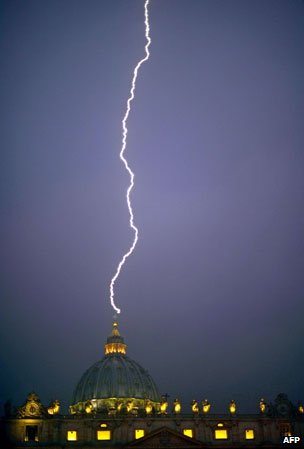
Another factor that needs considering is the level of lightning activity in early February in the region around Rome - something the UK's Met Office is able to monitor and record with the help of a system of sensors dotted around Europe. "The records the Met Office keeps of lightning data is essentially the co-ordinates of the lightning strike and the time that the lightning strike occurred when it was picked up by our system. "That can then be used to create lightning maps and lightning density maps, so you can tell how many strikes occurred in a given region," says Graeme Anderson, a Met Office lightning detection scientist.
Thanks to the pictures of the event taken by photographers, Anderson was able to identify the exact time of the strike, and he was able to find the record that this particular strike had created. "We were able to look back at our data and zoom in on the Vatican area. There was quite a lot of lightning activity in the area at that time, but we did record a lightning stroke within the area of Rome at 17.54 and 24 seconds." "Given the time of arrival it's very likely that this is in fact the same lightning stroke that struck St Peter's, being picked up by our system." But is it unusual?
More
BBC News - What is the chance of lightning striking St Peter's?