Good article...
Why Did the World Trade Center Collapse? Science, Engineering, and Speculation
There were multiple causes for the collapse which include, airliner impact, Jet fuel, explosion and fire. Fire DID NOT melt the metal and, it did buckle metal which failed.
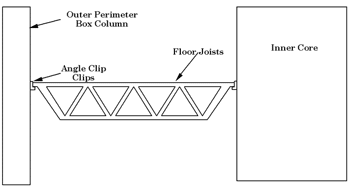
"The additional problem was distortion of the steel in the fire. The temperature of the fire was not uniform everywhere, and the temperature on the outside of the box columns was clearly lower than on the side facing the fire. The temperature along the 18 m long joists was certainly not uniform. Given the thermal expansion of steel, a 150°C temperature difference from one location to another will produce yield-level residual stresses. This produced distortions in the slender structural steel, which resulted in buckling failures. Thus, the failure of the steel was due to two factors: loss of strength due to the temperature of the fire, and loss of structural integrity due to distortion of the steel from the non-uniform temperatures in the fire."
"As the joists on one or two of the most heavily burned floors gave way and the outer box columns began to bow outward, the floors above them also fell. The floor below (with its 1,300 t design capacity) could not support the roughly 45,000 t of ten floors (or more) above crashing down on these angle clips. This started the domino effect that caused the buildings to collapse within ten seconds, hitting bottom with an estimated speed of 200 km per hour. If it had been free fall, with no restraint, the collapse would have only taken eight seconds and would have impacted at 300 km/h.
1 It has been suggested that it was fortunate that the WTC did not tip over onto other buildings surrounding the area. There are several points that should be made. First, the building is not solid; it is 95 percent air and, hence, can implode onto itself. Second, there is no lateral load, even the impact of a speeding aircraft, which is sufficient to move the center of gravity one hundred feet to the side such that it is not within the base footprint of the structure. Third, given the near free-fall collapse, there was insufficient time for portions to attain significant lateral velocity. To summarize all of these points, a 500,000 t structure has too much inertia to fall in any direction other than nearly straight down."