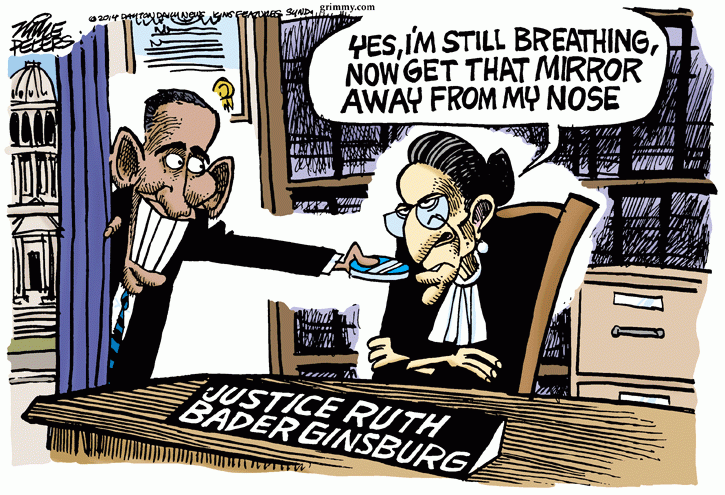
Oh? Well, why don't you first demonstrate that you rightly understand the decision on its own terms. Then tell us what Ginsburg's blathering about. Then I'll tear it to shreds for ya.
Wanting to talk about facts? Big mistake. You should have stuck with whining, being that facts always have such a liberal bias.
"Big mistake"? "Whining"?

It's stupid to say that corporations have religious rights. Corporations, being corporations, don't have rights. People have rights.
Spoken like a true . . .
statist of the Marxist persuasion. (By the way, folks, mamooth, the statist, doesn't like the term
statist . . . or the term
womanish.
)
No. The
fact that privately owned business ventures in the Republic of the United States of America have First Amendment rights and have always had First Amendment rights goes to the fact that they are, you know, privately owned business ventures. They are owned by, you know, people, not the government.
This isn't the former Soviet Union.
If you're going to make a new policy that corporations have rights because the people owning them have rights. . . .
Bingo! However, you're still a bit confused. Corporations have always had the full slate of First Amendment rights. That's not a new policy, indeed, it's no policy at all. It's the imperative of natural and constitutional law, backed by more than two centuries of case and statutory law, most recently and significantly underscored by the Religious Freedom Restoration Act (RFRA) which reasserted the Sherbert Test of
Sherbert v. Verner and
Wisconsin v. Yoder. Essentially, Congress slapped the Court down with the RFRA as the latter threatened to thwart historical and legal precedent! (Someone in the above suggested that the
Burwell v. Hobby Lobby decision had nothing to do with the Constitution. Wrong!) What would be new is the notion that they don't have these rights, and what the Obama Administration attempted to pull is rank tyranny, the imposition of its depraved morality on the people against the inalienable prerogatives of ideological free-association and private property.
See how that works?
This
still isn't the former Soviet Union, though not for any lack of treachery on the part of statists like you.
. . . then congratulations, you've just destroyed the corporate veil. A magic one-way door is not possible; there either is or isn't a veil, and you've just said there isn't one. If rights can flow from owners to corporations, then liabilities, both criminal and civil, can flow back from corporations to owners. (Thanks for handing that win to the liberals.)
LOL! Corporations along with their owners, which are one and the same, have been subject to the liabilities of civil proceedings and the sanctions of criminal misconduct for decades.
Burwell v. Hobby Lobby has absolutely no bearing on that historical fact of life at all. So congratulations, you're the lucky winner of this thread's booby prize for make-it-up-as-you-go-along pabulum.
May you rest in peace.
It's also dishonest to put in a "This decision only affects the very narrow topic of birth control coverage, and should not be used for other precedence" clause, as the conservative justices did. The "don't use this as precedence" clause was also used in Bush vs. Gore, and it's a indication of unsupportable partisan crap. Honest judges making legally supportable decisions don't declare that their decisions shouldn't be used as precedence.
No. See there. You're wrong again. In this instance, the Court is alluding to the precedent of
National Federation of Independent Business v. Sebelius in which that contemptuous whore Roberts saddled the people with yet another unconstitutional abomination when he magically changed the Affordable Health Care Act's penalty into a tax, and to (1)
the compelling government interest and (2)
the least restrictive application exceptions of the RFRA.
You're talking to an authority on immigration and nationality law, so I'm well-versed in the reading of case law. You don't know what you're talking about. The Court routinely restricts the applications of its
rationes decidendi for purposes of clarity. Case law is bottomed on the principle of
stare decisis. That is the only thing being emphasized here.
I think that just about destroys your lunacy. Anybody want to add anything to this?
As for Ginsburg, I say again:
Ginsburg's like that crazed and deformed aunt (the obscenity-spouting elephant girl) whom one might hide away from the neighbors in one's basement for most of the year and only briefly let out, though tethered to a chain, for spring cleanings. Fortified by a stiff shot of whiskey and wearing a face shield to protect the eyes from errant sprays of spittle, one would then drive her back into the dark recesses with a cattle prod while the eldest son stood by with a double-barreled shotgun . . . just in case the old battle-ax broke free of its bonds. —M. D. Rawlings