Better get thee to a library instead of concerning yourself over glasses.
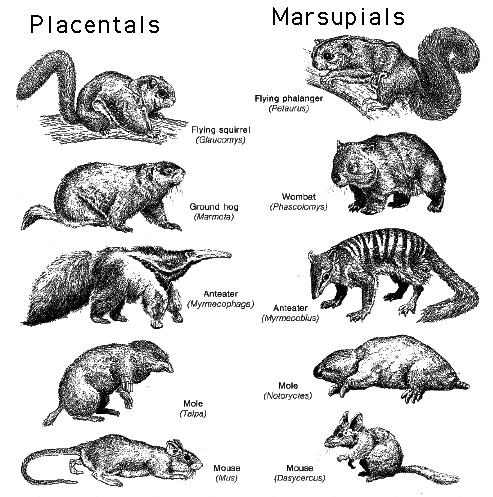
The fossil record isn't perfect, but we have a whole host of examples of transitional species. Which is what makes their claim cute, especially when they call it 'missing links.' Evolution still stands regardless.
Not only would Darwin call your post nonsense...
...but so would contemporary paleontologists, such as the experts referenced.
But rather than merely skewer your idea, as I just did, I'd rather consider the basis for your ideology.
Evolution is a theory....yet the ideologues such as yourself pretend that it is fact.
You do know the difference between theory and fact, don't you? 'else you need to get thee to a library.
There must be some burning desire to shut your eyes tightly, cover your ears, and stamp your little feet....
Could it be your view that man is a self-creator, that there is no God, and you folks will protest any view that suggests that there is a Divine, Nature's God, a Creator, a Supreme Judge of the World, and Divine Providence....you know, the terms used in the Declaration of Independence?
Is that what you are protesting???
Why?
I don't mind if you have some secular belief, but why pretend that there is profusion of 'missing links'?
'Cause, there isn't.
My, my. Only a theory. You just demonstrated your total ignorance of science, old gal.
Theory is as good as it gets in science.
How is the meaning of theory in science different from the everyday use of the term? - Yahoo! Answers
A scientific theory is a scientific work, which describes a system behind observations and makes predictions for future observations.
This should also be the everyday use, but there are also people, who think, a theory is sloppy work, not always true and untested.
But that is wrong - a scientific theory is the highest form of a scientific work, with a long list of conditions reached, not turn a simple hypothesis about the observations into this theory. A theory for example, has to be fallible. That means: It must be contain a prediction, which would invalidate the theory, if the prediction does not come true. The theory of evolution for example predicted the existence of a way to give the attributes of the parents to the children. Almost a century after the theory of evolution, the DNA was found.
Of course, science can be wrong. That's why a theory has to be able to be wrong. A theory, which is under all imaginable conditions true, is not scientific. But that is no problem for science. When a theory is found to be wrong, there has to be a better one. Science is a dynamic process. The theory of gravitation for example is still not done. We know that there are many phenomena, this theory does not describe. For example Black holes are still not adequately described by it. So, there is now the search for a better theory.
But that does not mean, that a scientific theory, which was found wrong, is also bad. The theory of gravity by Galileo is already found wrong for centuries, but still, you can do a lot of good work, by assuming a constant gravity acceleration. It is not accurate, but often accurate enough (for example for rocket guidance, this model of gravity gets often used for simplifying math). Each new theory becomes more accurate.
So, a good theory, which passed many tests in history, can still be wrong. But: the chance that it is right is around 99.9999%.