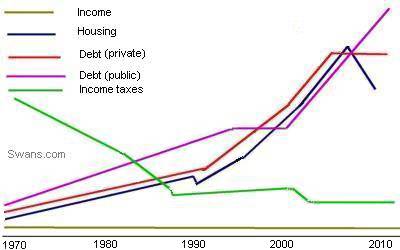
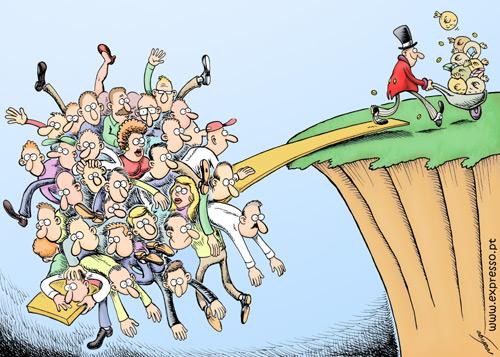
Big money manages the world today. We are witnessing another transformation that removes democracy and replaces it with a plutocracy while we sleep and work, and oddly we support this plutocracy through our inaction and voting special interests. Which side of the ideology spectrum are you on, does it matter?
"The 20th century has been characterized by three developments of great political importance: The growth of democracy, the growth of corporate power, and the growth of corporate propaganda as a means of protecting corporate power against democracy." Alex Carey [see
Democracy after Citizens United | MIT World ]
"Some commentators at the time, who were not in a position of responsibility and hence could not influence the decision making, had a different take on the financial mayhem. In the U.S., the free-market purists -- the "Atlas Shruggians," if you will -- vociferated that
the failed banks ought to be let go into bankruptcy, ignoring the fact that these megabanks "account for 85% of the assets of the world's top 1,000 banks ranked by Tier 1 capital" (cf., Andrew G. Haldane). To let them go into bankruptcy would certainly have wiped out the investors, but it also would have debilitated the depositors and led to a total collapse of the Main Street economy.
However, there was another alternative -- neither let the banks fail nor make the investors whole, the latter having been the road taken (with few exceptions) -- that was advocated by other commentators, including this one, who were not in a position of responsibility either: the governmental seizure of these megabanks; that is the nationalization of these behemoths. Analysts and economists such as Paul Jorion and Frédéric Lordon in France (3) or Joseph Stiglitz, Paul Volcker, and Robert Kuttner in the U.S. come to mind. Sheila Bair, who headed the Federal Deposit Insurance Corporation (FDIC) for five years until her retirement on July 8, 2011, was a strong proponent of that approach. Under her leadership, the FDIC successfully managed over 370 bank failures in the past three and one-half years -- the biggest one was Washington Mutual, which was the sixth-largest US banking institution with over $300 billion in assets when it collapsed in September 2008, and was seized by the Office of Thrift Supervision and put into receivership with the FDIC. Unfortunately, Mrs. Bair commanded little clout in the higher echelons of the Bush and Obama administrations."
Swans Commentary: Clueless Or Malevolent "Leaders"? Part I - The Financial Crisis, by Gilles d'Aymery - ga295
Middy, middy, middy.
If only your interest was economics and facts, rather than the Left-wing envy and liberal sophistry.
1.
There is no perennial group known as the 'wealthy'...not in America. The term applies to a snap-shot in time, as said group is fluid, dynamic and changes.
"More than three-quarters of those working Americans whose incomes were in the bottom 20 percent in 1975 were also in the top 40 percent of income earners at some point by 1991, says Sowell."
Source: Thomas Sowell, "How Media Misuse Income Data To Match Their Preconceptions," Investor's Business Daily, January 12, 2010.
For text:
How Media Misuse Income Data To Match Their Preconceptions - Investors.com
2. The opperative term is
'opportunity.'
The vast majority of our millionaires earned their money. They didn't inherit it.
3. Over any extended period, from 1929 onward, prosperity has increased, not decreased.
4. In this nation,
work is honored, and is rewarded.
a.
Wages equal the marginal productivity of labor, meaning that the outcome in terms of income and wealth is a function of what one does. It is also a function of how many people do the same.
5. In Alan Reynolds Income and Wealth, he studied the data, and found the following. Certainly
the top fifth of households has a far greater proportion of same, but it also has six times as many full-time workers as the bottom fifth, heavily composed of two-earner couples with older children or other relatives who work. The bottom fifth is heavily composed of aged or younger couples, the retired or the still in school. Also, some in the bottom fifth because they are part of the underground economy, or in crime, so income is not reported. Or suffer addictions which preclude work.
a. In 2004,
56.4% of households in the bottom fifth featured no work by anyone for the entire year. HINC-05--Part 1
b.The total number of full time, year round workers in the bottom fifth for 2004 was less than 3 million
which compares to 16.4 million in the top fifth of households. Ibid.
The difference in income
does not reflect inequality, but rather, productivity. The fact that the lowest fifth are neither starving, nor living in the streets reflects the intrinsic
generosity of our society, and the transfer of incomes via government programs. 80% of income in the bottom fifth is from such transfers; it is only 2% for the top fifth.
Only a purblind socialist would argue that doing no work is the basis for the same rewards as those producing and working...
...don't you agree?