New Zealand emergency services and defense personnel evacuated hundreds of tourists and residents from a small South Island town amid more strong aftershocks yesterday, after a powerful earthquake killed two people. The magnitude 7.8 tremor struck just after midnight on Sunday, destroying farm homesteads, sending glass and masonry toppling from buildings in the capital, Wellington, and cutting road and rail links throughout the northeast of the ruggedly beautiful South Island. As aftershocks continued to rattle the region, emergency services cordoned off streets in Wellington and evacuated several buildings due to fears one of them might collapse.
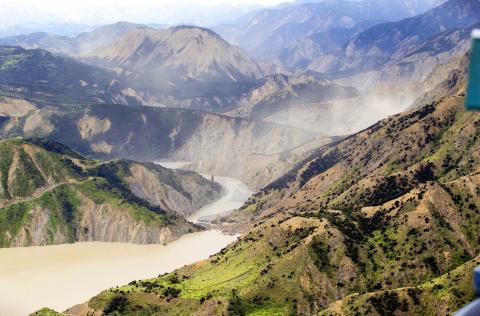
Clouds of dust created by a strong aftershock on Monday hang above the Clarence River, which was blocked by landslides following an earthquake north of Kaikoura, New Zealand, on Sunday.
Wellington Mayor Justin Lester said the vacant building appeared to have suffered structural damage when the land it was on subsided in the earthquake. A fire service official said a major structural beam had “snapped like a bone.” The town of Kaikoura, a popular base for whale-watching about 150km northeast of Christchurch, the South Island’s main city, remained cut off after massive landslides destroyed roads. Four New Zealand Defence Force helicopters flew into the town yesterday morning and two Royal New Zealand Navy vessels were heading to the area carrying supplies and to assist with the evacuation, Headquarters Joint Forces New Zealand acting commander Air Commodore Darryn Webb told TVNZ. “We’re looking to do as many flights as we can out of Kaikoura today,” he said.
About 400 of the 1,200 tourists stranded in the town were flown out yesterday, including 12 people with a variety of injuries, officials said. The Red Cross, which used defense force helicopters to bring in emergency generators, satellite communications and water containers, said water in the town was running out. Mark Solomon, a leader of South Island’s indigenous Maori Ngai Tahu community, which has tourism and fisheries businesses around Kaikoura, said the local marae, a Maori meeting place, had received 1,000 people since Monday morning. Many slept overnight in the communal hall or in vehicles outside. The community fed them with crayfish, a delicacy for which the South Island town is famous. With no power, the tanks that hold the expensive crustaceans had stopped pumping. “It’s better to use the food than throw it in the rubbish, so we sent it up to the marae to feed people,” Solomon told reporters by telephone.
MORE