Historians have argued that southern lawmakers ensured that the Servicemen’s Readjustment Act of 1944 (commonly known as the G.I. Bill) was administered by states instead of the federal government to guarantee that states could direct its funds to white veterans. Similarly, in order to secure the support of white southern lawmakers, Congress included segregation clauses or rejected anti-discrimination clauses in the Hospital Survey and Reconstruction Act of 1946 (commonly known as the Hill Burton Act), which paid for our modern healthcare infrastructure. The same tactics were applied to the American Housing Act of 1949, which helped white Americans buy single family homes. These federal legislative decisions enshrined the government sanctioned discrimination of African Americans for decades to come and perpetuates the racial hierarchy today.
Throughout the 20th century, American federal, state, and local municipal governments expanded and solidified segregation efforts through zoning ordinances, slum clearance policies, construction of parks and freeways through Black neighborhoods, and public housing siting decisions.
The passage of the Fair Housing Act in 1968 outlawed housing discrimination, but did not fix the structures put in place by 100 years of discriminatory government policies, and residential segregation continues today.
California Reparations Study pg.9
Contrary to what Americans are taught, the U.S. Supreme Court’s landmark 1954 case, Brown v. Board of Education, which established that racial segregation in public schools is unconstitutional, did not mark the end of segregation.
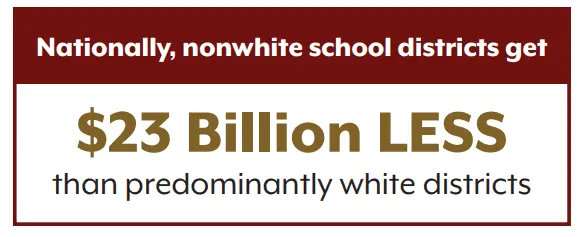
After Brown v. Board, many white people and white-dominated school boards throughout the country actively resisted integration. In the South, segregation was still in place through the early 1970s due to massive resistance by white communities. In the rest of the country, including California, education segregation occurred when government sanctioned housing segregation combined with school assignment and siting policies. Because children attended the schools in their neighborhood and school financing was tied to property taxes, most Black children attended segregated schools with less funding and resources than schools attended by white children. In 1974, the U.S. Supreme Court allowed this type of school segregation to continue in schools if it reflectedresidential segregation patterns between the cities and suburbs. In part, as result of this and other U.S. Supreme Court decisions that followed to further undermine desegregation efforts, many public schools in the United States were integrated and then resegregated, or never integrated in the first place.
California Reparations Study pg.11


