Here's some more stuff you can pretend you didn't see.
William Lee, University’s lead counsel, discusses the Supreme Court case with Sherri Ann Charleston, chief diversity and inclusion officer.

news.harvard.edu
Although an expert for SFFA suggested at trial that socioeconomic status might be a comparable substitute for race, Lee said an analysis done for the College by University of California, Berkeley, economist David Card, winner of the 2021 Nobel Prize, found that such an approach would result in a class that was less academically qualified and would have 40 percent fewer African American students. His analysis also showed that many factors unrelated to race can tip the scales in a student’s favor.
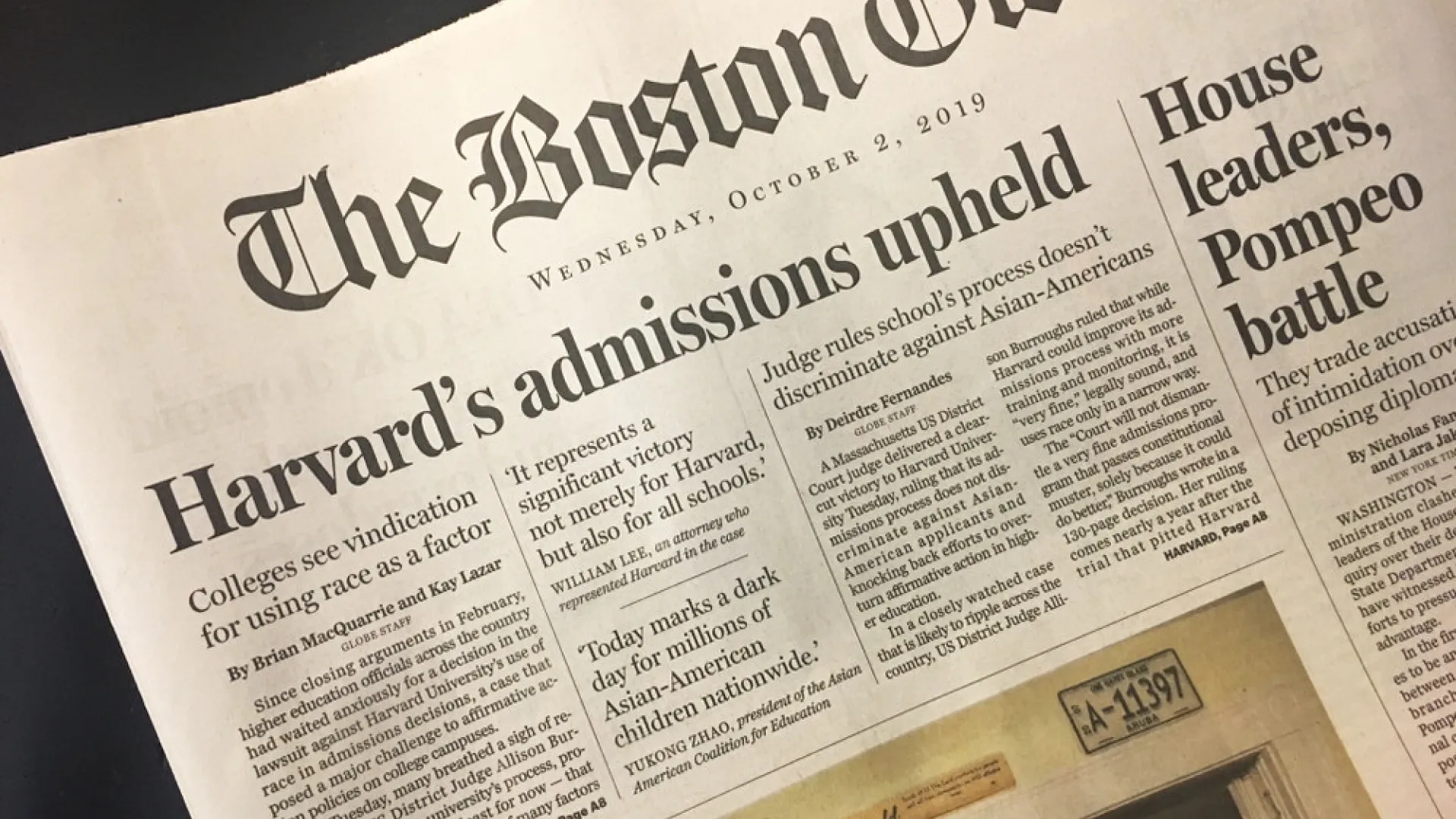
The College’s admissions office does not discriminate against Asian-Americans, a federal judge ruled October 1.

www.harvardmagazine.com
Although Harvard looks at the projected racial makeup of each class in making admissions decisions, to ensure that it reaches diversity goals, Burroughs wrote, it does not impose quotas or quota-like “target levels” for different racial groups. Having minimum goals for minority enrollment, she added, is not tantamount to a quota: “Every applicant competes for every seat.”
On the third count, alleging that Harvard puts undue emphasis on race, she wrote that colleges that use race as more than just a “plus” factor tend to use either a quota system or “assign some specified value to applicants’ racial identity.” Harvard does neither, she wrote: it uses race on an individualized, context-dependent basis for each applicant, and not as the “defining feature” of any application.
And on the fourth count, Burroughs sided with Harvard’s position that no feasible race-neutral alternatives would achieve its diversity goals: options like eliminating early-action admissions, admitting more transfer students, increasing outreach to potential applicants, and offering more financial aid, she wrote, “would likely have no meaningful impact on racial diversity.” One proposal, considered in this case and more broadly in discourse about college admissions, would be to give preference to low-income students instead of considering race. But this would result in a significant decline in African-American enrollment, she wrote.
The Supreme Court will soon consider whether to take up the long-awaited Students for Fair Admissions v. Harvard case, which pits Harvard’s race-conscious admissions process against a group of Asian-American applicants who don’t fit into Harvard’s idea of “favored minorities.” The central idea...

www.city-journal.org
The reason why Harvard admissions officers don’t consider Asian-Americans a “minority” for assistance purposes is because in their eyes, Asian-Americans are too successful to be helped. As a group, Asian-Americans are socioeconomically on par with whites; educationally, they outpace whites (though there is nationwide variation, just as there is among any racial group). Yet, Asian-Americans did not gain their status in this country because of inherited “privilege”—as many on the left allege whites have done—but through a relentless focus on academic preparation and self-sufficiency. As I write in my upcoming book
An Inconvenient Minority, “Asian American students compete hard for their educational opportunities . . . Poor and rich Asians alike study an average of thirteen hours per week, more than twice as much as the typical non-Hispanic white student who studies a mere 5.5 hours per week at home.” Harvard prefers to ignore the reality of Asian-American students’ hard work and preparation—that is, their merit—and instead treat them in the admissions process as if they were a privileged group.
The consequence of considering Asian-Americans unfavored minorities is clear: less qualified individuals from other social groups get their shot before Asian-Americans with higher qualifications do.
According to Students for Fair Admissions’ analysis, a black applicant to Harvard in the 40th academic percentile of all applicants has a higher chance of admission than an Asian-American in the 90th academic percentile. Asians in the 90th academic percentile are unfavored compared with Hispanics in the 60th percentile and whites in the 80th percentile as well.