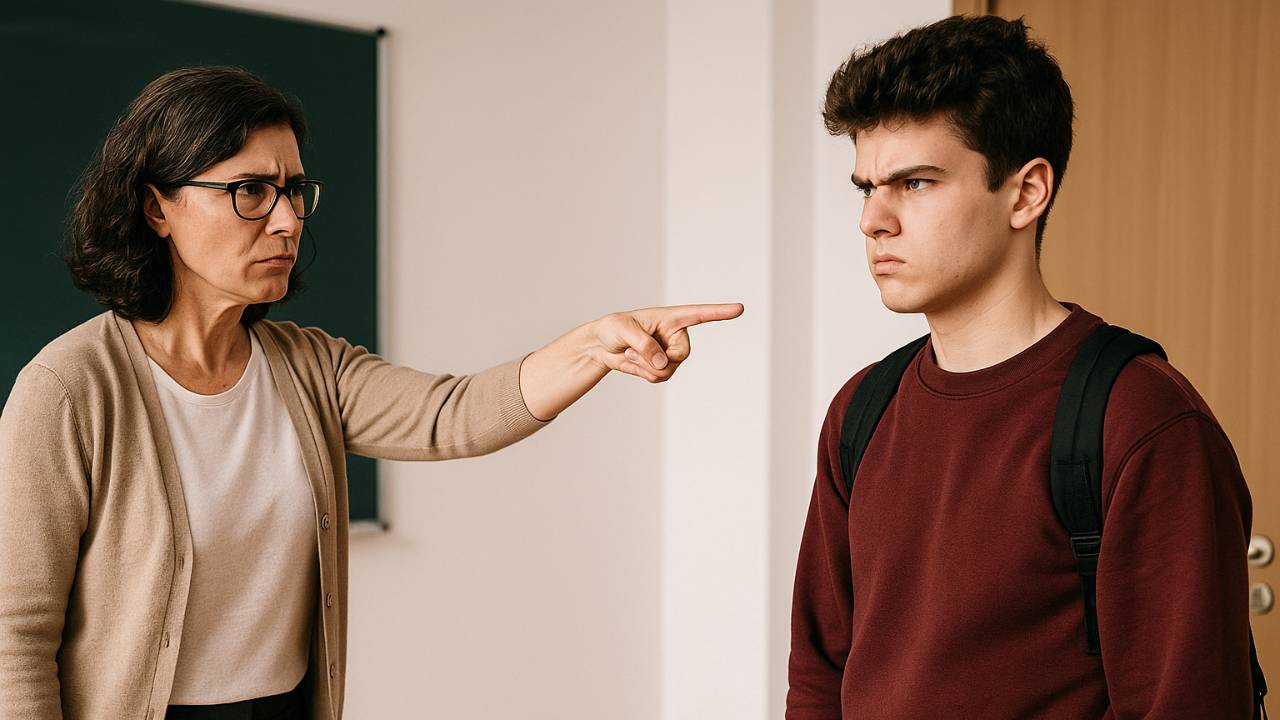
Discipline

Classroom management is a varied and complex issue. There are a lot of approaches to a student who is disrupting the learning of the other students. Sometimes it's as simple as redirecting the student's attention and refocusing them on the task at hand. Sometimes I'll take a student out into the hallway and have a personal word with them. Often this brief personal attention is all it takes to help a student realize what they are doing and why it's not appropriate. When you get to know students well personally you can prevent problems ahead of time by deliberately placing students into pair or group work with other students you know they can work with productively. I often invite disruptive students to stop by my classroom after school where I can let them discuss things that might be driving unproductive behavior if they choose to. Sometimes their issues are too expansive to deal with in the limited interactions they have with me and other approaches are needed. I try to keep open communication with the family or caretakers at home to see what we can do together to help a student succeed. We have guidance counselors, social workers, and community representatives to help with this. I have found that encouraging students to get involved with sports, student groups or other activities can sometimes give them an outlet that helps them focus their energy in more productive ways.

Of course, there are some students with issues that run too deep for any of these (and other) approaches to be effective. Immediate issues like fighting, throwing things, or threatening other students require their removal from the room right away. I have had to do this more often than I'd like. It's why the students most likely to engage in such behavior are often assigned to my classes. If a student has to be removed but later is returned, they are always welcomed back with respect and understanding. 2nd chance, 3rd chance, never give up. There is only so much you can do, but you do what you can.

An important approach to the differing capabilities of students in a given class is differentiation. Different versions of a given class activity can be adjusted to be more challenging for some students and a bit simpler for others. Sometimes the use of a struggling student's L1 can help them more successfully engage with class material as needed. This adds a great deal more time to lesson prep, but if it's what a student needs it should be made available. The more you get to know students the more you understand who needs what. It's about the students, not the convenience of the teacher.

There is so much more to it, but I hope that somewhat addresses your question.
^^^
 
How about 18-year-olds who are 6'5", 300+pounds and fresh out of prison? Boo-hoo about small children playing the recorder.

Well you're idiotic enough to propose that hey, just talk about their feelings and "build relationships" with them and then, I guess get beat down still.
 
Bullshit. I want a straight answer that you seem incapable of giving.
You're either lazy or stupid. Either way, **** off. I did you the favor of providing a detailed answer and you can't be bothered to read it.
 
You're either lazy or stupid. Either way, **** off. I did you the favor of providing a detailed answer and you can't be bothered to read it.

I wanted a simple answer, you gave me a wall of ******* text.
 
Well you're idiotic enough to propose that hey, just talk about their feelings and "build relationships" with them and then, I guess get beat down still.
I never said that, wanna-quit.
 
Classroom management is a varied and complex issue. There are a lot of approaches to a student who is disrupting the learning of the other students. Sometimes it's as simple as redirecting the student's attention and refocusing them on the task at hand. Sometimes I'll take a student out into the hallway and have a personal word with them. Often this brief personal attention is all it takes to help a student realize what they are doing and why it's not appropriate. When you get to know students well personally you can prevent problems ahead of time by deliberately placing students into pair or group work with other students you know they can work with productively. I often invite disruptive students to stop by my classroom after school where I can let them discuss things that might be driving unproductive behavior if they choose to. Sometimes their issues are too expansive to deal with in the limited interactions they have with me and other approaches are needed. I try to keep open communication with the family or caretakers at home to see what we can do together to help a student succeed. We have guidance counselors, social workers, and community representatives to help with this. I have found that encouraging students to get involved with sports, student groups or other activities can sometimes give them an outlet that helps them focus their energy in more productive ways.

Of course, there are some students with issues that run too deep for any of these (and other) approaches to be effective. Immediate issues like fighting, throwing things, or threatening other students require their removal from the room right away. I have had to do this more often than I'd like. It's why the students most likely to engage in such behavior are often assigned to my classes. If a student has to be removed but later is returned, they are always welcomed back with respect and understanding. 2nd chance, 3rd chance, never give up. There is only so much you can do, but you do what you can.

An important approach to the differing capabilities of students in a given class is differentiation. Different versions of a given class activity can be adjusted to be more challenging for some students and a bit simpler for others. Sometimes the use of a struggling student's L1 can help them more successfully engage with class material as needed. This adds a great deal more time to lesson prep, but if it's what a student needs it should be made available. The more you get to know students the more you understand who needs what. It's about the students, not the convenience of the teacher.

There is so much more to it, but I hope that somewhat addresses your question.
^^^^^
 
... studied Dante’s Inferno in middle school—in the Bronx! (One of my classmates went to MIT and Stanford to develop the first IBM punchcard computer chess program)
...
Wow, you read a book and your classmate went to a good college. You must be a genius!
 
... There was little to no interest in helping me find what I want to be when I grow up, how to work with classmates, how the world works and what matters in life.
That's YOUR failing.
 
I came across this article on one of the educators feeds I constantly get in my inbox. Bear in mind these are NOT my words or my opinion, though I do agree with some of it to some degree. The author is obviously a drama queen feeling self-righteous. It may come across as "touchy feely" to those with no experience in a highly challenging urban school environment. Again, not my words.


"I’m fed up. Honestly, I’ve had it with the old-school crowd on X preaching the same tired nonsense about “removing disruptive kids” and keeping the “good kids” away from them.

Just this week, I read posts that made me want to throw my coffee across the room:


and


and


This is old-school education thinking at its worst—segregating kids, labeling them as “bad,” and pretending academics can thrive in a vacuum without addressing emotional needs. And I’m done being polite about it.


Old-School Discipline Hurts Everyone​

Isolating students doesn’t just fail the so-called “disruptive” kids—it fails every child in the classroom.

Here’s why:

  1. It destroys belonging.
    When we remove students, we tell them they don’t belong. And when kids don’t feel like they belong, they stop caring. Period. They stop caring about school, about relationships, about themselves. I’ve seen this play out hundreds of times—kids labeled as “behavior problems” eventually wear that label like a badge. And once that happens, good luck getting them to re-engage.
  2. It fuels resentment in the entire classroom.
    Students notice when peers are kicked out or consistently separated. It creates an “us vs. them” mentality. The so-called “good kids” begin to believe that anyone who struggles is a problem to get rid of, not a person to understand. That’s not education—that’s social conditioning to dehumanize people who are different.
  3. It teaches nothing about empathy or responsibility.
    The whole point of being in a classroom community is to learn how to live in a community. You don’t learn empathy by sitting only with kids who never push your buttons. You don’t learn responsibility by having “the troublemakers” removed. You learn those things by navigating relationships with people who are different from you—who frustrate you, challenge you, and make you grow.
  4. It puts academics over humanity.
    I keep seeing these old-school posts saying, “We need to focus on academics.” Let me ask you this: what kid learns well when they feel like they don’t belong? Show me the research that proves anxiety, isolation, and shame are the keys to higher test scores. Spoiler: it doesn’t exist.
  5. It creates adults who quit when things get tough.
    If we teach kids that you just “remove” difficult people from your life, we’re setting them up for failure in the real world. Life doesn’t work that way. In jobs, relationships, and communities, you can’t just exile people who annoy you. Schools are supposed to prepare kids for life, not teach them to avoid it.

I Used to Be One of Those Teachers​

I get it—I really do. I used to be one of those teachers who thought removing “problem kids” was the answer. Early in my career, I believed that getting rid of disruptions would make my class run smoothly.

And yes, for a day or two, it was quiet. But you know what happened next? Those same kids came back angrier, more frustrated, and more determined to push back. And the rest of the class?

They learned that if you mess up enough, you just get kicked out. No growth. No learning. Just punishment.

It took me years to realize that the real work isn’t in removing students; it’s in creating a classroom culture that makes removal unnecessary in the first place."


SEL
Bah!
 
Boy them teachers and coaches sure can argue with each other a lot. :oops:
 
15th post
Not necessary. Garbage.
Extra crap with not enough benefits to warrant using it.
Combining socialization and "emotions" with learning? :cuckoo:
FAIL idea. Just messes it all up.
 
Unkotare is a union shill who advocates public indoctrination above everything else. He opposes charter schools, homeschooling, vouchers, etc., anything that would force the public "education" establishment to up their game. This is also why limpwrists like him support "mainstreaming" mental defects and disciplinary problem students.
 

New Topics

Latest Discussions

Back
Top Bottom