Leonid Kupriyanovich
Soviet radio engineer and inventor
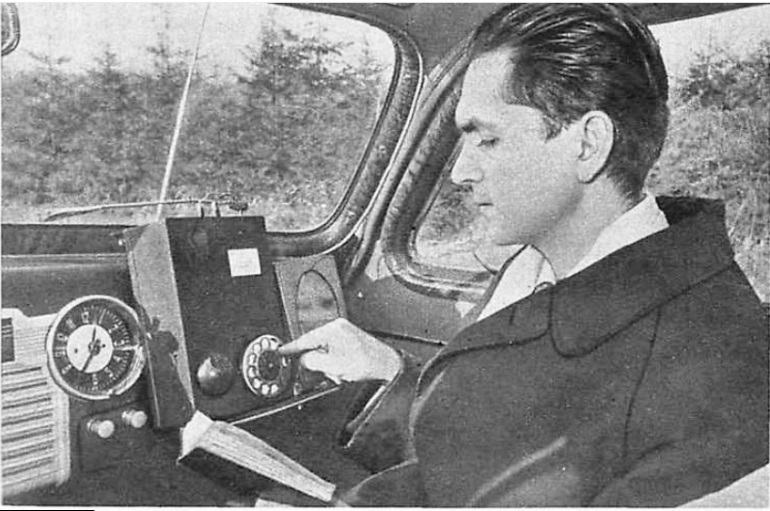
Leonid Kupriyanovich got a patent in 1957 for a wireless phone device. The first portable cell phone weighed 6.6 lbs. The inventor managed to reduce its weight to 1.1 lbs one year later. In 1961, he presented a portable handset weighing only 0.15 lbs.
Source:
Soviet radio engineer and inventor Leonid Kupriyanovich got a patent in 1957 for a wireless phone device. The first portable cell phone weighed 6.6 lbs. The inventor managed to reduce its weight to 1.1 lbs one year later. In 1961, he presented a portable handset weighing 0.15 lbs only. Back...

russkiymir.ru
Obninsk Nuclear Power Plant
"Connected to the
power grid in June 1954, Obninsk was the first grid-connected
nuclear power plant in the world,
[2]"
Source:

en.wikipedia.org
The EBR-1 that you mentioned was just a research reactor. The Soviets had the F-1, predating the EBR-1.
Nikolay Devyatkov
Inventor of Microwave Vacuum Tubes:
en.wikipedia.org
More sources for Soviet Inventions:
“Human history is in essence a history of ideas,” Herbert Wells wrote. Thanks to the drive to uncover the world’s mysteries, humans invent new devices, make new discoveries, form entire schools of thought. Here, we examine the most prominent examples invented by Russians.

www.rbth.com
Answer: First to photograph the far side of the Moon. First man in Space. First to land on Venus and many more. The Russians are not an ignorant people, although much of the brain power have left. It’s there failure to throw off the yoke of authoritarian forms of government, and there Mongol way ...

www.quora.com
en.wikipedia.org
en.wikipedia.org
A large majority of important inventions come from university scientists, government researchers, and independent inventors, for whom monetary gains aren't dominant considerations, if at all. The profit incentive for innovation is profoundly contradictory. For the profit incentive to operate, innovators must be able to gain monopoly control over the innovation and bar competitors, or else the first innovator’s profit will be small and fleeting. However, the legal and extra-legal means that capitalist innovators use to gain such monopoly power (patents and predatory tactics) prevent the rapid diffusion of new products and processes. It actually undermines innovation.
Notice how patents need the strong hand of the government to enforce them. Without the social apparatus of the state, there's no real innovation under capitalism.
As capitalist innovators follow the guide of profits, the following problems arise:
1) Innovations are disproportionally directed at upper-income consumers.
2) The public good is largely ignored in the innovation process. A company buys the parents to control a certain technological innovation with the purpose of controlling and even suppressing it, to avoid the expense of having to retool or restructure its operation with that new technology.
3) Under capitalism, many products are designed to fail after an X amount of time or use. This practice is known as "planned obsolescence". Soviet products were designed to last.
4) The monopoly power required to stimulate innovation leads to high monopoly prices for the resulting product, limiting the use of the new innovation and hence reducing the benefit from it.
5) Much innovation activity is pure waste, as firms devote innovation resources toward the end of defeating rivals rather than benefitting consumers.
While capitalism does promote the development of the forces of production, it does so in a manner that is severely flawed. Capitalism can promote innovation only if the state and other non-capitalist institutions play an active role in organizing and financing the innovation process. It can do so only with significant monopoly power and barriers to entry that simultaneously promote and hinder technical progress. And it produces a severely distorted innovation process that, after a certain stage of development, may subtract as much from human welfare as it contributes.
.For those interested, here are some socialist responses to this common misconception that capitalism results in more technological innovation than socialism:
Capitalism will soon be replaced by a non-profit system of production, due to advanced, 21st-century automation technology and AI. A non-profit system of production is the "non-scary", more palatable way of saying "socialism".