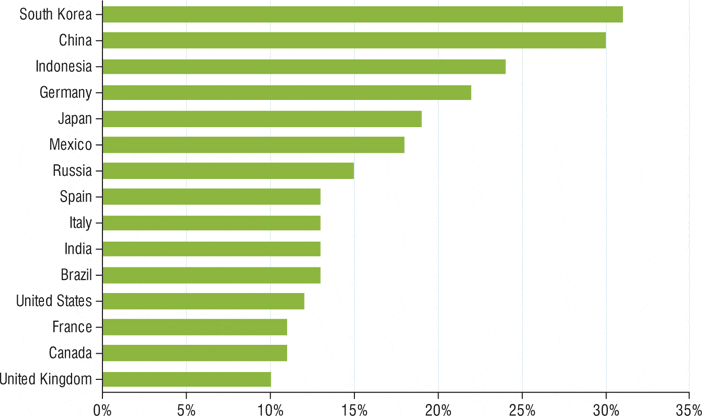
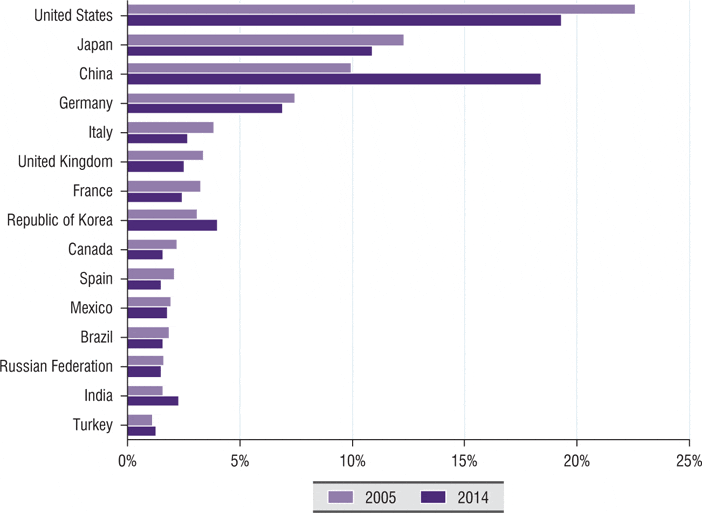
Americans strongly agree with both major presidential candidates about the importance of bringing manufacturing jobs back to the United States and are willing to pay more for consumer goods to make it happen. (To see survey question wording,
click here.)
Americans Are Willing to Pay More to Bring Back Manufacturing Jobs - Rasmussen Reports™
But
only Trump has a plan to bring those jobs back.
It's good that Americans are willing to pay higher prices. I wonder how the hell they intend to obtain the money to pay those higher prices?
Complex industrial processes such as steel production, papermaking, car manufacturing and mineral processing use multiple layered and networked computer control systems, usually referred to as "distributed control systems," (DCS) which widely perform operational management, monitoring and automation for the whole production lines. If manufacturing jobs that have been offshored were to return to the U.S., just what do you think companies will do? I'll tell you what they'lld do; they'll recognize that they have to build a wholly new manufacturing facility in the U.S. and in the process of doing so, they'll implement DCS instead of hiring people. And what they implement will be 2020-era technology, not the late 20th century to early 21st century tech they are using in their overseas factories.
If any jobs are created by that process, they'll be tech jobs and other highly skilled jobs that will be just as inaccessible to the folks who can't get one of the ~3M available "good" jobs that exist now as are those jobs they can't get now. Accordingly, what is the point of bringing back manufacturing when all it'll do is raise prices for everyone and increase the quantity of jobs that have gone unfilled.
I guess there's one good thing about doing it, however. Highly skilled folks who already have "good" jobs will see their salaries go up, for the need to implement new automation technology will result in another wave of "change jobs every two years to, at a minimum, double your salary" much like what happened in the 1990s.
Red:
Good, then would you mind showing or explaining a few things? You see, I don't know about you, but when someone tells me I must pay more, the very first question I ask is, "How much more?" Accordingly, what I want to see from Trump or his team is the following:
- What are Trump's estimates of how much higher will be the consumer prices Americans must pay as a result of bringing back those manufacturing jobs?
- What econometric model did he (or his advisors) use to arrive at that estimate. I presume he (his team) used one of the gravity models of economic modeling. I just want to know which one and what assumptions they applied when doing so. It may be that he (his advisors), rather than performing the estimation/analysis themselves, relied upon an existing study and extrapolated his/their estimates from it using some rational methodology. That's okay too; I just want to know enough so I can examine the study and the methods used for the application of its ideas to Trump's plan.
I love plans. I'm always happy to look at them and consider their merit. As far as I know, Trump's strategy is to impose tariffs (goods tariffs or income taxes).