Liu Yuejin, director of the Public Security Ministry's anti-drug bureau, told the state-run Global Times newspaper Monday the plan called for bombing drug lord Naw Kham's mountain hideout in northeastern Burma using an unmanned aerial vehicle (UAV) to end a months-long manhunt. China's top drug tsar told the newspaper the drone strike option was eventually passed over to try to capture Naw Kham alive, which finally occurred last April in a joint Chinese-Laotian operation. But his comments reveal that China is weighing targeting killings seriously.
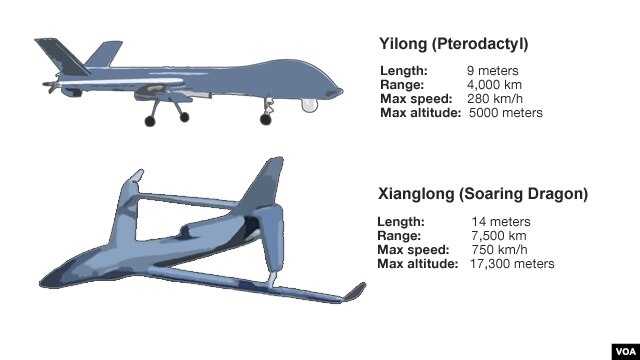
The Yilong and Xianglong, two Chinese drone models.
Beijing is becoming more willing to project power outside China, moving away from its previous policy of non-interference in international affairs, according to Peter Dutton, director of the China Maritime Studies Institute at the U.S. Naval War College. "This is a new change. This is China behaving more actively in the international sphere to protect its interests beyond its borders than it had in the past," Dutton said. Previously, China would have insisted that such interventions "either [take place] in international waters, or have United Nations approval," he said.
Legal ambiguity
For years, the United States, Israel and Britain have dominated the global drone market, and the U.S. is known to have launched armed UAV strikes against foreign targets. But China has vastly improved its technology of late, unveiling large numbers of new drone models at recent air shows and modernizing its global navigation system, Beidou, to compete with the U.S. Global Positioning System as well as Russian and EU rivals.
The Obama administration has justified drone strikes in Pakistan, Yemen and Somalia by claiming those governments were "unwilling or unable to suppress the threat posed by the individual being targeted," according to a recently leaked Justice Department memo. The leaked "white paper" outlines legal arguments for using drone aircraft to target and kill American citizens abroad who are considered terrorists.
American University Law Professor Stephen Vladeck says Washington needs to be much more specific about its criteria for using armed UAVs, because China and other countries are paying close attention. "Part of the problem is that because the U.S. government is engaged in what seems like so many drone strikes, and has not exactly been forthcoming about the criteria it uses, it's possible for countries like China to point at the U.S. example and say, 'if they're doing it, so can we,'" Vladeck said.
Proliferation and demand