Climate Change in BC Dave Daust Historic climate Fifteen thousand years ago, most of BC was covered in ice. The ice melted between thirteen and ten thousand years ago after which the climate became warm, initially drier and then moister. About 4,500 years ago, BC entered a cooler period. Over the last 1,000 years, the northern hemisphere followed a slow cooling trend until about 1900 when rapid warming began, corresponding with increased industrialization and land clearing (Figure 1). Within those general trends are warmer and cooler periods as shown by the red oscillations in the figure below. See Hebda (1995) and Spittlehouse (2008) for further detail.
Figure 1. “Variation in the annual Northern Hemisphere temperature over the last 2000 years expressed as the difference between the annual values and the 1961–1990 average. The green line shows data from the instrumental record and the red line is a multiproxy reconstruction from tree rings, ice cores, and corals. The blue line is the low-frequency component with uncertainty. (Adapted from Moberg et al. 2005.)” Reproduced from Spittlehouse 2008 with permission.
Climate varies over a range of temporal scales. Variation in Earth’s tilt and orbit around the sun influence variation over centuries and millennia (
Milankovitch cycles - Wikipedia). Several climatic oscillations that operate on the scale of years to decades affect BC, including the El Niño Southern Oscillation, Pacific Decadal Oscillation, Pacific North American Pattern and Arctic Oscillation (Moore et al. 2010). Variation due to oscillations can exceed mean changes in climate variables over a century (Rodenhuis et al. 2009). For example, in southwestern BC, precipitation in La Niña/cool PDO years is 39% greater than in El Nino/warm PDO years (Kiffney et al. 2002).
BC has become warmer over the last century. Northern and southern BC have warmed more than coastal BC and parts of central BC (Rodenhuis 2009). Annual minimum temperatures have warmed more than maximum temperatures—BC is becoming “less cold” rather than “warmer” (Rodenhuis 2009, Pike et al. 2008). All seasons have warmed, but winter has warmed the most. As a result of warming, seasons are changing. The frost-free period has lengthened by 21 days over the last half of the last century.
https://www2.gov.bc.ca/assets/gov/e...ience/2a_va_bc-climate-change-final-aug30.pdf
Much more information in the article.



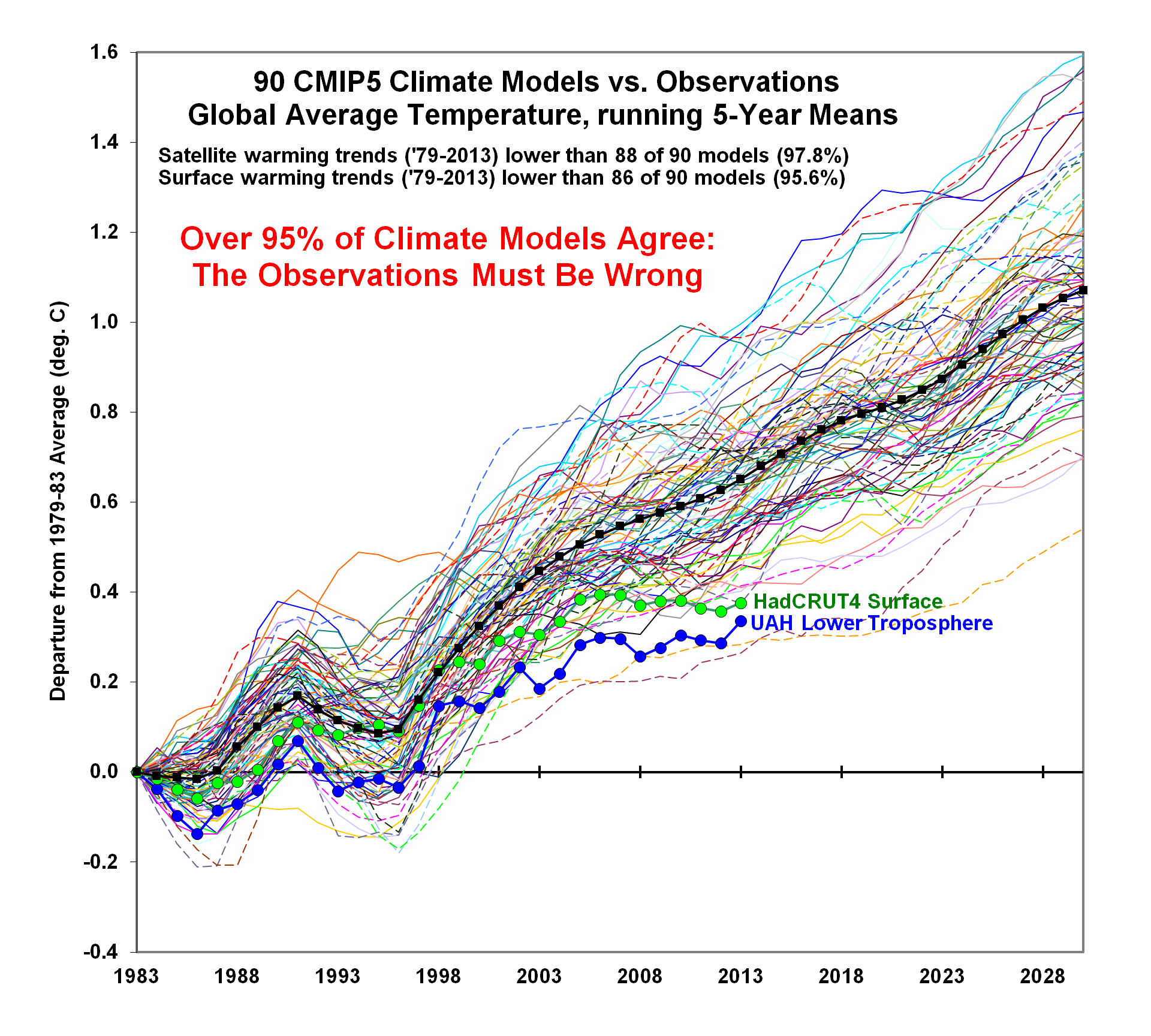

 ) deniers could not possibly be be winning more decisively. Some have opinions about climate change effecting the planet, but climate change action is happening nowhere, most notably in the US.
 . When that happens, climate crusaders can boast all they want about the "decided science" but until then, the level of losing continues to be prolific!!


