oreo
Gold Member
To answer your question, about half the states, mostly in the Northeast and in the Far West DO want to KEEP it legal.Who in the hell wants to make it legal for a woman to kill her child on demand just for the sake of convenience?
If, we as a civilized society, are going to let a woman kill her child shouldn't it be for a little better reason than she just doesn't want to be bothered?
But that has nothing to do with the issue of Roe v. Wade.
Roe is all about States' Rights to BAN the procedure.
As a medical procedure in demand with lots of tried and true surgical methods, it starts out as legal. Surgery has no moral issues attached to it.
Then WHAM! some state legislatures come along and try to make this ILLEGAL for moral reasons. This is where the 1st Amendment of separation of church and state get violated.
So something has to give. Either states' rights had to give or the 1st Amendment had to give.
The Berger Court ruled essentially in favor of the 1st Amendment against States' Rights, but they did it with an off the wall "right to privacy" interpretation which does not exist for women and their vagina's in the Federal Constitution.
Oh well. Bad law. But both the 1st Amendment AND States' Rights (the 10th Amendment) could not win. One of them had to lose.
There was another States Rights issue, and Privacy was also brought up.
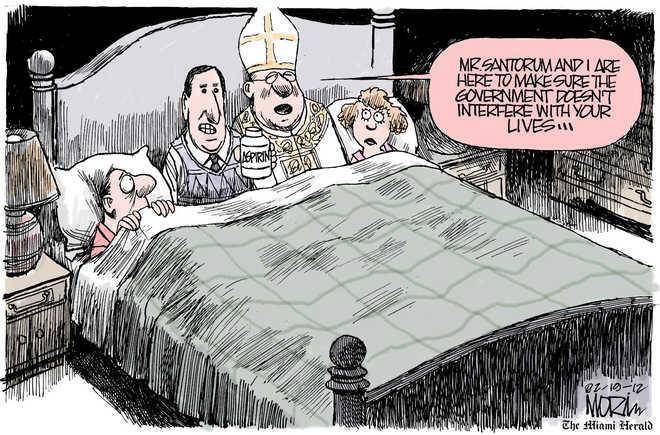
Rick Santorum is actually on video and still says " that states have the right to ban birth control contraceptives." Meaning your next door neighbor via a ballot will decide for you if you use them or not.
Santorum is still arguing with a 1965 U.S. Supreme Court decision (Griswold v Connecticut.) Of course on the campaign trail in 2012 (while he stated well yes states have that right birth control contraceptives, but who would ever be crazy enough to pass it.)
Well, I just don't trust crazy people so I would prefer that Griswold V Connecticut isn't challenged by the same people that want to repeal Roe V Wade--because in my opinion they are just mini Rick Santorums. They feel that it's O.K. to intervene into the private-personal lives & decisions of women, and have some type of mental capacity to believe that's O.K. to do, when it clearly isn't.
The court also considered Griswold v Connecticut a Privacy issue, even though the word privacy was never written in the U.S. Constitution.
Griswold v. Connecticut - Wikipedia