P F Tinmore,
et al,
Again, your statements are questionable in there inference.
RoccoR said:
As you can see, in 1948 - the Government of Palestine, under the Mandate, was in the hands of the Mandatory, not the Palestinians; without regard to citizenship. There was no nation of people inside defined international borders of the Mandate Territory.
Even people in non self governing territories have these rights.
- The right to self determination.
- The right to independence.
- The right to sovereignty.
- The right to territorial integrity.
(COMMENT)
This may be true. But there is a big difference between h
aving a "right" and
exercising that "right." Of the people in the former Mandate for Palestine, the Hashemite Kingdom (1946), the Israelis (1948) and the Palestinian (1988) declared independence.
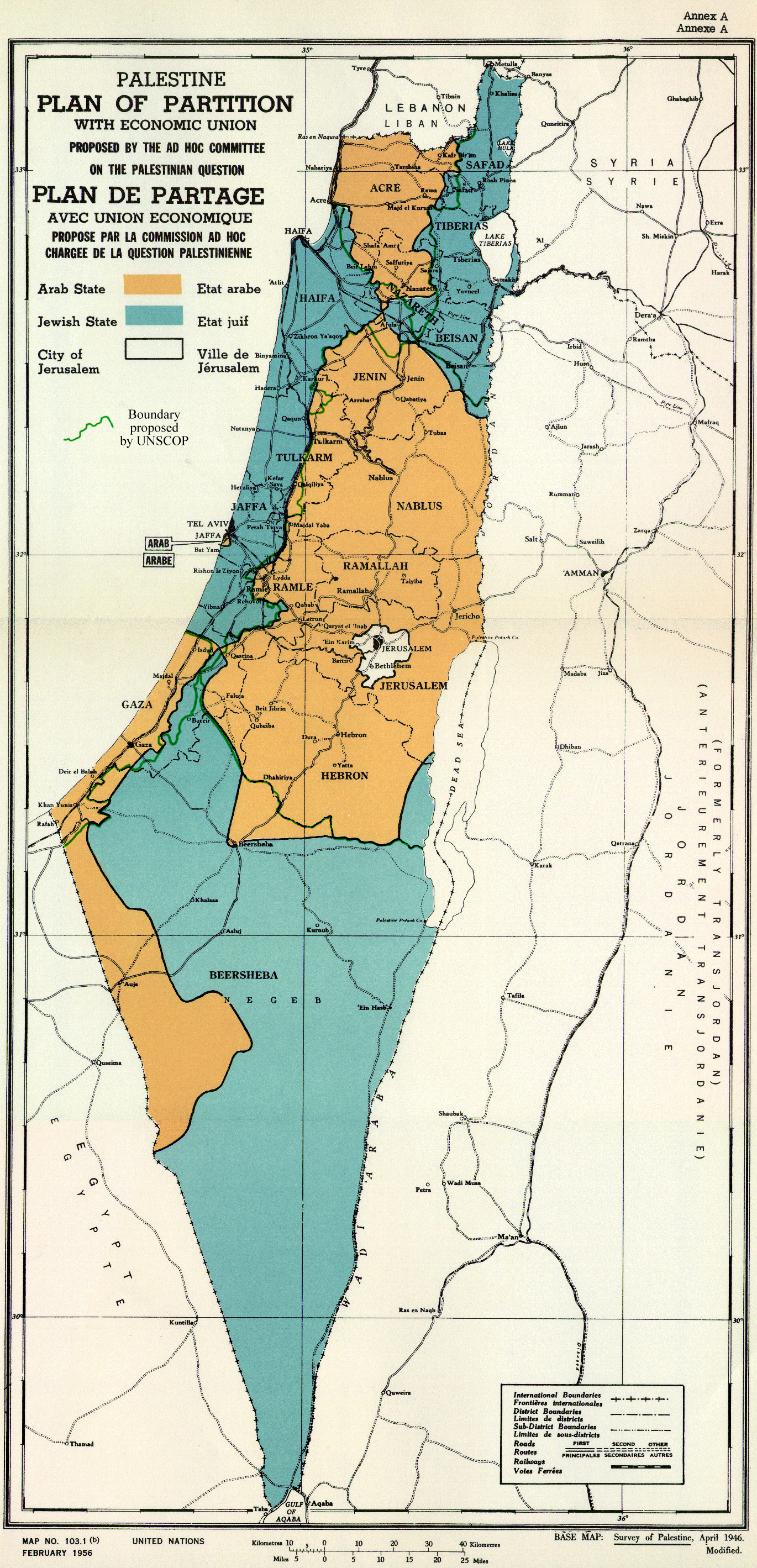
BTW, the mandate had no territory or borders. It worked inside Palestine's international borders.
(COMMENT)
What are you using as the authority for the establishment of "Palestine's international borders?"
You cannot be using the Treaty of Lausanne. It discusses the Ottoman Empire Sanjaks
(administrative divisions of the Ottoman Empire) of Nablus, Acre, the Southern portion of the Beirut Vilayet, and the Mutasarrifate of Jerusalem; but not Palestine. The entire area was considered Syria, "from the Mediterranean to the frontier of Persia" -- under the treaty.
The legal commission for the administration of Occupied Enemy Territory named Palestine
(a territory within such boundaries as may be determined by the Principal Allied Powers - defined by the Palestine Order in Council) was confirmed by the Council of the League of Nations (24 July 1922) and which came into effect on 26 September 1923.
The
Franco-British Convention on Certain Points Connected with the Mandates for Syria and the Lebanon, Palestine and Mesopotamia, signed December 1920. It delineates the boundaries between the French Mandates and the Brithish Mandates.
EXCERPT Franco-British Convention on Certain Points Connected with the Mandates for Syria and the Lebanon said:
The British and French Governments, respectively represented by the undersigned Plenipotentiaries, wishing to settle completely the problems raised by the attribution to Great Britain of the mandates for Palestine and Mesopotamia and by the attribution to France of the mandate over Syria and the Lebanon, all three conferred by the Supreme Council at San Remo, have agreed on the following provisions:
Article 1
The boundaries between the territories under the French mandate of Syria and the Lebanon on the one hand and the British mandates of Mesopotamia and Palestine on the other are determined as follows:
On the east, the Tigris from Jeziret-ibn-Omar to the boundaries of the former vilayets of Diarbeki/r and Mosul.
On the south-east and south, the aforesaid boundary of the former vilayets southwards as far as Roumelan Koeui; thence a line leaving in the territory under the French mandate the entire basin of the western Kabur and passing in a straight line towards the Euphrates, which it crosses at Abu Kemal, thence a straight line to Imtar to the south of Jebul Druse, then a line to the south of Nasib on the Hedjaz Railway, then a line to Semakh on the Lake of Tiberias, traced to the south of the railway, which descends towards the lake and parallel to the railway. Deraa and its environs will remain in the territory under the French mandate; the frontier will in principle leave the valley of the Yarmuk in the territory under the French mandate, but will be drawn as close as possible to the railway in such a manner as to allow the construction in the valley of the Yarmuk of a railway entirely situated in the territory under the British mandate. At Semakh the frontier will be fixed in such a manner as to allow each of the two High Contracting Parties to construct and establish a harbour and railway station giving free access to the Lake of Tiberias.
On the west, the frontier will pass from Semakh across the Lake of Tiberias to the mouth of the Wadi Massadyie. It will then follow the course of this river upstream, and then the Wadi Jeraba to its source. From that point it will reach the track from El Kuneitra to Banias at the point marked Skek, thence it will follow the said track, which will remain in the territory under the French mandate as far as Banias. Thence the frontier will be drawn westwards as far as Metullah, which will remain in Palestinian territory. This portion of the frontier will be traced in detail in such a manner as to ensure for the territory under the French mandate easy communication entirely within such territory with the regions of Tyre and Sidon, as well as continuity of road communication to the west and to the east of Banias.
From Metullah the frontier will reach the watershed of the valley of the Jordan and the basin of the Litani. Thence it will follow this watershed southwards. Thereafter it will follow in principle the watershed between the Wadis Farah-Houroun and Kerkera, which will remain in the territory under the British mandate, and the Wadis El Doubleh, El Aioun and Es Zerka, which will remain in the territory under the French mandate. The frontier will reach the Mediterranean Sea at the port of Ras-el-Nakura, which will remain in the territory under the French mandate.
SOURCE: JSTOR British Parliamentary Command Papers, Misc. No. 4 (1921).
Again, what authority do you use to show the International Borders of Palestine?
Most Respectfully,
R