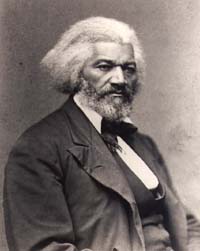
And none of you were here on July 4th, 1776, none of you fought the British for your freedom either. And since most of you are from ancestors who came here after this happened, your ancestors did not fight to win your freedom from Britain either.
So without further ado, one of the greatest speeches in American history.
What To The Slave Is The 4th Of July?"
FREDERICK DOUGLASS SPEECH, 1852
Fellow citizens, pardon me, allow me to ask, why am I called upon to speak here today? What have I, or those I represent, to do with your national independence? Are the great principles of political freedom and of natural justice, embodied in that Declaration of Independence, extended to us? and am I, therefore, called upon to bring our humble offering to the national altar, and to confess the benefits and express devout gratitude for the blessings resulting from your independence to us?
For the rest of the speech:
http://www.freemaninstitute.com/douglass.htm
Frederick Douglas never fought in the revolutionary war...but he became a strong supporter of the constitution.
"However, as Frederick Douglass matured in his political views, he evolved in his personal position regarding the Law of the Land. In fact, Douglass made one of the most dramatic changes in position regarding the value of the U.S. Constitution in the years leading up to the outbreak of the Civil War.
As Douglass read and studied more, and became more aware of other abolitionists, he began to pull away from Garrison’s orbit of persuasion. On December 3, 1847, after Douglass came back from a tour of England and Ireland, he used funds entrusted to him to start his own weekly abolitionist newspaper that he called The North Star. This initiated a substantial break with his previous supporter. Garrison felt largely responsible for the rise in prominence of the former slave, but ironically opposed the move to establish a separate abolitionist news organization. He may have regarded it as some needless competition for his own newspaper. Nonetheless in The North Star, Douglass replicated Garrisonian views that the Constitution was intentionally pro-slavery."
"Frederick Douglass had even publically debated with Lysander Spooner and Gerrit Smith who were abolitionists that supported the Constitution. In 1846, Spooner, an ardent abolitionist, had written a book titled The Unconstitutionality of Slavery which proposed the opposite perspective of Garrison, in which Spooner expressed that the Founders had not deliberately legalized slavery. Eventually, Frederick Douglass made public a dramatic change of opinion about the Constitution in his newspaper, and later in a public speech, he proclaimed it as “a glorious liberty document.” Such a dramatic personal shift in opinion reflected a larger split within the abolition movement in general due to perceptions regarding the Constitution and the proper way for the nation to deal with the institution of slavery."
Read more at
Frederick Douglass and defending the U.S. Constitution | Communities Digital News