What ever happened to that ridiculous climate change hoax.

That's all your side can do right now, is have the data shoved in your face, lie, and claim it isn't there.

Earth SAP is not going up, not for the past 60 years, proving Earth is neither warming nor experiencing an ongoing net ice melt.


CO2 FRAUD "faux skeptics" don't like that. They support CO2 FRAUD because they are part of it. They want it to continue. They want dumb Americans to believe there has been "warming" when there has been none. So this is where we are...


THREE PLANETS, all having rising SAP when WARMING

Mars
Pluto
Earth


What happens when Earth actually does warm, as it did during Jurassic?


"During the Jurassic Period, the Earth's climate was much warmer and wetter than it is today."


then the giant flying creatures of the dinosaur age could only fly if the atmospheric pressure was much higher than it is now: at least 3.7–5.0 bar


They cannot refute 600 miles to the pole
They cannot show us one single photo documenting "ocean rise"
They have no breakout in cane activity
They've been lying about Antarctic ice since CO2 FRAUD began in 1988
The actual unFUDGED satellite and balloon data shows NO WARMING in the atmosphere
They have no real data showing atmospheric warming at all
They squirt bleach in coral and blame that on "warming" that does not exist


They cannot even answer basic climate questions correctly...


Earth SAP is not going up

There is no Earth SAP.
 
What part of....

"Earth's plate tectonics are expected to slow and eventually stop as the planet cools, with models suggesting this could happen in roughly 1 to 5 billion years"

...did you not understand?


LOL!!!

So we need to watch carefully for it in a billion years, but not now... got it... sounds like another waste of taxpayer money studying something to create a faux "crisis."
 
There is no Earth SAP.


Out to 6 digits, been at that point for decades if not centuries...


Atmospheric pressure, also known as air pressure or barometric pressure (after the barometer), is the pressure within the atmosphere of Earth. The standard atmosphere (symbol: atm) is a unit of pressure defined as 101,325 Pa (1,013.25 hPa), which is equivalent to 1,013.25 millibars, 760 torr (or about 760 mmHg), about 29.9212 inches Hg, or about 14.696 psi.<a href="Atmospheric pressure - Wikipedia"><span>[</span>1<span>]</span></a> The atm unit is roughly equivalent to the mean sea-level atmospheric pressure on Earth; that is, the Earth's atmospheric pressure at sea level is approximately 1 atm.
 
LOL!!!

So we need to watch carefully for it in a billion years, but not now... got it... sounds like another waste of taxpayer money studying something to create a faux "crisis."
Actually it's saying you don't have to worry about the earth's core cooling but the earth's core is slowly cooling. It's not warming up. It's not staying the same. It is slowly cooling.
 
Earth's plate tectonics are expected to slow and eventually stop as the planet cools, with models suggesting this could happen in roughly 1 to 5 billion years, depending on the specific cooling rates and mantle dynamics considered, with some estimates pointing to around 1.45 billion years when the mantle becomes too cool to flow, halting surface activity like mountain building and volcanism.

Which once again starts to run into things like the expansion of the sun.

In general, most I have read or listened to this have generally stipulated that it becomes meaningless. As that will also provide not only a stronger external heat source, but also the tidal forces from a larger sun will impact the planet even more. After all, that is the entire reason that Venus still has a molten core.

If Venus was to replace the Earth or Mars in location, it's core would have gone cold billions of years ago. It is only the tidal effects of the sun that it remains molten.

I often joke that once you start to reach distances that far in the future, it largely becomes little more than whistling in the dark, or mental masturbation. Kinda like speculating what "Earth Mark I" was like before the Theia impact. Was the surface solid? Were there water oceans? Was there life?

Ultimately, it does not matter and we will never know. Because the entire surface (including the mantle) was completely destroyed and the entire planet "reset".
 
... even though there will be no evidence of that for the next billion years....
Feel free to believe the earth's core will never cool down. I'll just add it to the list of crazy things you believe.
 
Feel free to believe the earth's core will never cool down. I'll just add it to the list of crazy things you believe.


LOL!!!


Why is Earth spherical?
 
Gravity. Although I halfway expect you are going to tell me it's because of SAP. :icon_rolleyes:


LMAO!!!


All spherical shapes in space are that way because the center is not solid.

Something like being 500 miles in diameter, the force of gravity causes heat in the center, which results in "melting" of rock, causing a spherical shape.


Find an object in space 500 miles in diameter that is not spherical....
 
LMAO!!!


All spherical shapes in space are that way because the center is not solid.

Something like being 500 miles in diameter, the force of gravity causes heat in the center, which results in "melting" of rock, causing a spherical shape.


Find an object in space 500 miles in diameter that is not spherical....
You should really learn how to use google.

Planets are round because gravity pulls all their mass equally towards the center, making a sphere the most efficient shape to minimize potential energy, essentially smoothing out irregularities like mountains or bumps over time. While spinning causes slight bulges at the equator (making them "oblate spheroids"), the dominant force is gravity acting as a powerful, inward-pulling equalizing force from all directions as the planet forms from molten material.

How gravity shapes planets:
  • Center of Mass: Gravity pulls all matter in a celestial body toward its center of mass.
  • Equal Pull: This force acts equally in all directions, pulling everything as close to the center as possible
    .
    • Sphere is Optimal: A sphere is the geometric shape where every point on the surface is equidistant from the center, making it the most stable configuration for large, massive objects.
    • Overcoming Material Strength: For objects large enough (more than a few hundred miles wide), gravity's pull is stronger than the rigidity of the rock and metal, forcing them into a spherical shape.
Why they aren't perfect spheres:
  • Rotation: A planet's spin creates a centrifugal force that counteracts gravity slightly at the equator, causing it to bulge outwards.
  • Oblate Spheroid: This results in a shape called an oblate spheroid (like Earth), which is slightly flattened at the poles and bulging at the equator, says Wikipedia.
 
gravity's pull is stronger than the rigidity of the rock and metal, forcing them into a spherical shape.


still solid?

LOL!!!

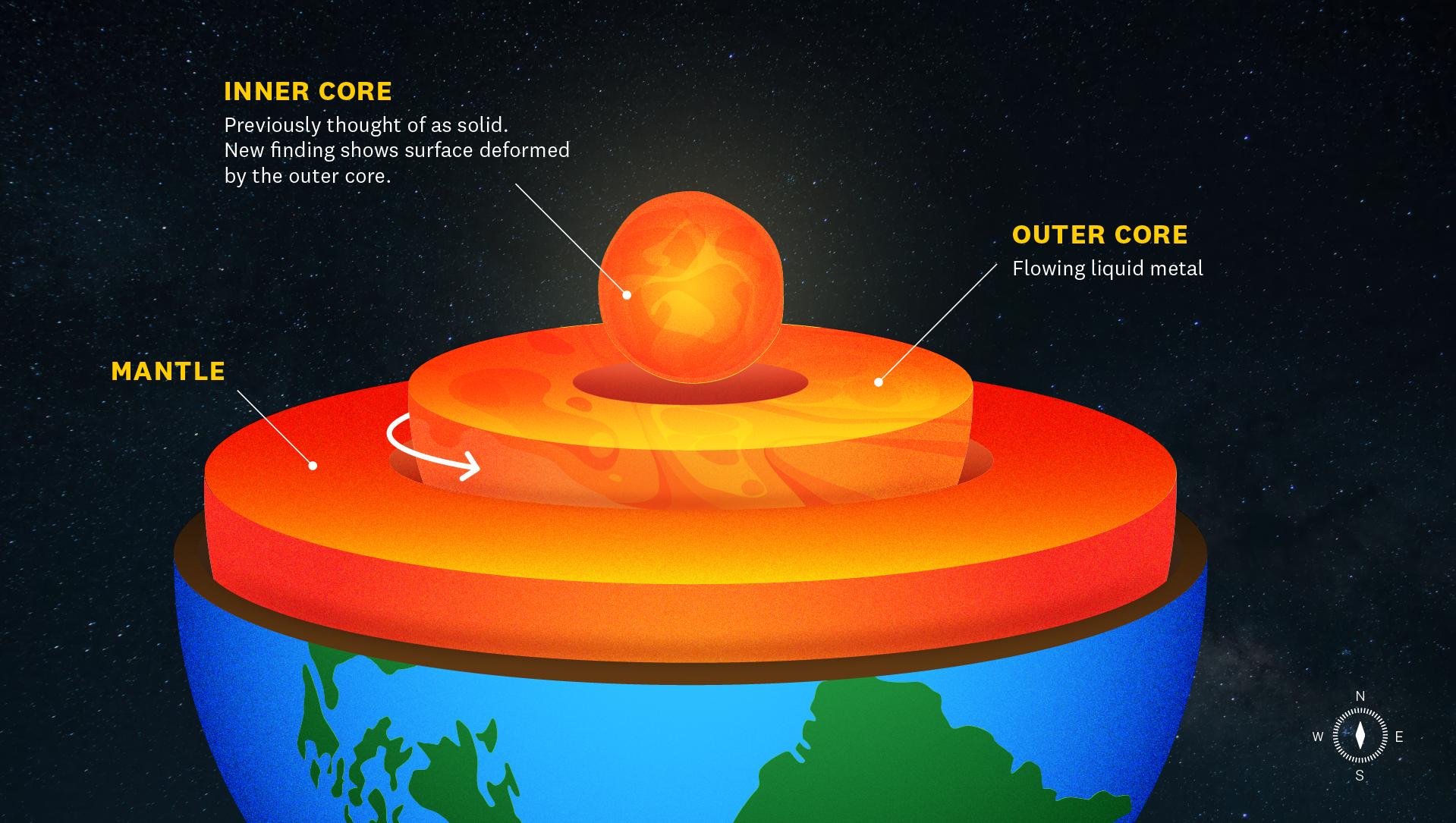
Earth is only solid 30-40 miles down from the crust.
 
still solid?

LOL!!!

Earth is only solid 30-40 miles down from the crust.
Earth is round primarily because of gravity pulling all its mass inward equally, forcing it into a sphere (or slightly squished sphere) as it formed; the liquid outer core and solid inner core's structure are a result of this process and the planet's internal cooling, not the cause of its overall shape, though the liquid core's flow generates our magnetic field.

Why Earth is Round (Gravity):
  • Gravitational Pull: During its formation, gravity pulled all the dust and rock together towards the center.
  • Hydrostatic Equilibrium: Gravity pulls equally from all directions, naturally molding large celestial bodies into the most compact shape possible: a sphere, minimizing surface area.
  • Slight Bulge: Earth's rotation causes it to bulge slightly at the equator, making it an oblate spheroid rather than a perfect sphere.
Earth's Core Structure (Result, Not Cause):
  • Differentiation: Heavy elements like iron and nickel sank to the center, while lighter materials formed the mantle and crust.
  • Liquid Outer Core: This molten iron-nickel layer flows, generating Earth's magnetic field.
  • Solid Inner Core: Intense pressure keeps the innermost part solid, despite extreme temperatures, as it slowly crystallizes from the liquid outer core.
So, the liquid core is a feature within the spherical Earth, a product of its formation under gravity, not the force that made it round in the first place.
 
15th post
You know what isn't an ongoing debate? The earth is spherical because of gravity.


Gravity is the force pulling it together at the center, but that's not the issue. The issue is whether or not anything below 30-40 miles from crust is solid, and you don't have a clear case that there is.
 
Back
Top Bottom