What conditions would you accept an abortion, if any?

Nope, they allow infants born alive during a botched abortion to die


It is essentially the same thing

Typically, to evade the partial birth ban, a solution of potassium chloride or digoxin is injected directly into the fetal heart using ultrasound to guide the needle. This is often done by providers who do not perform intact dilation and extraction procedures (as well as by those who do) because they feel the broad wording of the ban compels them "to do all they can to protect themselves and their staff from the possibility of being accused".

So, I guess doing this right before birth is Ok with you.
If it is born, it is born. Abortion or not.
If I was in congress, I would have supported that bill. At least at face value.
 
Trans is a psychological disorder.
We've been over this before.

No, being transgender is not considered a mental disorder by major medical and psychological organizations. Both the World Health Organization (WHO) and the American Psychiatric Association (APA) have updated their guidelines to reflect this understanding.

Current Official Classifications
  • World Health Organization (WHO): The WHO removed "gender identity disorder" from the mental and behavioral disorders chapter in its International Classification of Diseases (ICD-11), effective in 2022. It is now classified as "gender incongruence" under a chapter on sexual health, a move intended to reduce stigma while ensuring access to medical care.
  • American Psychiatric Association (APA):The APA explicitly states that "gender nonconformity is not in itself a mental disorder". In its Diagnostic and Statistical Manual of Mental Disorders (DSM-5-TR), the diagnosis of "gender identity disorder" was replaced with
    "gender dysphoria"
The Distinction: Transgender Identity vs. Gender Dysphoria
It is important to differentiate between simply being transgender and experiencing gender dysphoria.
  • Being Transgender: This term refers to a person whose internal psychological sense of gender (gender identity) does not align with the sex they were assigned at birth. It is a natural variation of human experience and identity, not a pathology.
  • Gender Dysphoria: This is a diagnostic term used to describe the clinically significant distress or impairment that some transgender people experience due to the incongruence between their assigned sex and their gender identity. The diagnosis exists to ensure individuals can access necessary medical treatments and support, such as hormone therapy or surgery, which often alleviate this distress.

Mental health challenges like anxiety and depression are found at higher rates in the transgender community; however, studies show these issues are primarily the result of experiences with discrimination, stigma, and social exclusion (transphobia), rather than being inherent to transgender identity itself.
 
When I saw the title of this thread, the first thing I thought of was "Phone call for
Mr. 1srelluc. Will Mr.1srelluc please pick up the courtesy phone?"

:laughing0301:
50 million is not really the number we would now be burdened by either given abortion's 50 year history....That's 2+ generations so figure at least another 50 million on top of that.

Think of the way things are going today and then try to claim that we did not dodge a bullet.
 
We've been over this before.

No, being transgender is not considered a mental disorder by major medical and psychological organizations. Both the World Health Organization (WHO) and the American Psychiatric Association (APA) have updated their guidelines to reflect this understanding.

Current Official Classifications
  • World Health Organization (WHO): The WHO removed "gender identity disorder" from the mental and behavioral disorders chapter in its International Classification of Diseases (ICD-11), effective in 2022. It is now classified as "gender incongruence" under a chapter on sexual health, a move intended to reduce stigma while ensuring access to medical care.
  • American Psychiatric Association (APA):The APA explicitly states that "gender nonconformity is not in itself a mental disorder". In its Diagnostic and Statistical Manual of Mental Disorders (DSM-5-TR), the diagnosis of "gender identity disorder" was replaced with
    "gender dysphoria"
The Distinction: Transgender Identity vs. Gender Dysphoria
It is important to differentiate between simply being transgender and experiencing gender dysphoria.
  • Being Transgender: This term refers to a person whose internal psychological sense of gender (gender identity) does not align with the sex they were assigned at birth. It is a natural variation of human experience and identity, not a pathology.
  • Gender Dysphoria: This is a diagnostic term used to describe the clinically significant distress or impairment that some transgender people experience due to the incongruence between their assigned sex and their gender identity. The diagnosis exists to ensure individuals can access necessary medical treatments and support, such as hormone therapy or surgery, which often alleviate this distress.

Mental health challenges like anxiety and depression are found at higher rates in the transgender community; however, studies show these issues are primarily the result of experiences with discrimination, stigma, and social exclusion (transphobia), rather than being inherent to transgender identity itself.
Copy all the garbage you want you have no understanding of the disorder or any common sense. Just toxic empathy. When a parent supports their childrens gender dysphoria is Munchausen's by proxy Syndrome.
Its socially contagious disorder that has dropped by 60% last year because its advocates have lost power and credibility.
Detransitons are increasing
Among the total of 237 survey participants, 92% were birth-registered females. Approximately 2/3 had transitioned both socially and medically, while just under 1/3 transitioned only socially (the option of "only medical" transition was not provided in the survey responses). Among those who medically transitioned, 46% underwent "gender-affirming" surgeries (vs. only undergoing hormonal interventions).
The average age of transition was 18 for social transition (17 for females, 24 for males), and 20.7 for medical transition (20 for females, 26 for males). A quarter of the respondents began medical transition before 18. The average age of detransition was 23 (22 for females, 30 for males). On average, detransition occurred roughly 5 years after transition was initiated (with males taking somewhat longer to detransition).
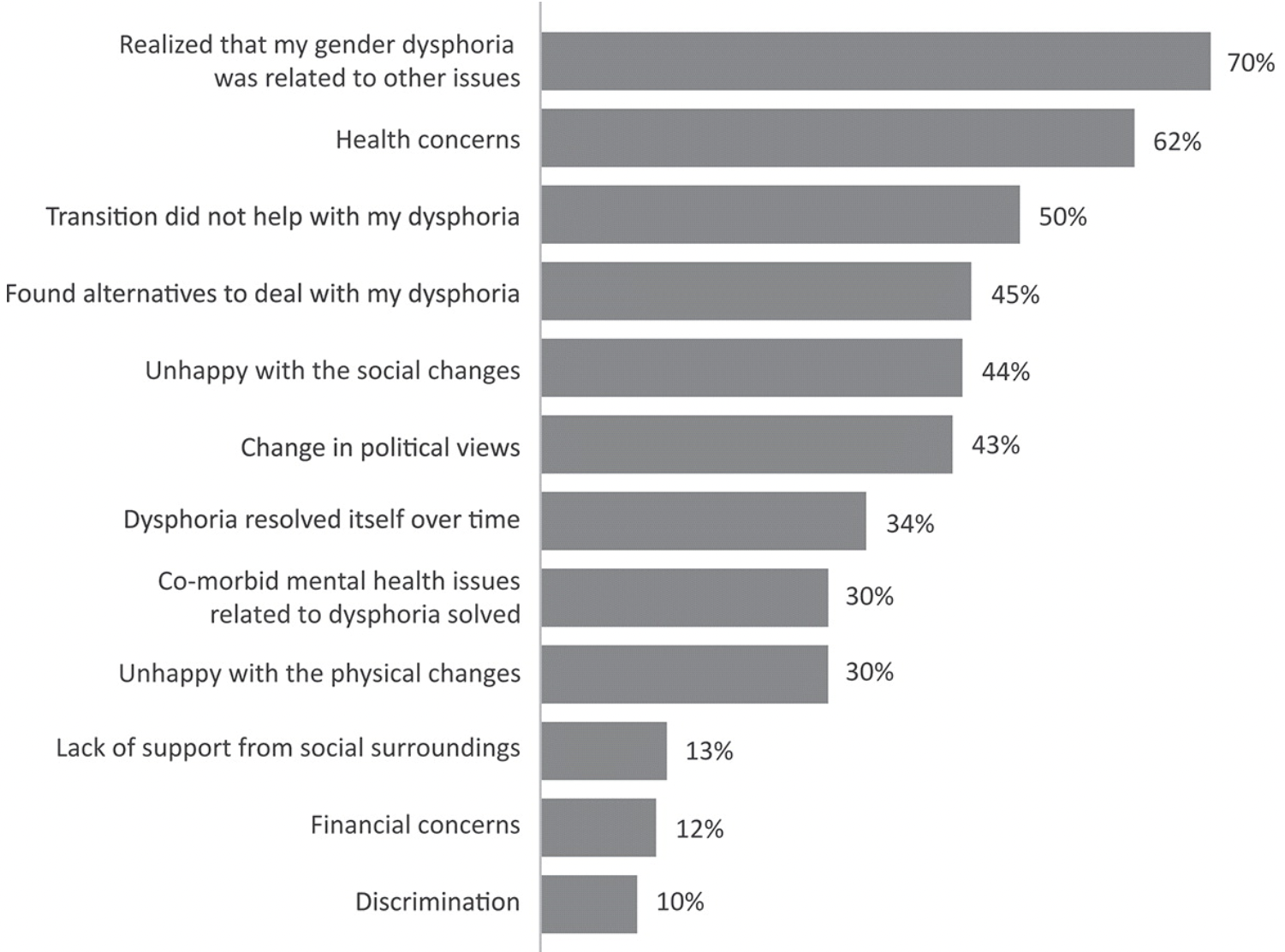
The participants' decision to detransition was most often tied to the realization that their gender dysphoria was related to other issues (70%), health concerns (62%), and the fact that transition did not alleviate their dysphoria (50%). Interestingly, over 4 in 10 (43%) participants endorsed a change in political views as a reason for detransition.​

Reasons for Detransitioning

figure


Figure 1. Reasons for detransitioning (n=237). Vandenbussche E (2021).
Most participants reported significant difficulties finding the help that they needed during their detransition process from medical, mental health, or LGBT communities. Only 13% of the respondents received help from LGBT organizations when detransitioning, compared to 51% when transitioning. A number of participants reported negative reactions from LGBT and medical communities, and 51% of the sample expressed that they did not feel supported during their detransition.
Most detransitioners reported ongoing needs related to managing comorbid mental health conditions (65%), finding alternatives to medical transition (65%), and coping with regret (60%). Half of the sample reported the need for medical information on stopping or changing hormone regimens. A great majority of participants also expressed the need to hear about others' detransition experiences (87%) and getting in contact with other detransitioners (76%). The study highlights the urgency of providing appropriate medical, psychological, legal, and social support to detransitioners.
This is the first large-sample, peer-reviewed study of the experiences of individuals who identify as detransitioners. Another study earlier this year also attempted to examine detransitioner experiences, but it used a sample of individuals who self-identified as transgender, non-binary, or as "cross-dressers." That study suggested that the leading reason for their detransition was external pressure. In contrast, this most recent study of individuals who explicitely identify as "detransitioners" suggests a strong influence of internal, rather than external, factors. The marked difference in the findings between these two recent studies, both of which use convenience online samples, highlights how the choice of sample may impact study applicability.​
As the numbers of detransitioners have sharply grown in the last 5 years, and as transition eligibility has become far less restrictive, it is inevitable that the number of detransitioners will grow. It is vital that health systems begin to track detransition in order to better understand the trajectories of gender dysphoric youth. It is also critical that gender medicine practitioners develop treatment protocols to help detransitioning individuals with significant unmet mental and physical health needs.​
 
Copy all the garbage you want you have no understanding of the disorder or any common sense. Just toxic empathy. When a parent supports their childrens gender dysphoria is Munchausen's by proxy Syndrome.
Its socially contagious disorder that has dropped by 60% last year because its advocates have lost power and credibility.
Detransitons are increasing

Among the total of 237 survey participants, 92% were birth-registered females. Approximately 2/3 had transitioned both socially and medically, while just under 1/3 transitioned only socially (the option of "only medical" transition was not provided in the survey responses). Among those who medically transitioned, 46% underwent "gender-affirming" surgeries (vs. only undergoing hormonal interventions).
The average age of transition was 18 for social transition (17 for females, 24 for males), and 20.7 for medical transition (20 for females, 26 for males). A quarter of the respondents began medical transition before 18. The average age of detransition was 23 (22 for females, 30 for males). On average, detransition occurred roughly 5 years after transition was initiated (with males taking somewhat longer to detransition).
The participants' decision to detransition was most often tied to the realization that their gender dysphoria was related to other issues (70%), health concerns (62%), and the fact that transition did not alleviate their dysphoria (50%). Interestingly, over 4 in 10 (43%) participants endorsed a change in political views as a reason for detransition.​

Reasons for Detransitioning

figure


Figure 1. Reasons for detransitioning (n=237). Vandenbussche E (2021).

Most participants reported significant difficulties finding the help that they needed during their detransition process from medical, mental health, or LGBT communities. Only 13% of the respondents received help from LGBT organizations when detransitioning, compared to 51% when transitioning. A number of participants reported negative reactions from LGBT and medical communities, and 51% of the sample expressed that they did not feel supported during their detransition.

Most detransitioners reported ongoing needs related to managing comorbid mental health conditions (65%), finding alternatives to medical transition (65%), and coping with regret (60%). Half of the sample reported the need for medical information on stopping or changing hormone regimens. A great majority of participants also expressed the need to hear about others' detransition experiences (87%) and getting in contact with other detransitioners (76%). The study highlights the urgency of providing appropriate medical, psychological, legal, and social support to detransitioners.

This is the first large-sample, peer-reviewed study of the experiences of individuals who identify as detransitioners. Another study earlier this year also attempted to examine detransitioner experiences, but it used a sample of individuals who self-identified as transgender, non-binary, or as "cross-dressers." That study suggested that the leading reason for their detransition was external pressure. In contrast, this most recent study of individuals who explicitely identify as "detransitioners" suggests a strong influence of internal, rather than external, factors. The marked difference in the findings between these two recent studies, both of which use convenience online samples, highlights how the choice of sample may impact study applicability.


As the numbers of detransitioners have sharply grown in the last 5 years, and as transition eligibility has become far less restrictive, it is inevitable that the number of detransitioners will grow. It is vital that health systems begin to track detransition in order to better understand the trajectories of gender dysphoric youth. It is also critical that gender medicine practitioners develop treatment protocols to help detransitioning individuals with significant unmet mental and physical health needs.​
You are literally arguing against the American Psychiatric Association (APA) and using an article that does not dispute the APA's finding that "gender nonconformity is not in itself a mental disorder"

The only thing the article you posted found was that: most detransitioners could benefit from some form of counseling and in particular when it comes to psychological support on matters such as gender dysphoria, comorbid conditions, feelings of regret, social/physical changes and internalized homophobic or sexist prejudices. Medical support was also found to be needed by many, in order to address concerns related to stopping/changing hormone therapy, surgery/treatment complications and access to reversal interventions. Furthermore, the current study has shown that detransitioners need spaces to hear about other detransition stories and to exchange with each other.

How exactly do you believe this is proving what you said? That "Trans is a psychological disorder?"
 
You are literally arguing against the American Psychiatric Association (APA) and using an article that does not dispute the APA's finding that "gender nonconformity is not in itself a mental disorder"

The only thing the article you posted found was that: most detransitioners could benefit from some form of counseling and in particular when it comes to psychological support on matters such as gender dysphoria, comorbid conditions, feelings of regret, social/physical changes and internalized homophobic or sexist prejudices. Medical support was also found to be needed by many, in order to address concerns related to stopping/changing hormone therapy, surgery/treatment complications and access to reversal interventions. Furthermore, the current study has shown that detransitioners need spaces to hear about other detransition stories and to exchange with each other.

How exactly do you believe this is proving what you said? That "Trans is a psychological disorder?"
The APA is motivated by politics they dont define mental illness. Thier job is to kee[ fees high.
More are detransitioning.
Every case has a premorbid personality disorder or emotional disturbance. The trans ideology is a symptom not a normal state.
But you can easily prove your point by describing how a man can change into a women biologically and have the capacity to give birth.
Start by defining what a woman is.
Then describe how it done. Other wise admit you have no idea what this is
 
The APA is motivated by politics they dont define mental illness. Thier job is to kee[ fees high.
More are detransitioning.
Every case has a premorbid personality disorder or emotional disturbance. The trans ideology is a symptom not a normal state.
But you can easily prove your point by describing how a man can change into a women biologically and have the capacity to give birth.
Start by defining what a woman is.
Then describe how it done. Other wise admit you have no idea what this is
My point is that transgenderism is not considered a mental disorder by major medical and psychological organizations. Both the World Health Organization (WHO) and the American Psychiatric Association (APA) have updated their guidelines to reflect this understanding.
 
My point is that transgenderism is not considered a mental disorder by major medical and psychological organizations. Both the World Health Organization (WHO) and the American Psychiatric Association (APA) have updated their guidelines to reflect this understanding.

Your point is man can change into a woman so explain how thats done. Times are changing
Several hospital systems and medical institutions in the United States have altered, paused, or reversed their, or restricted, support for gender-affirming care (GAC), particularly for minors, often citing legal, regulatory, or safety risks.
Hospital Systems and Medical Centers
  • Children’s National Hospital (Washington, D.C.): Halted gender-transition surgeries for individuals under 19.
  • Children’s Hospital of Richmond and VCU Health (Virginia): Stopped providing gender-transition surgeries to individuals under 19.
  • Denver Health (Colorado): Stopped providing gender-transition surgeries to minors.
  • Children’s Hospital of Los Angeles (California): Halted new gender-affirming care patients, as noted by the LA LGBT Center.
  • Corewell Health (Michigan): Initially paused, then later decided to resume, gender-affirming care for new minor patients.
  • Children’s Hospital of Colorado: Halted certain gender-affirming services.
  • UVA Health (Charlottesville, Virginia): Reversed or altered services.
  • Children’s Hospital of the King’s Daughter (Virginia): Altered services.
  • Planned Parenthood (Arizona): Reversed, affecting care for minors and adults.
  • Prisma Community Care (Arizona): Reversed.
  • Catholic Hospitals (Nationwide): The U.S. Conference of Catholic Bishops formalized a ban on gender-affirming care at Catholic hospitals, which, according to the Catholic Health Association, account for over 1 in 7 patients in the U.S..
Contextual Factors for Reversal
  • Legal/Regulatory Pressure: Many of these decisions followed state-level bans or executive orders aimed at restricting gender-affirming care, particularly following a January 2025 executive order, which led to a surge in hospitals pausing services for minors.
  • Safety Concerns: Organizations have reported high levels of harassment and threats directed at providers, which has contributed to the suspension of services.
  • Reversals of Position: Some institutions have struggled with the decision, such as Corewell Health in Michigan, which announced a pause on services and then reversed that decision to resume care.
 
Your point is man can change into a woman so explain how thats done. Times are changing
Several hospital systems and medical institutions in the United States have altered, paused, or reversed their, or restricted, support for gender-affirming care (GAC), particularly for minors, often citing legal, regulatory, or safety risks.
Hospital Systems and Medical Centers
  • Children’s National Hospital (Washington, D.C.): Halted gender-transition surgeries for individuals under 19.
  • Children’s Hospital of Richmond and VCU Health (Virginia): Stopped providing gender-transition surgeries to individuals under 19.
  • Denver Health (Colorado): Stopped providing gender-transition surgeries to minors.
  • Children’s Hospital of Los Angeles (California): Halted new gender-affirming care patients, as noted by the LA LGBT Center.
  • Corewell Health (Michigan): Initially paused, then later decided to resume, gender-affirming care for new minor patients.
  • Children’s Hospital of Colorado: Halted certain gender-affirming services.
  • UVA Health (Charlottesville, Virginia): Reversed or altered services.
  • Children’s Hospital of the King’s Daughter (Virginia): Altered services.
  • Planned Parenthood (Arizona): Reversed, affecting care for minors and adults.
  • Prisma Community Care (Arizona): Reversed.
  • Catholic Hospitals (Nationwide): The U.S. Conference of Catholic Bishops formalized a ban on gender-affirming care at Catholic hospitals, which, according to the Catholic Health Association, account for over 1 in 7 patients in the U.S..
Contextual Factors for Reversal
  • Legal/Regulatory Pressure: Many of these decisions followed state-level bans or executive orders aimed at restricting gender-affirming care, particularly following a January 2025 executive order, which led to a surge in hospitals pausing services for minors.
  • Safety Concerns: Organizations have reported high levels of harassment and threats directed at providers, which has contributed to the suspension of services.
  • Reversals of Position: Some institutions have struggled with the decision, such as Corewell Health in Michigan, which announced a pause on services and then reversed that decision to resume care.
And doesn't change what I showed you. Transgenderism is not considered a mental disorder by major medical and psychological organizations. Both the World Health Organization (WHO) and the American Psychiatric Association (APA) have updated their guidelines to reflect this understanding.
 
And doesn't change what I showed you. Transgenderism is not considered a mental disorder by major medical and psychological organizations. Both the World Health Organization (WHO) and the American Psychiatric Association (APA) have updated their guidelines to reflect this understanding.
It sure does and keep in mind they make a lot of money performing these useless treatments
Trans believes a man can change into a woman
Explain how thats done put up or shut up
You also cant understand valid research from biased research .
So Ill give you the results from a Swedish Meta Study ( thats a study of studies)They found serious flaws in studies supporting trans treatment

Conclusions​

Persons with transsexualism, after sex reassignment, have considerably higher risks for mortality, suicidal behaviour, and psychiatric morbidity than the general population. Our findings suggest that sex reassignment, although alleviating gender dysphoria, may not suffice as treatment for transsexualism, and should inspire improved psychiatric and somatic care after sex reassignment for this patient group.

Transsexualism (ICD-10),[1] or gender identity disorder (DSM-IV),[2] is a condition in which a person's gender identity - the sense of being a man or a woman - contradicts his or her bodily sex characteristics. The individual experiences gender dysphoria and desires to live and be accepted as a member of the opposite sex.

The treatment for transsexualism includes removal of body hair, vocal training, and cross-sex hormonal treatment aimed at making the person's body as congruent with the opposite sex as possible to alleviate the gender dysphoria. Sex reassignment also involves the surgical removal of body parts to make external sexual characteristics resemble those of the opposite sex, so called sex reassignment/confirmation surgery (SRS). This is a unique intervention not only in psychiatry but in all of medicine. The present form of sex reassignment has been practised for more than half a century and is the internationally recognized treatment to ease gender dysphoria in transsexual persons.[3], [4]

Despite the long history of this treatment, however, outcome data regarding mortality and psychiatric morbidity are scant. With respect to suicide and deaths from other causes after sex reassignment, an early Swedish study followed 24 transsexual persons for an average of six years and reported one suicide.[5] A subsequent Swedish study recorded three suicides after sex reassignment surgery of 175 patients.[6] A recent Swedish follow-up study reported no suicides in 60 transsexual patients, but one death due to complications after the sex reassignment surgery.[7] A Danish study reported death by suicide in 3 out of 29 operated male-to-female transsexual persons followed for an average of six years.[8] By contrast, a Belgian study of 107 transsexual persons followed for 4–6 years found no suicides or deaths from other causes.[9] A large Dutch single-centre study (N = 1,109), focusing on adverse events following hormonal treatment, compared the outcome after cross-sex hormone treatment with national Dutch standardized mortality and morbidity rates and found no increased mortality, with the exception of death from suicide and AIDS in male-to-females 25–39 years of age.[10] The same research group concluded in a recent report that treatment with cross-sex hormones seems acceptably safe, but with the reservation that solid clinical data are missing.[11] A limitation with respect to the Dutch cohort is that the proportion of patients treated with cross-sex hormones who also had surgical sex-reassignment is not accounted for.[10]

Data is inconsistent with respect to psychiatric morbidity post sex reassignment. Although many studies have reported psychiatric and psychological improvement after hormonal and/or surgical treatment,[7], [12], [13], [14], [15], [16] other have reported on regrets,[17] psychiatric morbidity, and suicide attempts after SRS.[9], [18] A recent systematic review and meta-analysis concluded that approximately 80% reported subjective improvement in terms of gender dysphoria, quality of life, and psychological symptoms, but also that there are studies reporting high psychiatric morbidity and suicide rates after sex reassignment.[19] The authors concluded though that the evidence base for sex reassignment “is of very low quality due to the serious methodological limitations of included studies.”

The methodological shortcomings have many reasons. First, the nature of sex reassignment precludes double blind randomized controlled studies of the result. Second, transsexualism is rare [20] and many follow-ups are hampered by small numbers of subjects.[5], [8], [21], [22], [23], [24], [25], [26], [27], [28] Third, many sex reassigned persons decline to participate in follow-up studies, or relocate after surgery, resulting in high drop-out rates and consequent selection bias.[6], [9], [12], [21], [24], [28], [29], [30] Forth, several follow-up studies are hampered by limited follow-up periods.[7], [9], [21], [22], [26], [30] Taken together, these limitations preclude solid and generalisable conclusions. A long-term population-based controlled study is one way to address these methodological shortcomings.

Here, we assessed mortality, psychiatric morbidity, and psychosocial integration expressed in criminal behaviour after sex reassignment in transsexual persons, in a total population cohort study with long-term follow-up information obtained from Swedish registers. The cohort was compared with randomly selected population controls matched for age and gender. We adjusted for premorbid differences regarding psychiatric morbidity and immigrant status. This study design sheds new light on transsexual persons' health after sex reassignment. It does not, however, address whether sex reassignment is an effective treatment or not.
 
And doesn't change what I showed you. Transgenderism is not considered a mental disorder by major medical and psychological organizations. Both the World Health Organization (WHO) and the American Psychiatric Association (APA) have updated their guidelines to reflect this understanding.
Perhaps they are wrong. What do you believe?
 
Perhaps they are wrong. What do you believe?
According to them, they are saying the condition itself is not a mental illness. They are saying if transgenderism causes stress, it's the stress that is the mental illness. In other words, if someone is comfortable in their own skin, they have no mental illness which sounds right to me.
 
According to them, they are saying the condition itself is not a mental illness. They are saying if transgenderism causes stress, it's the stress that is the mental illness. In other words, if someone is comfortable in their own skin, they have no mental illness which sounds right to me.
Except that really doesn't happen! :abgg2q.jpg:
 
15th post
50 million is not really the number we would now be burdened by either given abortion's 50 year history....That's 2+ generations so figure at least another 50 million on top of that.

Think of the way things are going today and then try to claim that we did not dodge a bullet.
So maybe forced abortions and sterilizations?
 
I couldn't be happier for you to believe that. What goes around comes around.
I know one transgender person and she/he got that way through diagnosed mental illness. She/he was crackers in the first place due to emotional abuse by her parents and grandmother. She is a lesbian in a committed relationship with a female, but cut off her tits to make her look more boyish. I have no problem with that, because she was of legal age, but I know for a fact that she is mentally ill. None of that means I don't care about her/him.
 
I know one transgender person and she/he got that way through diagnosed mental illness. She/he was crackers in the first place due to emotional abuse by her parents and grandmother. She is a lesbian in a committed relationship with a female, but cut off her tits to make her look more boyish. I have no problem with that, because she was of legal age, but I know for a fact that she is mentally ill. None of that means I don't care about her/him.
I don't have a horse in the race. But I'm so conservative I won't stand for other so called conservatives making conservatism look bad by making false statements.
 

New Topics

Back
Top Bottom