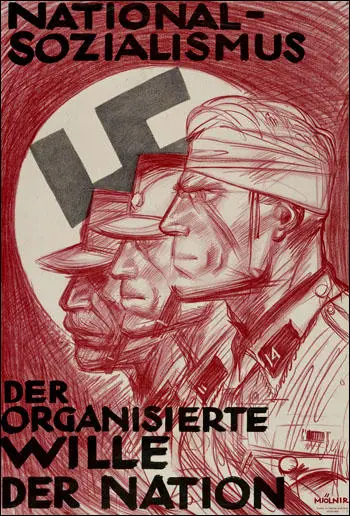
If Hitler had lost, his rival would have been in charge, also a right winger but an 'Establishment' right winger, not a 'Socialist' one. He would have been a much more competent dictator than Hitler was, so, as usual with history, be careful what you might have changed ...

en.wikipedia.org
He was the man behind the 'Black Armies', and more.
en.wikipedia.org
"[Reflecting this position as a "state within the state", the
Reichswehr created the
Ministeramt or Office of the Ministerial Affairs in 1928 under General
Kurt von Schleicher to
lobby politicians ostensibly for improved military budgets, but in fact the
Ministeramt was the vehicle for military interference with politics.
[19] German historian
Eberhard Kolb wrote that:
"...from the mid-1920s onwards the Army leaders had developed and propagated new social conceptions of a militarist kind, tending towards a fusion of the military and civilian sectors and ultimately a totalitarian military state (
Wehrstaat)".
[20]
In 1926, Seeckt was ousted by the so-called "modern" faction within the
Reichswehr as a group of more technocratic officers were known, which saw Seeckt as too conservative as he was less willing to see the sort of radical reorganization of German society that the "modern" faction wanted.
[20] What the German military wanted to see above all was the
Wiederwehrhaftmachung of Germany, namely the total militarization of German society in order to fight a
total war and thus ensure that Germany did not lose the next war.
[21] As such, what both the Nazis and the German Army wanted to see was Germany remade into a totally militarized
Volksgemeinschaft that would be ruthlessly purged of those considered to be internal enemies, such as the
Jews who were believed to have "stabbed" Germany in "the back" in 1918.
[22]
Many officers in the early 1930s started to express admiration for Nazism, which they saw as the best way of creating the much desired
Wehrstaat (military state).
[23] An important sign of the sympathy for Nazism within the military came in September–October 1930, with the trial in
Leipzig of three junior officers, Lieutenant
Richard Scheringer [
de], Hans Friedrich Wendt and
Hans Ludin. The three men were charged with membership in the
Nazi Party; at that time membership in political parties was forbidden for members of the
Reichswehr. The three officers openly admitted to Nazi Party membership and used it as their defence to claim that the Nazi Party membership should not be forbidden to
Reichswehr personnel. When the three officers were caught
red-handed distributing Nazi literature at their base, their commanding officer, General
Ludwig Beck (of the 5th
Artillery Regiment based in
Ulm), was furious at their arrest, and argued that since the Nazi Party was a force for good,
Reichswehr personnel should be allowed to join the Party.
[24] At the Leipzig trial of Ludin and Scheringer, Beck and other officers testified about the good character of the accused, described the Nazi Party as a positive force in German life, and proclaimed his belief that the
Reichswehr ban on Nazi Party membership should be rescinded. The trial in Leipzig caused a media sensation and Hitler himself testified at the trial about how much Nazi and
Reichswehr values were one and the same.
[25] After the trial, many
Reichswehr officers started to favour the NSDAP.
[26]
By 1931, Germany's reserves of experienced reservists were coming to an end, because Part V of the
Treaty of Versailles forbade
conscription and existing reservists were ageing.
[27] General Kurt von Schleicher worried that unless conscription was restored soon, German military power would be destroyed forever.[27] So, Schleicher and the rest of the Reichswehr leadership were determined that Germany must end Versailles, and in the meantime saw the SA and the other right-wing paramilitary groups as the best substitute for conscription. Schleicher and other Reichswehr generals made secret contacts with the SA leadership starting in 1931.[27] Like the rest of the Reichswehr leadership, Schleicher viewed democracy as a great impediment to military power, and firmly believed that only a dictatorship could make Germany a great military power again.[23] Thus Schleicher worked to replace the democracy with a dictatorship headed by himself. In this way, Schleicher played a key role in the downfall of the Weimar Republic and unintentionally helped to bring about Nazi Germany.[28]]"
Bold in last paragraph added by me. And, contrary to popular belief, Jews were not 'special' in being targeted for extermination, they just had the bad luck to be first in line; soon, all the Slavs would follow them into the ovens as soon as they were no longer useful to the war efforts, Russians included:
"[
Planning the war of extermination in the East
On August 22, 1939, in a conference between Hitler and all of the
Reich's senior military leaders, Hitler stated quite explicitly that the coming war against Poland was to be a "war of extermination" in which Hitler expressed his intention to "...to kill without pity or mercy all men, women and children of the Polish race or language".
[46] The British historian Sir
John Wheeler-Bennett wrote that whatever doubts the Wehrmacht might still have had about the sort of regime that they were about to go to war for and the kind of people that they would be fighting for in this war, should have been clearly dispelled by Hitler's genocidal comments during the conference of August 22, 1939, and that the claims made after the war that the Wehrmacht simply did not understand the nature of the regime that they fought for, are not believable.
[46] Anti-Semitic and anti-Polish attitudes like the views expressed above coloured all the instructions that came to Wehrmacht during the summer of 1939 as part of the preparations for the
invasion of Poland.
[45]
The war against the Soviet Union was presented as a war of extermination right from the start. On March 3, 1941, Hitler summoned the entire military leadership to hear a secret speech about the upcoming
Operation Barbarossa in which Hitler stressed that Barbarossa was to be a "war of extermination", that the German military was to disregard all the laws of war, and that he both expected and wanted to see the deaths of millions of people.
[47] With the exception of Admiral
Wilhelm Canaris, who protested that this was both morally and legally wrong, none of the officers who heard Hitler's speech voiced any objections.
[47]
Since some of the officers, such as General
Franz Halder, who had previously argued with Hitler about military matters remained silent after hearing this speech,
John Wheeler-Bennett presumes that they had no objections to the sort of war that Hitler intended to wage.
[48] In 1989, British historian
Richard J. Evans wrote that right from the beginning of the war against the Soviet Union on June 22, 1941, the Wehrmacht waged a genocidal war of "extreme brutality and barbarism".
[49] Evans wrote that Wehrmacht officers regarded the Russians as "subhuman"; were from the time of the invasion of Poland in 1939 telling their troops the war was caused by "Jewish vermin"; and explained to their troops that war with the Soviet Union was to wipe out the "Jewish Bolshevik subhumans", the "Mongol hordes", the "Asiatic flood" and the "red beast", language clearly intended to produce war crimes by reducing the enemy to something less than human.
[50] Such views helped to explain why 3,300,000 of the 5,700,000 Soviet POWs taken by the Germans died in captivity.
[51]
Criminal orders
On May 19, 1941, the OKW issued the "
Guidelines for the Conduct of the Troops in Russia", which began by declaring that "Judeo-Bolshevism" to be the most deadly enemy of the German nation and that "It is against this destructive ideology and its adherents that Germany is waging war".
[52] The "Guidelines" urged "ruthless and vigorous measures against Bolshevik inciters,
guerrillas, saboteurs, Jews and the complete elimination of all active and passive resistance".
[52] Reflecting the influence of the guidelines, in a directive sent out to the troops under his command, General
Erich Hoepner of the Panzer Group 4 proclaimed:
The war against Russia is an important chapter in the German nation's struggle for existence. It is the old battle of the Germanic against the Slavic people, of the defense of European culture against Muscovite-Asiatic inundation and of the repluse [sic] of Jewish Bolshevism. The objective of this battle must be the demolition of present-day Russia and must, therefore, be conducted with unprecedented severity. Every military action must be guided in planning and execution by an iron resolution to exterminate the enemy remorselessy [sic] and totally. In particular no adherents of the contemporary Russian Bolshevik system are to be spared.
[53]
Very typical of the German Army propaganda as part of the preparations for Barbarossa was the following passage from a pamphlet issued in June 1941:
Anyone who has ever looked into the face of a Red commissar knows what the Bolsheviks are. There is no need here for theoretical reflections. It would be an insult to animals if one were to call the features of these, largely Jewish, tormentors of people beasts. They are the embodiment of the infernal, of the personified insane hatred of everything that is noble in humanity. In the shape of these commissars we witness the revolt of the subhuman against noble blood. The masses whom they are driving to their deaths with every means of icy terror and lunatic incitement would have brought about an end of all meaningful life, had the incursion not been prevented at the last moment" [the last statement is a reference to the "preventive war" that Barbarossa was alleged to be].
[54]
As a result of the very intense anti-Semitic and anti-Slavic
propaganda before and during Barbarossa, most Army officers and soldiers tended to regard the war against the Soviet Union in Nazi terms, seeing their Soviet opponents as so much sub-human trash deserving to be destroyed without mercy.
[54] One German soldier wrote home on August 4, 1941, that:
Having encountered these Bolshevik hordes and having seen how they live has made a lasting impression on me. Everyone, even the last doubter knows today, that the battle against these sub-humans, who've been whipped into a frenzy by the Jews, was not only necessary but came in the nick of time. Our
Führer has saved Europe from certain chaos.
[54]
]"