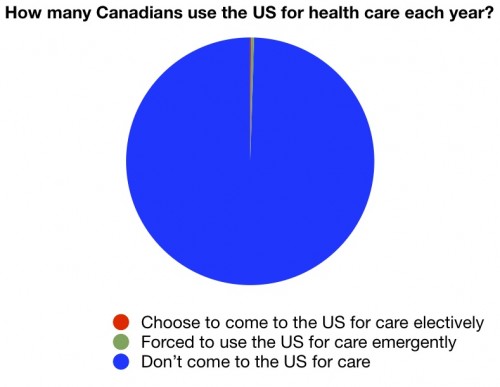
I read the entire piece. It is a fluff piece- It proves nothing and offers nothing with regards to any kind of real study. The headline itself is telling - Which "American Think tank"?
People come from all over the world to be treated in the US. We have some of the finest doctors and specialized medicine treatment bar none.
FLUFF personified...
Once again a liberal can't read well and so posts something they want to make it about.
I never said "large numbers of Canadians" come to the US for medical care. I stated that: People come from all over the world come here to be treated in the US. We have some of the finest doctors and specialized medicine treatment bar none"
The fact that Canadians don't mind long wait times is not a new piece of information- but for the wealthier Canadians who want specialty care...guess where they come. Mediocre medicine for the poor and middle class has become normalized. HMO's have contributed to that same kind of sub standard care as being acceptable and normal here. Obamacare merely put the government in charge of saying live with it and oh yeah subsidize.
I believe that creating a free market solution is possible. The number of solutions offered by conservatives, such as portability; co-ops; and cafeteria plans, in combination with the following article's idea, would go a long way in making good health care more affordable and accessible.
John C. Goodman: Why Mandated Health Insurance Is Unfair - WSJ.com
Yes, 'some' people come to America for health care. 'Some' people travel to Russia for caviar, BUT, wouldn't it make sense that the highest number would come from a country that is on our entire northern border? It ain't happening because, just like every single argument that comes from right wing parrots, it's BULLSHIT.
MORE Americans go to other countries for health care.
A McKinsey and Co. report from 2008 found that a plurality of an estimated 60,000 to 85,000 medical tourists were traveling to the United States for the purpose of receiving in-patient medical care; the same McKinsey study estimated that 750,000 American medical tourists traveled from the United States to other countries in 2007 (up from 500,000 in 2006)
wiki
Nearly
1 million Californians seek medical care in Mexico annually.
Traveling for Care -- Outside the U.S.
America's health care is at the bottom of all industrialized countries.
A recent study reported in the Journal of the Royal Society of Medicine compared the amounts of money spent by nineteen Western countries on health care relative to their respective gross domestic product (GDP). The authors, Professor Colin Pritchard of the Bournemouth University School of Health and Social Care, and Dr. Mark Wallace of the Latymer School of London, ranked countries by the average percentage of GDP spent on health care between 1979 and 2005. They then looked at mortality rates for all adults (15-74 years old) and for just the older population (55-74) to determine a cost-effective ratio, i.e., how much bang for the buck each country has been getting for the money spent. The conclusions are striking.
Increasing Health Care Costs
It will come as no surprise that health care costs have gone up everywhere. In 1980, Sweden spent nine percent of its GDP on health care. The USA came in second at 8.8%. Most countries averaged about 7.1% of GDP. In 2005, the picture had changed. The United States was far in front of all other countries, spending an average of 12.2% of its GDP for all public and private health care costs. Germany was a somewhat distant second at 9.7%, with the average for all countries standing at 7.4%. In other words, while average health care expenditures increased from 7% to 7.4%, Americas costs jumped from 8.8% to 12.2% of GDP over the same span of time.
Mortality Rates
The study then looked at trends in mortality rates for both the entire adult population (15-74) and for older people (55-74). Deaths per million population were looked at, and the authors found that mortality rates had declined in segments of this population in every country, an indication that medical science has indeed improved over the past few decades.
Utilizing standard statistical tools and analysis, the authors then ranked the same 19 countries according to their effectiveness in reducing the mortality rate for the elderly populace ages 55 to 74. Comparing the amount of money spent by each country on health care and the reduced mortality rates, the countries fell into the following ranking:
1 Ireland
2 United Kingdom
3 New Zealand
4 Austria
5 Australia
6 Italy
7 Finland
8 Japan
9 Spain
10 Sweden
11 Canada
12 Netherlands
13 France
14 Norway
15 Greece
16 Germany
17 USA
18 Portugal
19 Switzerland
Conclusions
Take a look. America outspends everyone else by far on health care, and has shown the least amount of improvement on mortality rates, with the exception of Portugal and Switzerland. Why does the United States do such a poor job?
The authors give several potential reasons, including regional disparities in health care availability in a country as large as the US, the much higher rate of firearms-related homicides here, and the higher number of un-insureds we have. The study is, however, consistent with other reports that show the USA is doing a poor job of health care for its citizens. A recent UNICEF report looked at well-being of children among major industrialized countries (e.g. material wealth, family relationships, health care), and found the United States ranking 23rd of 24 countries reviewed.
Universal vs. Private Health Insurance
There is one factor common to the top 15 countries on the above list. They all have strong state funding of single-payer universal health care, instead of insurance based health care tied to employment. The bottom four countries Germany, USA, Portugal and Switzerland all depend more heavily on profit-based, private health insurance provided primarily through the employer/employee relationship.
I never gave anybody hell. I just told the truth and they thought it was hell.
Harry S. Truman