So , assume they import machinery to increase production , that doesn't create a larger market.
Because furriners never buy US output with their dollars.
And increased production never leads to lower prices.
Assume they buy back their own stock, same thing.
They bought back my shares, now I have more money to buy goods and services.
why do I get the idea that you work in the financial sector ?
Is it because in moments I can point out your idiocy?
So , assume they import machinery to increase production , that doesn't create a larger market.
Because furriners never buy US output with their dollars.
And increased production never leads to lower prices.
Good grief! Yes they do , but as I said that would only be relevant IF the US trade balance was possitive, which is not.
And yes , sometimes you get lower prices, and sometimes you get higher prices in spite of higher efficiency because commodities increase their prices ( e.g. oil).
Assume they buy back their own stock, same thing.
They bought back my shares, now I have more money to buy goods and services.
Ah... but the devil is in the details isn't it?
How would you spend it ? Treasury bonds ? Insurance ? Foreign currency? Imported goods? Stock from another company?
A house in another country? Another bubling asset?
Not all of the options will create domestic jobs.
Is it because in moments I can point out your idiocy?
Nah, it's probably because you seem to think that macro is applied micro.
Good grief! Yes they do , but as I said that would only be relevant IF the US trade balance was possitive, which is not.
If we import $3, the fact that foreigners buy $2 of our exports is irrelevant?
Ah... but the devil is in the details isn't it?
Yes. The detail where you thought the corporation stuck its extra profit up its ass.
If we import $3, the fact that foreigners buy $2 of our exports is irrelevant?
No, what I meant is that IF productivity increases AND you have a negative trade balance ( which is the case of the US ) and the ratio of wages / GDP decreases (the US case), it is irrelevant that you increase your productivity, because:
a) Your local market is shrinking
b) Your increase in productivity is only increasing private debt and probably producing more goods than the market can take.
Yes. The detail where you thought the corporation stuck its extra profit up its ass.
Again , your words, not mine. What I said is that whatever they have done to their money has not translated, during the last 25 years or so in a growth in the internal market.
What I said is that whatever they have done to their money has not translated, during the last 25 years or so in a growth in the internal market.
You'll have to show me your proof of "no growth in the internal market".
So , assume they import machinery to increase production , that doesn't create a larger market.
Because furriners never buy US output with their dollars.
And increased production never leads to lower prices.
Assume they buy back their own stock, same thing.
They bought back my shares, now I have more money to buy goods and services.
why do I get the idea that you work in the financial sector ?
Is it because in moments I can point out your idiocy?
So , assume they import machinery to increase production , that doesn't create a larger market.
Because furriners never buy US output with their dollars.
And increased production never leads to lower prices.
Good grief! Yes they do , but as I said that would only be relevant IF the US trade balance was possitive, which is not.
And yes , sometimes you get lower prices, and sometimes you get higher prices in spite of higher efficiency because commodities increase their prices ( e.g. oil).
Assume they buy back their own stock, same thing.
They bought back my shares, now I have more money to buy goods and services.
Ah... but the devil is in the details isn't it?
How would you spend it ? Treasury bonds ? Insurance ? Foreign currency? Imported goods? Stock from another company?
A house in another country? Another bubling asset?
Not all of the options will create domestic jobs.
Is it because in moments I can point out your idiocy?
Nah, it's probably because you seem to think that macro is applied micro.
Good grief! Yes they do , but as I said that would only be relevant IF the US trade balance was possitive, which is not.
If we import $3, the fact that foreigners buy $2 of our exports is irrelevant?
Ah... but the devil is in the details isn't it?
Yes. The detail where you thought the corporation stuck its extra profit up its ass.
If we import $3, the fact that foreigners buy $2 of our exports is irrelevant?
No, what I meant is that IF productivity increases AND you have a negative trade balance ( which is the case of the US ) and the ratio of wages / GDP decreases (the US case), it is irrelevant that you increase your productivity, because:
a) Your local market is shrinking
b) Your increase in productivity is only increasing private debt and probably producing more goods than the market can take.
Yes. The detail where you thought the corporation stuck its extra profit up its ass.
Again , your words, not mine. What I said is that whatever they have done to their money has not translated, during the last 25 years or so in a growth in the internal market.
What I said is that whatever they have done to their money has not translated, during the last 25 years or so in a growth in the internal market.
You'll have to show me your proof of "no growth in the internal market".
Again ?
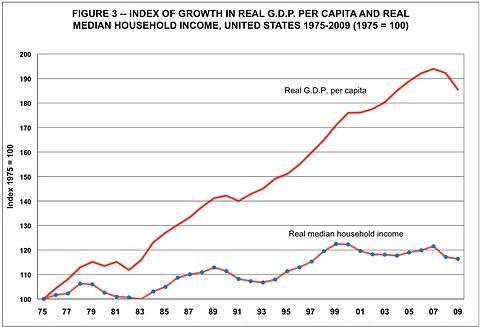
To be precise, the internal market has grown but only because population has increased and household debt is at an all time high.
Regardless, the purchasing power of consumers has not gone up, a higher percent of their income goes to service debt and a lower percent to purchase goods and services.
I'm not entirely sure how true that claim is. Certainly to some extent, people have borrowed money to achieve a life style at age 30, that their parents only acquired at age 50. As a result of spreading the belief that debt is good, and that everything is fine as long as you can make the payments, instead of remaining on Judeo-Christian values that being debt was bad, yes you are correct that more money is going to debt service.
However, your graph is inherently inaccurate. The issue comes from the use of household income.
In the 1940s, barely 8% of the population lived in alone. Today almost 30% of the population lives alone.
Moreover, many parents pay for their college age sons and daughters to live in their own apartments and places. For the purposes of 'household income', whatever income they earned at home, would be added to the family income. However the moment they moved out for college, even while living on the money of their parents, their income from the part time, or summer job, would be considered a separate income.
So a father making $60,000 a year, with a daughter that earns $15,000 a McJob, would be read as a single household with a $75,000 income.
But once the daughter moved out, you would have two separate households, one at $60,000, and another at $15,000. Both lowering the statistical average dramatically.
Additionally, with people moving away from Judeo-Christian values, of staying together for life, divorce dramatically increased in the 1970s. Once again, this broke up families turning one household with a high income, into two households with much lower incomes.
IF the man is making $60K, and the women $40K, you have one household making $100,000 a year. Divorce changes that into two households, making $40K and $60K.
So any statistical graph based on household income, is inherently flawed and completely useless to determine any economic effect. Wage could be increasing across the entire spectrum of income ranges, but with divorce and higher levels of single people, the "household income" numbers won't show it.
In fact, in an odd irony, the high number of people living alone, in and of itself, suggests that income levels have gone up. In times gone past, trying to live alone would be more economically difficult.



.png)


