GDP = C+I+G + NX ("macro-economic formulation")
GDP = C + S + T ("micro-economic 'house-holds' formulation")
Do you have a reference for that?
Twin deficits hypothesis - Wikipedia, the free encyclopedia
Yes, nice find. "house-holds formulation" seems like a reasonable term for it. "micro-economic" does not seem reasonable. "micro-economic" is a study of specific markets. "macro-economics" is a study of the aggregate performance of the economy, including the aggregate performance of the markets. One way of looking it is like this;
The EOE, MV=PQ is an aggregate of all markets. Within that are individual markets
GDP = PQ_Oil + PQ_Television + PQ_HealthInsurance + PQ_other_markets.
Micro-economics studies, among other things, the performance of the individual markets like PQ_Oil. PQ is the equilibrium point of the supply and demand simultanious equations. Within that PQ_Oil is BP, Chevron, Texaco, Arco, Exxon, etc. They provide substitutes.
GDP = C + S + T is still an aggregate function, making it a macro-economic formulation.
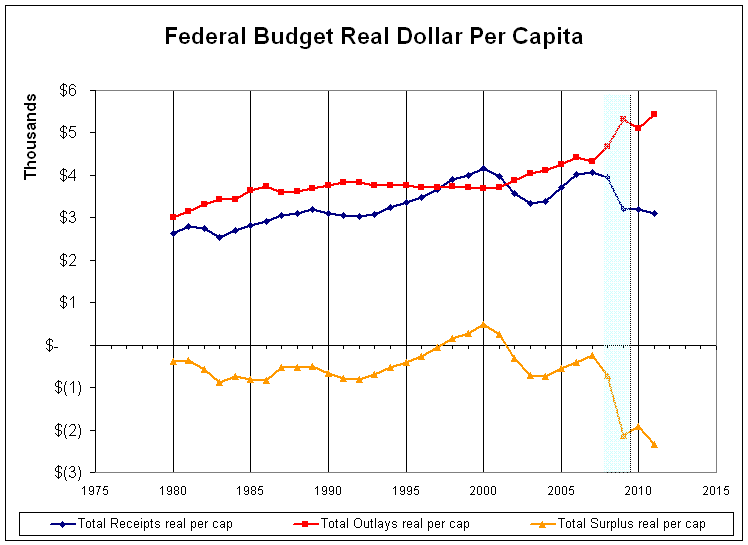
is the G in C+I+G + NX the same as Government outlays?
according to Wikipedia, so that (T-G) = Government budget (revenues - expenditures).
Confirmed.
the "micro" formulation confuses me, if "T" is total Taxes paid by HHs, then what about non-personal Taxes, e.g. business Taxes ?? If you account "T" only from private HHs; then use that "T" in "T-G"; then you have not accounted for corporate Tax flows. Perhaps "corporations" must be accounted, as "individual persons", as indeed they legally are ?? If so, would "corporate Consumption" include capital "Investments" ?? (i hope there are books you can buy that are better than Wikipedia)
You have to do the flow diagrams. The flow is a closed system, closed loop with no sources or sinks. A surface can be placed such that it cuts through the flow at any location. Properly constructed, the sum of all the flows through that surface are GDP. Making flow diagrams, repeatedly, is a necessary exercise. I expect I will be doing one again. Different flow diagrams, with the elements significantly different, remain equivalent as long as they are constructed within the context of the identical closed system, closed loop with no sources or sinks. As such, any surface that cuts through the flow at any location are identical between each flow diagram.
The diagram must differentiate between businesses that supply end use products and businesses that supply intermediate product. On the supply output side of GDP, only end use products are accounted for in the CGIMX version. The CGIMX is an accounting for all the flow through the surface of which domestic output is on one side and consumption is on the other side. This is confligrated by the fact that imports are commingled with domestic output at the point of consumption. Essentially, between domestic output and consumption is C+G+I+X, foreign consumers being simply another consumer. As such, the surface is extended to capture imports and subtract them out.
On the other side of the supply, all GDP is also income for households. I haven't done this one yet, but I suspect it may be easier as a separate diagram, organized a bit differently. On the expense side of households, all that income is expended as C + T + S.
I absolutely get the question of how C has to have imports removed from one version while not in the other. Without going through the elements and construction of the flow diagrams, it isn't clear to me. Still, I am 100% confident that, when I finally do, it will become obvious.
Indeed, as you pointed to it, I realized that the C + T + S version is simpler and less confounded. The CGIMX version is forced by available accounting books to put it together.
hope there are books you can buy that are better than Wikipedia.
Yes, Wikipedia can suffer from a) being to much of just an overview and b) written by experts at a level only a couple of steps below their expertise. It is an Encyclopedia and is therefor just a summary.
A current college text is the absolute best. You might consider finding the appropriate class listing for macro econ at a state university and ordering that book. Get one that suits your math skills. Advanced state university and all manner of private universities like MIT will use calculus. Intermediate state colleges will use algebra. Algebra is, for most people, easier to read. It is difficult to teach oneself. We don't know what level we are at and how the concepts build. I have often found myself overwhelmed in having picked up a text that was too advanced, lacking the fundamentals and lacking a vision of what was really important.
I added the link, in my signature, to a college text written by an MIT professor of economics. Fundamental texts do not address every question, that may arise, specifically. They do provide a comprehensive set of fundamental tools with which to construct an answer. And, care must be made to ensure that 1) understanding is correctly applied and 2) that the principle isn't over extended.
It all comes down to getting enough clues from the fundamentals to be able to then construct personal models. It is also useful to study physics to get an understanding of how physical models have been realized. Getting a model, whether it be one's mental picture, a schematic, or a mathematical model that is comprehensive, closed, and solidly connected to the natural world is a skill.
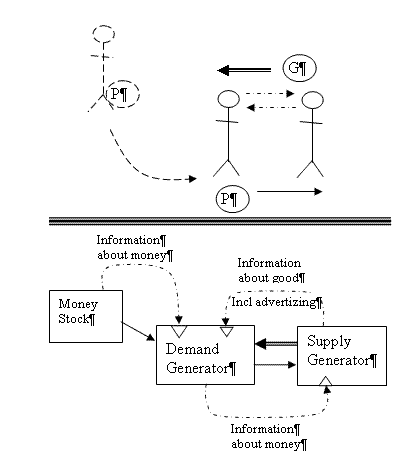
Here is an exchange model
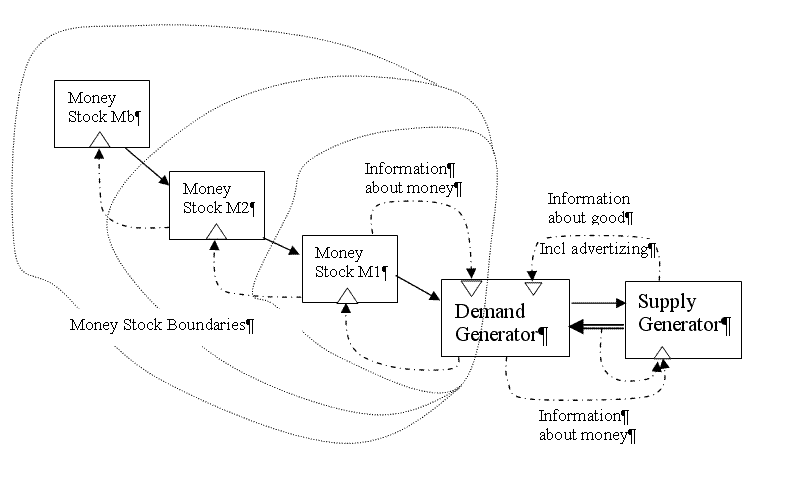
Here is the exchange model expanded to capture the changing nature of the MV=PQ model. MV=PQ can refer to M_base*V_base, M1*Vm1, M2*Vm2. The expanding boundaries to demonstrates that, regardless, nothing else changes in the consideration except the M and V definition. I left out a couple of the information paths, like Mb to M2. It may not be detailed enough, but it is along the right lines. The trick is to get exactly who talks to whom about what such that the funds are triggered to move.
Some where, I have some flow diagrams for that view of GDP = MV = PQ and GDP = C + G + I + X - M. I still need a GDP = S + T + C.
It is absolutely essential to get the connection to the physical reality perfect because one mis-step throws everything off.
Considerations must include the well defined diagram and schematic, the mathematical model, the actual normalized data in a visual format before the story can be applied.
I have seen every manner of mis-step, especially in attempting to use the "logical" structure of language to construct an manipulate a model. The fact is that the structure of language has insufficient constraints and every manner of insane conclusions can be reached in doing so.
We are of two minds, one being objective and one being subjective. Ideas are the combination of an object and feeling. Connectivity between objects based on feeling is subjective, not objective, and leads to irrational conclusions. The only rational conclusions come out of constraining the reasoning along objective lines. Even manipulation of mathematics can do the same, though less often.
The term "opportunistic" is primarily a subjective and emotional term. All economic behavior is opportunistic. There is an opportunity to gain utility from a set of circumstances. As typically used, "opportunistic" is used to tag a particular economic behavior as "bad". There is no "bad" in positive economics. There can be "bad" in normative but it depends on a world view foundation.
The only way to get a sound understanding is to utilize all of our tools and ensuring that they are all constant in the final conclusion.
(as an earth ape, 99% as dumb as chimpanzees, and 95% as dumb as gorillas, i need "simple"; the "micro" HH formulation, of the Income/Expenditure equation, seems to sum, over all "Tax-paying persons"; if "corporations" are not truly "persons", then (logically) they should neither vote, nor pay Taxes; that Taxes target businesses smacks more of "opportunism for OPM" than any logically sound economic or political principle; i may now be opposed, according to "political principles" [which i won't really understand]; "follow the money, man, and make more of it" [and "knowing [what economics equations imply] is [the first] half of the battle"])
There is no "any logically sound economic or political principle" that can lead to "that Taxes target businesses smacks more of "opportunism for OPM" because there it isn't a logic issue. Economics is simply a description of how the economy functions and the fundamental philosophical principle is that it works or it doesn't. Political principles are simply that voters get pissed off or don't get pissed off and what policies can be put in place that function economically without pissing off the majority of the voters. And the difference is typically based on one's world view.
I stick with positive economics because it is the foundation of what is called normative economics. Without an understanding of the positive economics, there is no normative economics. Without normative economics, politics simply degrades to what doesn't piss of the voter regardless what is economically sound.
The structure of taxes is really based on what pisses off the voter and what jurisdiction the government entity has. Sometimes it is adjusted for it's effect on economic behavior or performance. From a closed loop general macro economic stand point, it really doesn't matter where the flow is tapped to get the sufficient revenues to fund the common government endeavors. It becomes, rather, an issue of balance between the markets as the value of the dollar is relative between goods and between markets. The specific effect that taxes have is a micro economic issue. Businesses do, in general, use and gain utility from government commons. Roadways facilitate commerce, the military stabilizes business interests overseas. And, while corporations may not seem to be logically individuals, they are comprised of individuals and represent individuals. Shifting taxes from corporate revenues to individual income simply shifts where the flow is tapped thus shifting the determination of wages.
Consider the sales tax. The sales tax is, in principle, a tax paid by the seller. Yet, it is calculated and presented as if it is a tax paid by the purchaser. Logically, it doesn't matter where it is tapped in the flow of funds in the exchange. Interestingly, a comparison of the calculations of the sales tax, between applying it on the price at the point of sale or applying it to the revenue after all the sales are done becomes a matter of a few pennies per product. While it is a tax to the seller and presented as if it is paid by the buyer, in the math of it, presenting it as if it is paid by the buyer saves a couple of pennies. From a macro standpoint, it doesn't matter if the tax is 10% calculated one way or 11% calculated another, the net revenue is the same. And the difference it makes, that the purchaser is aware that the tax is in there has very little meaning. The only thing that may have an economic affect is that taxes do not apply to food. That affects the relative balance between food and other products.