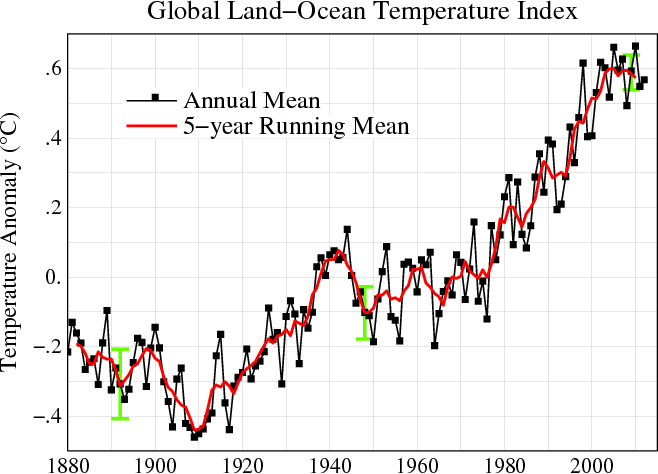
You are conflating two. Problems. Bad siting and a meat grinder set of adjustments that spit out warming trends regardless of the input.. Both are important and relevant
They were problems back in the 1970s, definitely.
But these days there are enough measuring stations and science units accessing the data from them that we are able to discount any compromised stations or research units and go with the others.
I've met the people here in Finland who work in this field and have been ery impressed by their credentials and lack of interest in politics!
I haven't seen compelling evidence to suggest warming has
not been occuring steadily for the past 150 years , have you?
Weather Stations Disappearing Worldwide | Watts Up With That?
Amazing as this sounds, weather stations used to monitor near surface temperature for the global climate record are disappearing worldwide at and alarming rate. There are two things going on here: 1) Stations are actually being closed down, particularly in Canada and in Russia in the early 1990′s. 2) Some stations while open, have disappeared off the reporting radar for global temperature metrics such as GISS.
--
In response to that, Steve McIntyre recently found that a number of stations that went missing from the NASA GISTEMP dataset are still actually in operation, and producing data, are not being updated into the GISTEMP dataset for some reason. Irregardless of the reason, the problem of dwindling data for the ROW as demonstrated by the video above is real.
What is strange though is that some obviously easy to locate data, (link to data) such as Bern, Switzerland, where the headquarters of the World Meteorological Organization (WMO) are located, are missing from NASA GISTEMP. Nearby stations such as Zurich, Switzerland are included in the GISTEMP database.
Other stations, such as Crater Lake, OR, are removed from the GISS source code released last year, with a citation saying they are excluded (but exist online in GISTEMP), but no reason is given. yet other stations like this terrible rooftop station cum heat anomaly (and closed by NWS for that reason) in Baltimore, MD are included.
The number of stations has decreased:
Historical Station Distribution « Climate Audit
And the data from the remaining stations is cherry-picked:
Climategate goes SERIAL: now the Russians confirm that UK climate scientists manipulated data to exaggerate global warming – Telegraph Blogs
Climategate has already affected Russia. On Tuesday, the Moscow-based Institute of Economic Analysis (IEA) issued a report claiming that the Hadley Center for Climate Change based at the headquarters of the British Meteorological Office in Exeter (Devon, England) had probably tampered with Russian-climate data.
The IEA believes that Russian meteorological-station data did not substantiate the anthropogenic global-warming theory. Analysts say Russian meteorological stations cover most of the country's territory, and that the Hadley Center had used data submitted by only 25% of such stations in its reports. Over 40% of Russian territory was not included in global-temperature calculations for some other reasons, rather than the lack of meteorological stations and observations.
The data of stations located in areas not listed in the Hadley Climate Research Unit Temperature UK (HadCRUT) survey often does not show any substantial warming in the late 20th century and the early 21st century.
The HadCRUT database includes specific stations providing incomplete data and highlighting the global-warming process, rather than stations facilitating uninterrupted observations.
On the whole, climatologists use the incomplete findings of meteorological stations far more often than those providing complete observations.
IEA analysts say climatologists use the data of stations located in large populated centers that are influenced by the urban-warming effect more frequently than the correct data of remote stations.
NASA and NOAA cherry-picking Canadian weather stations (but it could have been much worse!)
Perhaps the key point discovered by Smith was that by 1990, NOAA had deleted from its datasets all but 1,500 of the 6,000 thermometers in service around the globe.
These are the same datasets, incidentally, which serve as primary sources of temperature data not only for climate researchers and universities worldwide, but also for the many international agencies using the data to create analytical temperature anomaly maps and charts.
It seems that stations placed in historically cooler, rural areas of higher latitude and elevation were scrapped from the data series in favor of more urban locales at lower latitudes and elevations. Consequently, post-1990 readings have been biased to the warm side not only by selective geographic location, but also by the anthropogenic heating influence of a phenomenon known as the Urban Heat Island Effect (UHI).
For example, Canada's reporting stations dropped from 496 in 1989 to 44 in 1991, with the percentage of stations at lower elevations tripling while the numbers of those at higher elevations dropped to one. That's right: As Smith wrote in his blog, they left "one thermometer for everything north of LAT 65." And that one resides in a place called Eureka, which has been described as "The Garden Spot of the Arctic" due to its unusually moderate summers.
--
Not just Canadian data, but data sets everywhere were torqued so that cold data simply melted away, or so say these researchers.
For instance, Hawaiian data (taken on hot airport tarmacs, of course) was used as stand-in data for cooler ocean waters 1200km away.
You ask skeptics to provide science? We don't have to. It's up to AGW supporters to provide good science to back up their claims.
They've provided science -- but not good science.