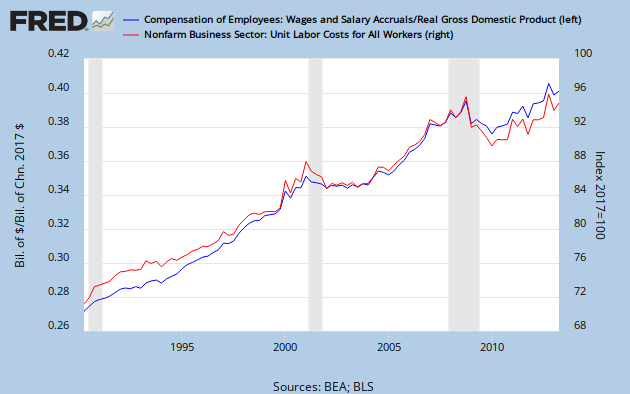
Prices are increasing not to offset the cost of wages, but the cost of doing business overall. Not only are do they include the wages paid to employees (direct cost) but it also involves many indirect cost. Wages have generally outpaced unit labour cost as a measure of overall productivity.
Generally, high paying jobs have lower labour unit cost because they employ workers who are very skilled who can also ensure that output is high and good wages can be afforded. This is a classic example of Henry Ford's 'Five Dollar a Day' strategy at his first factory in Dearborn, Michigan. Despite the fact that this higher wage was accompanied by an hour decrease, the higher wages was ensured to be accompanied by lower unit labour cost. Wages are becoming a larger component of overall labour cost, but still not the largest compared to all other indirect cost.
As far as profits are concerned, there are no realised profits. Majority of corporations are experiencing all time record profits, but it's on paper. Alot of corporations today operate their business on razor thin margins. But it's quite clear, if you want to pass on the profits to your employees, you have to lower labour cost.
Contrary to what you may believe, a business does not owe you a living.