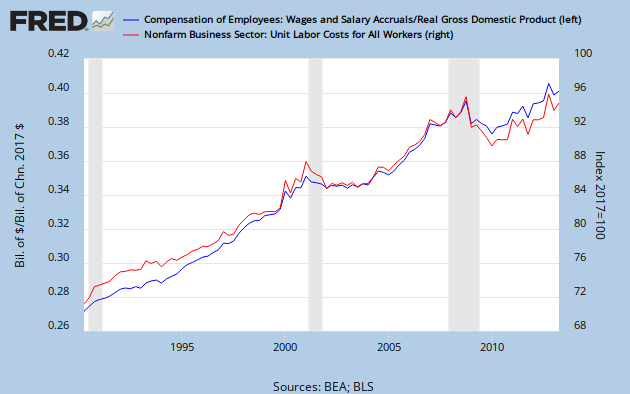
One additional point, to those who believe that real wages have not kept up with productivity. That might be half-true. Generally productivity is measured in total hours worked, as well as GDP per hours worked In terms of both, the US is either the most productivity in the world. There may be a few inconsistencies:
- The United States works far more hours most countries, but has just as much output as countries such as France, Germany, Ireland, and Norway.
- The United States is the largest economy in the world, and yet, it barely overshadows smaller economies in terms of productivity. In an economy, there are very different types of labor in a production process, each one different from the other. There for, it doesn't make much sense to divide something by an aggregate of heterogeneous units
Hence, productivity should be taken with a grain of salt, as with most economic data computed with a broad scope (GDP, CPI, etc). The United States may be more efficient and more productive, but what exactly do Americans spend more of their productive time doing, and why are they so efficient at it, despite the fact that wages are stagnant?
Well, most people do believe wages has lagged behind productivity, so:
Seeing that Americans are more efficient at taking my orders at AppleBees, we can see that the wages don't often warrant the productivity. Majority of the jobs which did warrant the productivity are being replaced with low-skilled, low-wage service sector jobs.
Although the decline in manufacturing is on a global scale (and excepted as countries industrialise more), the US is among the few who barely can keep it's manufacturing output as a percentage of GDP above the global average.
Is a decline in manufacturing actually a good thing? Don't know, don't care. That is all a matter of personal opinion, although it's not like Americans really couldn't use these jobs right about now. These countries with a stable manufacturing base (along with a stable manufacturing output) have a couple of things in common, but I'll just focus on one: An increase in real wages.
Germany (Too lazy to make own graphs):
Japan:
Australia:
And this pesky little bugger is the United States. Real Wages hasn't increased past pre-recession levels, but have still grown. So the idea that real wages have remained stagnant again is generally false.
So Americans are more productive, but their increased productivity doesn't warrant the wages Americans desire. If Americans want higher wages, they need to find ways to increase their human capital.