He won't only because he can't.
The only reason trump is not the threat he wants to be is because of our consritution.
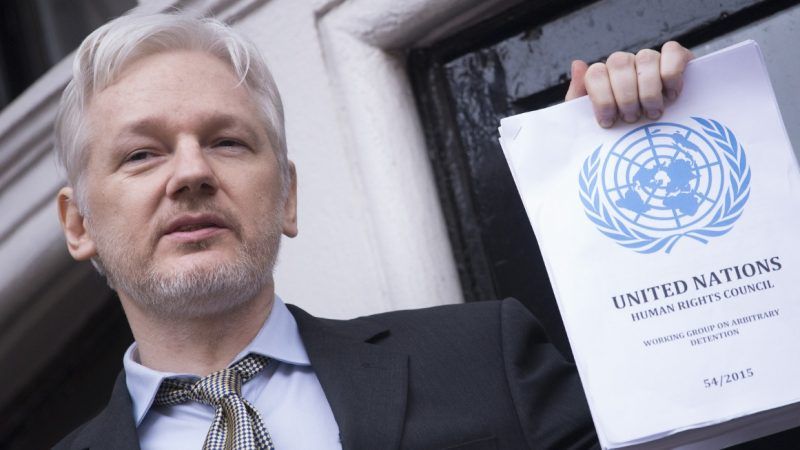
The Constitution is not stopping him from abridging the freedom of the press as it relates to Julian Assange.
Yes, they aren't perfect. That's a good lesson to remember.
Trump is using the Espionage Act to silence the free press. Are the consequences of that lesson lost on you?
No...I literally just said our institutions are not perfect, and we should remember that. I cant put it much more simply.
I'm confused. Where is the outrage from the "left"?
When Trump was calling the press names they were all beside themselves. Now that the threat has become real.....crickets. This does not bode well. It is very disconcerting.
Are you really puzzled?
THE PRESS BLAMES HIM FOR HILLARY’S LOSS:
Theory of Revised Julian Assange Indictment Could Apply to Ordinary Reporters.
Under the government's theory in some of the charges, any reporter who knowingly prints certain kinds of government secrets could equally be prosecuted.
Count 18, which was the one charge in the
initial indictment, alleges that Assange tried to help then-Bradley Manning crack a computer password; had the crack succeeded, the leaker would have been harder to identify.
Journalists and other speakers don't have the right to help others break into offices, safes, or computers, even when the break-in would help reveal important information.Very few reporters provide sources with lock picks or instructions on breaking into safes.
Most of the other counts focus on Assange's urging Manning to illegally leak information.
Manning did commit a crime by leaking the information in violation of the duty that Manning had voluntarily assumed when going to work handling confidential government data.
The Jury will tell us if Assange himself commited a crime by soliciting Manning's crime.
Soliciting a specific crime—urging a particular person to kill another particular person, or to steal certain kinds of material, or to illegally leak certain kinds of information—is itself criminal, and unprotected by the First Amendment. "Offers to engage in illegal transactions are categorically excluded from First Amendment protection," and that applies to solicitation of such illegal transactions as well (
U.S. v. Williams (2008).
Specifically asking a specific person for specific documents is not protected by the First Amendment, and parts of the indictment suggest that this is what Assange was doing:
After confirming that ASSANGE thought they had value, on March 8, 2010, Manning told ASSANGE that she was "throwing everything [she had] on JTF GTMO [Joint Task Force, Guantanamo] at [Assange] now." ASSANGE responded, "ok, great!" When Manning brought up the "osc," meaning the CIA Open Source Center, ASSANGE replied, "that's something we want to mine entirely, btw," which was consistent with WikiLeaks's list of "Most Wanted Leaks," described in paragraphs 4-5, that solicited "the complete CIA Open Source Center analytical database," an unclassified (but nonpublic) database.
To further encourage the disclosure of protected information, including classified information, the WikiLeaks website posted a detailed list of "The Most Wanted Leaks of 2009," organized by country, and stated that documents or materials nominated to the list must "e likely to have political, diplomatic, ethical or historical impact on release… and be plausibly obtainable to a well-motivated insider or outsider."
As of November 2009, WikiLeaks's "Most Wanted Leaks" for the United States included the following:
a. "Bulk Databases," including an encyclopedia used by the United States intelligence community, called "Intellipedia;" the unclassified, but non-public, CIA Open Source Center database; and
b. "Military and Intelligence" documents, including documents that the list described as classified up to the SECRET level, for example, "Iraq and Afghanistan Rules of Engagement 2007-2009 (SECRET);" operating and interrogation procedures at Guantanamo Bay, Cuba; documents relating to Guantanamo detainees; CIA detainee interrogation videos; and information about certain weapons systems.
Calls to leak specific documents would still be covered by the solicitation exception, rather than being mere abstract advocacy—just as calls to kill particular people or bomb particular buildings would be punishable solicitation, even if general abstract advocacy of revolutionary violence isn't.
Many a reporter has urged a source to leak particular documents, whether they are national defense secrets, trade secrets, confidential documents that are covered under some private nondisclosure agreement, or something like that, solicitation of crime. Perhaps reporters shouldn't urge such illegal behavior.
From in or about July 2010 …, [Assange], having unauthorized possession of, access to, and control over documents relating to the national defense [such as leaked Afghanistan and Iraq war activity reports and State Department cables], willfully and unlawfully caused and attempted to cause such materials to be communicated, delivered, and transmitted to persons not entitled to receive them.
Assange published (in violation of
18 U.S.C. § 793(e)) material that he knew was improperly leaked and was related to the national defense
within the meaning of the statute. To convict on these counts, a jury wouldn't have to find any complicity by Assange in the initial leak.
Third parties are generally free to publish material that they know was illegally
gathered (e.g; an illegal interception of a cell phone call), so long as the publishers weren't themselves involved in the illegal gathering.
A Jury could easily find that this doesn't apply to illegal leaks of national defense information. (The
Pentagon Papers case (1971) didn't resolve the issue, because it just overturned injunctions against publishing leaked information; a majority of the Justices left open the door to possible criminal prosecutions for such publication.)
In
U.S. v. Rosen (E.D. Va. 2006), the district court rejected a First Amendment challenge to the prosecution of two American Israel Public Affairs Committee (AIPAC) employees, who received illegally leaked information and then forwarded it to various journalists:
[D]efendants here contend that the First Amendment bars Congress from punishing those persons, like defendants, without a special relationship to the government for the disclosure of [national defense information]. In essence, their position is that once a government secret has been leaked to the general public and the first line of defense thereby breached, the government has no recourse but to sit back and watch as the threat to the national security caused by the first disclosure multiplies with every subsequent disclosure.
This position cannot be sustained. Although the question whether the government's interest in preserving its national defense secrets is sufficient to trump the First Amendment rights of those not in a position of trust with the government is a more difficult question, and although the authority addressing this issue is sparse, both common sense and the relevant precedent point persuasively to the conclusion that the government can punish those outside of the government for the unauthorized receipt and deliberate retransmission of information relating to the national defense.
Near v. Minnesota (1931) "No one would question that a government might prevent actual obstruction to its recruiting service or the publication of the sailing dates of transports or the number and location of troops," and note that the government argues that the publications jeopardized specific people identified in some of the documents as having helped America and its allies—but consider also the value of allowing news outlets to act as a check on government conduct, which is especially important precisely when it comes to matters of war and peace.)
Theory of Revised Julian Assange Indictment Could Apply to Ordinary Reporters
It looks to me like Assange has some exposure to conviction.