Rat in the Hat
Gold Member
- Mar 31, 2010
- 21,949
- 6,023
- 198
Chuck Norris puts the "laughter" in "slaughter".
[ame=http://www.youtube.com/watch?v=ZrHmcpRAZNs]Hitler Finds out Chuck Norris is Coming - [Episode Four] - YouTube[/ame]

Follow along with the video below to see how to install our site as a web app on your home screen.
Note: This feature may not be available in some browsers.

PressTV - New studies: ?Conspiracy theorists? sane; government dupes crazy, hostile
Recent studies by psychologists and social scientists in the US and UK suggest that contrary to mainstream media stereotypes, those labeled conspiracy theorists appear to be saner than those who accept the official versions of contested events.
Quote:
Jul 12, 2013
The most recent study was published on July 8th by psychologists Michael J. Wood and Karen M. Douglas of the University of Kent (UK). Entitled What about Building 7? A social psychological study of online discussion of 9/11 conspiracy theories, the study compared conspiracist (pro-conspiracy theory) and conventionalist (anti-conspiracy) comments at news websites.
The authors were surprised to discover that it is now more conventional to leave so-called conspiracist comments than conventionalist ones: Of the 2174 comments collected, 1459 were coded as conspiracist and 715 as conventionalist. In other words, among people who comment on news articles, those who disbelieve government accounts of such events as 9/11 and the JFK assassination outnumber believers by more than two to one. That means it is the pro-conspiracy commenters who are expressing what is now the conventional wisdom, while the anti-conspiracy commenters are becoming a small, beleaguered minority.
Perhaps because their supposedly mainstream views no longer represent the majority, the anti-conspiracy commenters often displayed anger and hostility: The research showed that people who favoured the official account of 9/11 were generally more hostile when trying to persuade their rivals.
Additionally, it turned out that the anti-conspiracy people were not only hostile, but fanatically attached to their own conspiracy theories as well. According to them, their own theory of 9/11 - a conspiracy theory holding that 19 Arabs, none of whom could fly planes with any proficiency, pulled off the crime of the century under the direction of a guy on dialysis in a cave in Afghanistan - was indisputably true. The so-called conspiracists, on the other hand, did not pretend to have a theory that completely explained the events of 9/11: For people who think 9/11 was a government conspiracy, the focus is not on promoting a specific rival theory, but in trying to debunk the official account.
In short, the new study by Wood and Douglas suggests that the negative stereotype of the conspiracy theorist - a hostile fanatic wedded to the truth of his own fringe theory - accurately describes the people who defend the official account of 9/11, not those who dispute it.
Additionally, the study found that so-called conspiracists discuss historical context (such as viewing the JFK assassination as a precedent for 9/11) more than anti-conspiracists. It also found that the so-called conspiracists to not like to be called conspiracists or conspiracy theorists.
Both of these findings are amplified in the new book Conspiracy Theory in America by political scientist Lance deHaven-Smith, published earlier this year by the University of Texas Press. Professor deHaven-Smith explains why people dont like being called conspiracy theorists: The term was invented and put into wide circulation by the CIA to smear and defame people questioning the JFK assassination! The CIAs campaign to popularize the term conspiracy theory and make conspiracy belief a target of ridicule and hostility must be credited, unfortunately, with being one of the most successful propaganda initiatives of all time.
In other words, people who use the terms conspiracy theory and conspiracy theorist as an insult are doing so as the result of a well-documented, undisputed, historically-real conspiracy by the CIA to cover up the JFK assassination. That campaign, by the way, was completely illegal, and the CIA officers involved were criminals; the CIA is barred from all domestic activities, yet routinely breaks the law to conduct domestic operations ranging from propaganda to assassinations.
DeHaven-Smith also explains why those who doubt official explanations of high crimes are eager to discuss historical context. He points out that a very large number of conspiracy claims have turned out to be true, and that there appear to be strong relationships between many as-yet-unsolved state crimes against democracy. An obvious example is the link between the JFK and RFK assassinations, which both paved the way for presidencies that continued the Vietnam War. According to DeHaven-Smith, we should always discuss the Kennedy assassinations in the plural, because the two killings appear to have been aspects of the same larger crime.
Psychologist Laurie Manwell of the University of Guelph agrees that the CIA-designed conspiracy theory label impedes cognitive function. She points out, in an article published in American Behavioral Scientist (2010), that anti-conspiracy people are unable to think clearly about such apparent state crimes against democracy as 9/11 due to their inability to process information that conflicts with pre-existing belief.
In the same issue of ABS, University of Buffalo professor Steven Hoffman adds that anti-conspiracy people are typically prey to strong confirmation bias - that is, they seek out information that confirms their pre-existing beliefs, while using irrational mechanisms (such as the conspiracy theory label) to avoid conflicting information.
The extreme irrationality of those who attack conspiracy theories has been ably exposed by Communications professors Ginna Husting and Martin Orr of Boise State University. In a 2007 peer-reviewed article entitled Dangerous Machinery: Conspiracy Theorist as a Transpersonal Strategy of Exclusion, they wrote:
Quote:
If I call you a conspiracy theorist, it matters little whether you have actually claimed that a conspiracy exists or whether you have simply raised an issue that I would rather avoid By labeling you, I strategically exclude you from the sphere where public speech, debate, and conflict occur.
But now, thanks to the internet, people who doubt official stories are no longer excluded from public conversation; the CIAs 44-year-old campaign to stifle debate using the conspiracy theory smear is nearly worn-out. In academic studies, as in comments on news articles, pro-conspiracy voices are now more numerous - and more rational - than anti-conspiracy ones.


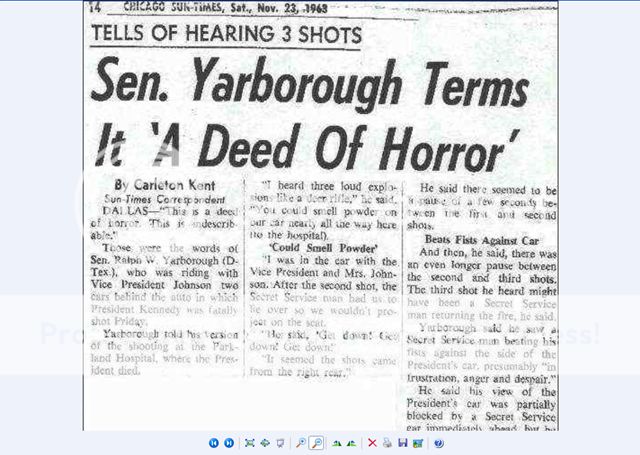

Look under 'Beats Fists Against Car'. "The third shot he heard might have been a Secret Service man returning the fire, he said."The Senator was two or three cars behind Jfk's, with LBJ. Look above 'could smell gunpowder'. He smelled gunpowder all the way to the hospital because the fatal shot came from the driver and the wind, according to Gary Mack was blowing back eastward. The motorcade was traveling west.

Read 'Preserving Their Legacy' by Mat Wilson.

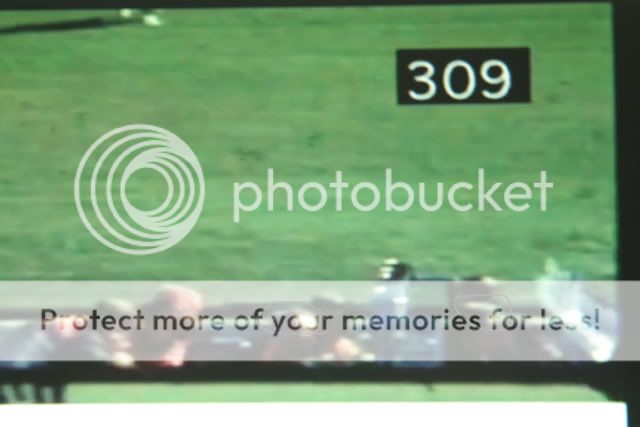
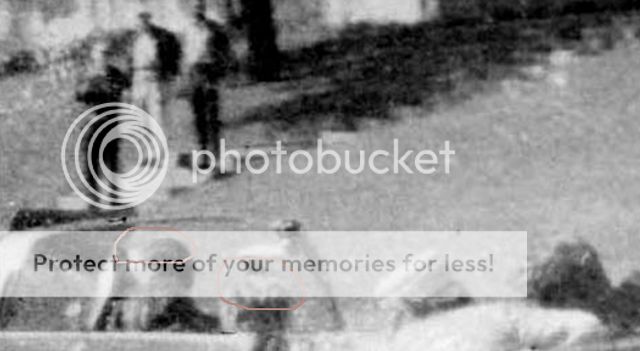
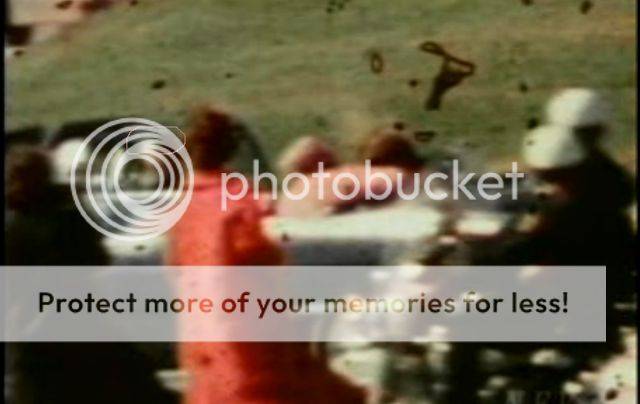
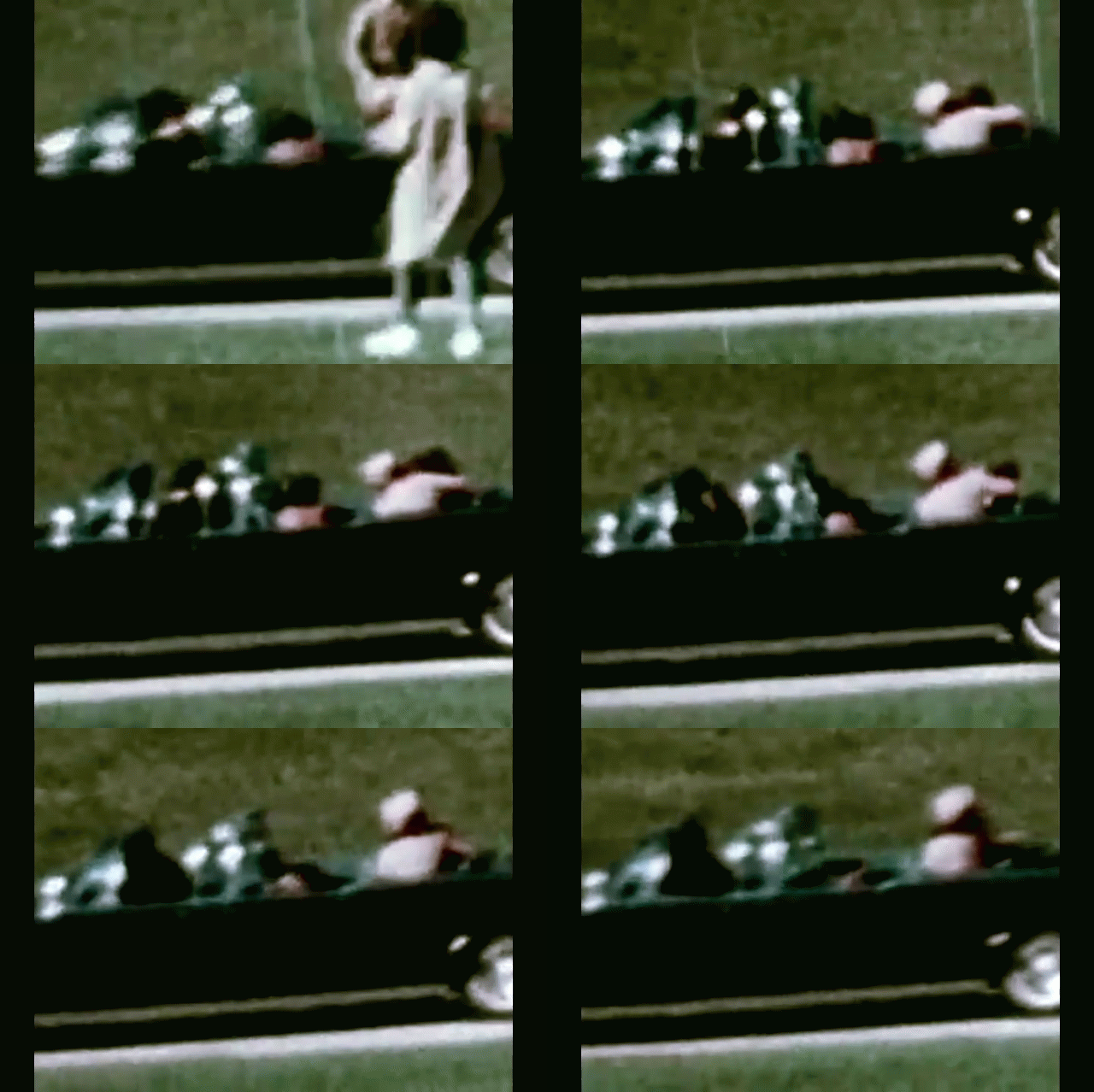
The reflection was proven fake long ago. It only appears in the Zapruder film. That means it wasn't added to three other recordings where it must be present if it were real.
-Mary Moorman took her polaroid at Zapruder frame 309, and in it the white blob was not added.
-The Muchmore Film is important and a bonus for proving Greer the real assassin. The capture below is the moment of the headshot and no fake reflection was added to Roy's head either.
-And finally, the all-important Nix Film provides a double whammy. Not only is it missing the white blob, but Roy's heads snaps back far enough to where his forehead faces the sky. Apparently they were able to curtail that movement in Zapruder. His head moves perfectly with the white blob in Zapruder, but they didn't bother adding any fake imagery to these three other recordings.
-In Nix, Greer's left arm raises to the level of his right shoulder and retracts after the shot. THAT'S THE SMOKING GUN.


7. James Altgens: (photographer, south curb of Elm):The last shot sounded like it came from the left side of the car, if it was close range because, if it were a pistol it would have to be fired at close range for any degree of accuracy," 7WCH518.
8. Hugh Betzner, Jr. (south curb of Elm, nr junction with Houston): I cannot remember exactly where I was when I saw the following: I heard at least two shots fired and I saw what looked like a firecracker going off in the president's car. My assumption for this was because I saw fragments going up in the air, I also remember seeing what looked like a nickel revolver in someone's hand in the President's car or somewhere immediately around his car 19WCH467
James Altgens (the man on right) was a press photographer and shared some mighty fine testimony that supports Greer's shot from the driver's seat. The pistol mention doesn't come from left field.