Venus
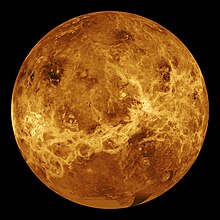
Venus has an extremely dense atmosphere, which consists mainly of carbon dioxide and a small amount of nitrogen....
The CO2-rich atmosphere, along with thick clouds of sulfur dioxide, generates the strongest greenhouse effect in the Solar System....
Studies have suggested that billions of years ago, the Venusian atmosphere was much more like Earth's than it is now, and that there may have been substantial quantities of liquid water on the surface, but, after a period of 600 million to several billion years, a
runaway greenhouse effect was caused by the evaporation of that original water, which generated a critical level of greenhouse gases in its atmosphere.
[emphasis added]
Measurements indicate there is 150 times as much deuterium, compared to normal hydrogen, in the atmosphere of Venus as there is on Earth. Since the radiation of the Sun, in the early history of the Solar System, was about 20% weaker than it is today, it is highly likely that Venus had a liquid ocean, and was much like the Earth. Either there was an ocean, and its evaporation rate was high, or the water was in a state of evaporation from the beginning.
In either case, since water is a greenhouse gas, the water vapor would have heated the atmosphere and surface of Venus. Calculations indicate that if an Earth-sized ocean were completely evaporated, on Venus, just as on Earth, the planet would be sufficiently hot to drive carbon from carbonate rock on the surface of the planet. This carbon, combined with oxygen as carbon dioxide, would accelerate the heating effects to create a runaway greenhouse planet, resulting in the hellhole which Venus is today.
Venus and Earth have about as much carbon as each other. On Earth, cooler temperatures, and the carbon cycle (which would not exist without a liquid ocean) have led to most of it being tied up in carbonate rock, saving the Earth from Venus' fate. If the carbon were ever released from the rocks of the Earth's crust into the atmosphere, the Earth would have an atmosphere of the same composition, temperature and density as that of Venus.
No doubt the tedious global heating denialists, in their desperate ignorance, will shriek the question : "If Venus once had a ocean, where is the water now? Venus today is dry as a bone!"
A moment's thought, and a little very basic knowledge of physics would enlighten them. Even on Earth, water molecules which reach high levels of the atmosphere are dissociated into oxygen and hydrogen by high-frequency radiation from the Sun. Then kinetic energy and the solar wind drive the lighter hydrogen atoms into outer space. The Earth is also losing its oceans and water -- just at a very slow rate -- up to the present time.
This process, accelerated by higher temperatures, weaker gravity and greater radiation from the Sun, would have led to Venus completely losing its water very quickly, in geological terms. The high levels of deuterium, a heavier isotope of hydrogen, on Venus is strong evidence that the lighter isotope has been removed from the planet.
I look forward to what forms of blither, junk science, red herrings, ad hominems, and spam pictures the insensate global heating deniers use to counter basic scientific fact.
..