Thanks for proving my point, in a way.
You don't know or understand science, or the type of lab test I was referring to, or both.
We'll start with the deficientcies of these five "lab tests" in this post.
Then in the next post I'll repeat what would be a valid lab test.
These two are basically two different articles about the same test.
Quote: "The balloon was
filled with either air or CO2."
While they show the heat retention of "air"* versus CO2, they fail to prove the critical issue. Can the heat retained by CO2 transfer to the air WITH IT in the same container!
*- Assumes that the "air" has same percent composition of the atmosphere;
These both FAIL!
Next is this, which again fails because it measures parts of the atmosphere separately rather than in a nature mix;
Quote: "students will have one bottle into which
one of the gases (regular air, water saturated air, CO2 ) has been placed."
Educational lab page detailing a hands-on greenhouse gas experiment where students compare temperature changes in gas-filled bottles exposed to light, covering materials, setup, data collection, and analysis questions to explore Earth's energy balance and greenhouse effect dynamics.
serc.carleton.edu
FAILS!
Next, this fails also for the same reason. Measuring air and CO2 separately, not in a combined mix.
QUOTE: "The demonstration includes two parts. In the first, students observe a model of the greenhouse effect in a greenhouse using transparent bottles containing air. In the second, they learn about the role of carbon dioxide by comparing the effects in
two separate vessels containing air and carbon dioxide respectively."
Use this demonstration to illustrate the greenhouse effect and the role of carbon dioxide as a greenhouse gas. Includes kit list and safety instructions.

edu.rsc.org
FAILS!
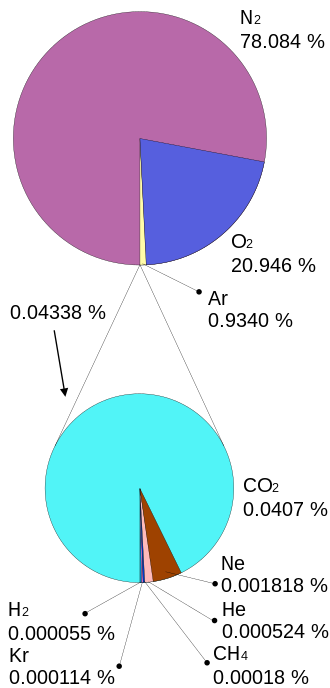
Next (and final of the five links) also fails because of the same reason. Using CO2 outside of the rest of the air/atmosphere. While interesting in showing the characteristics of CO2, it fails to show how CO2 transfers it's heat level to the surrounding atmosphere it is within. In none of the twelve "tests" is there 0.04% of CO2 within the 99.96% of Nitrogen, Oxygen, Argon, & Misc.
FAILS!

www.climate.gov
Human activities emit 60 or more times the amount of carbon dioxide released by volcanoes each year. Large, violent eruptions may match the rate of human emissions for the few hours that they last, but they are too rare and fleeting to rival humanity’s annual emissions. In fact, several individual U.S. states emit more carbon dioxide in a year than all the volcanoes on the planet combined do.