"Russia and the US opened up a communications hotline to avoid direct conflict with each other while supporting their proxies on opposite sides. In February 2018, after three years of gingerly avoiding a direct confrontation, the two world powers went toe to toe for the first time since the end of
World War I in what came to be known as the Battle of Khasham — a roughly four-hour battle in which the mighty Russian bear (with its Syrian allies) was reduced to a whimpering pup by a much smaller force of American commandos."
What Putin and much of the world expected to be a quick, easy victory over their smaller neighbor has rapidly devolved into a military disaster for Russia.

coffeeordie.com
As the afternoon sun began to sink over the cradle of civilization on Feb. 7, 2018, a group of US Marines and Army Special Forces soldiers watched surveillance drone feeds in disbelief as a large enemy force amassed 20 miles away near the eastern bank of the Euphrates River. The combined group of Syrian forces and
Russian mercenaries from the infamous Kremlin-linked Wagner Group swelled to an estimated 500 troops by early evening. With them were 27 vehicles — including Russian T-72 tanks and armored personnel carriers.
American brass monitoring the situation at the air operations center at Al Udeid Air Base in Qatar and the Pentagon were baffled as they watched a massive enemy force positioning itself to attack a nearby outpost where about
30 US Army Rangers and Delta Force commandos from the Joint Special Operations Command (JSOC) were working alongside Kurdish and Arab forces. American commanders readied aircraft and ground crews, and the members of the JSOC detachment prepared to defend themselves.
The Marines and Green Berets at the mission support site 20 miles away from the JSOC outpost in Deir al-Zour in northwestern Syria prepared a quick-reaction force of about 16 troops, loading four mine-resistant vehicles with anti-tank missiles, thermal optics, food, and water.
At 8:30 p.m., as three Russian tanks moved in closer, it became clear an attack was imminent, and the quick-reaction force prepared to launch.
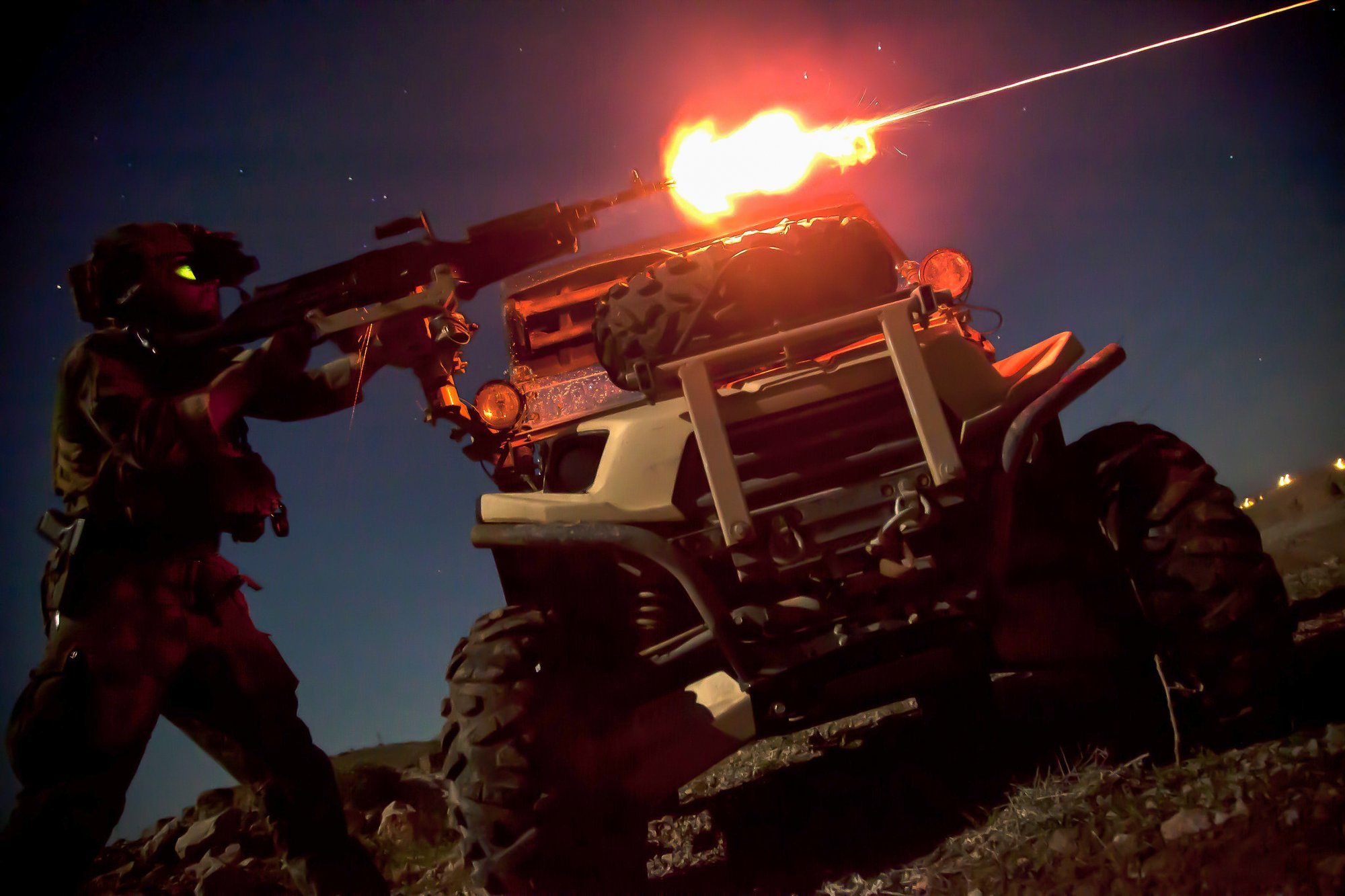
At approximately 10:30 p.m., the approaching column of Russian and Syrian vehicles opened fire on the tiny outpost. Tank, artillery, and mortar fire bombarded the Americans as they ran for their defensive positions and returned fire with machine guns and anti-tank missiles.
During the opening minutes of the battle, then-Secretary of Defense Jim Mattis contacted his Russian counterpart.
“The Russian high command in Syria assured us it was not their people,” Mattis
testified to Congress later. The secretary of defense then directed Chairman of the Joint Chiefs of Staff Gen. Joseph F. Dunford Jr. “for the force … to be annihilated.”
“And it was,” the former Marine general, whose troops nicknamed him “Chaos,” added.
With the expert direction of Air Force
combat controllers and others calling in air and indirect-fire support, waves of F-22 fighters, F-15E strike fighters, AH-64 Apache attack helicopters, AC-130 gunships, B-52 bombers, MQ-9 Reaper drones, and heavy Marine artillery relentlessly punished the enemy force.
The quick-reaction force sped toward the battle but was slowed by myriad obstacles, damaged roads, and the fact it was driving blacked out and relying on night-vision equipment. As the convoy of four vehicles made slow progress, American airpower and Marine artillery cut through the Syrian and Russian attackers like a scythe through hay.
“We should never have been there; our leadership messed up. The Americans knew exactly where we were,” former Russian mercenary and survivor of Khasham Marat Gabidullin told
The Guardian in February 2022.
Around 1 a.m. — with the enemy artillery and tanks finally silenced — the QRF reached the outpost and joined the turkey shoot.
Fighting from their vehicles, the Green Berets and Marines engaged the rapidly diminishing enemy force. Several Marines ran much-needed ammo to the commandos’ defensive positions while combat controllers guided a second wave of lethal strikes from American aircraft. An hour after the QRF’s arrival, the remnants of the attacking force fled the field. In their wake lay between 200 and 300 dead fighters. Inside the JSOC outpost, one allied Syrian fighter was wounded, and no Americans were harmed.

 sofrep.com