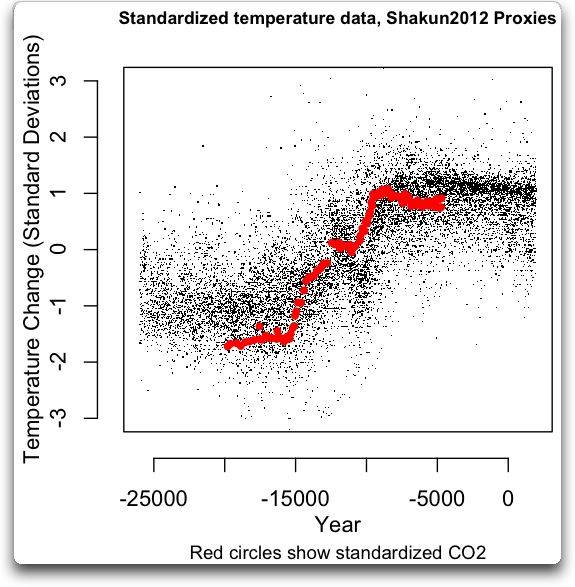
In other words... Perfectly good explanation that glaciation and the Ices Ages were a NATURAL event with the CO2 levels being a SECONDARY effect.. A combination of Earth orbital dynamics and fundamental changes in the Sun's radiation..
Good Job.. But of course NOW --- that evil CO2 has learned to become a PRIMARY cause of warming..
It was a good explanation. Too bad you're too retarded to understand it very well. "
CO2 levels" are not so much a "
SECONDARY" effect as they are a primary cause of the subsequent warming that is initially triggered by changes in orbital dynamics.
Past extreme warming events linked to massive carbon release from thawing permafrost
Nature 484, 8791 (05 April 2012) doi:10.1038/nature10929
Published online 04 April 2012
Robert M. DeConto, Simone Galeotti, Mark Pagani, David Tracy, Kevin Schaefer, Tingjun Zhang, David Pollard & David J. Beerling
(abstract)
Between about 55.5 and 52 million years ago, Earth experienced a series of sudden and extreme global warming events (hyperthermals) superimposed on a long-term warming trend1. The first and largest of these events, the PalaeoceneEocene Thermal Maximum (PETM), is characterized by a massive input of carbon, ocean acidification2 and an increase in global temperature of about 5 °C within a few thousand years3. Although various explanations for the PETM have been proposed4, 5, 6, a satisfactory model that accounts for the source, magnitude and timing of carbon release at the PETM and successive hyperthermals remains elusive. Here we use a new astronomically calibrated cyclostratigraphic record from central Italy7 to show that the Early Eocene hyperthermals occurred during orbits with a combination of high eccentricity and high obliquity. Corresponding climateecosystemsoil simulations accounting for rising concentrations of background greenhouse gases8 and orbital forcing show that the magnitude and timing of the PETM and subsequent hyperthermals can be explained by the orbitally triggered decomposition of soil organic carbon in circum-Arctic and Antarctic terrestrial permafrost. This massive carbon reservoir had the potential to repeatedly release thousands of petagrams (1015 grams) of carbon to the atmosphereocean system, once a long-term warming threshold had been reached just before the PETM. Replenishment of permafrost soil carbon stocks following peak warming probably contributed to the rapid recovery from each event9, while providing a sensitive carbon reservoir for the next hyperthermal10. As background temperatures continued to rise following the PETM, the areal extent of permafrost steadily declined, resulting in an incrementally smaller available carbon pool and smaller hyperthermals at each successive orbital forcing maximum. A mechanism linking Earths orbital properties with release of soil carbon from permafrost provides a unifying model accounting for the salient features of the hyperthermals.
Study suggests rising CO2 in the past caused global warming
A paper in Nature shows how increased CO2 in the atmosphere led to warming rather than the other way round
Research breakthrough: CO2 rises caused warming that ended last ice age
By Tierney Smith
4 April 2012
(excerpts)
Compelling new evidence suggests that rising CO2 caused much of the global warming responsible for ending the last ice age. The study, published in Nature, confirms what scientists have believed for sometime, and further supports the view that current rises in human-driven CO2 will lead to more global warming. CO2 was a big part of bringing the world out of the last Ice Age and it took about 10,000 years to do it, said Jeremy Shakun from Harvard University and lead-author of the report. Now CO2 levels are rising again, but this time an equivalent increase of CO2 has occurred in only about 200 years, and there are clear signs that the planet is already beginning to respond. While many of the details of future climate change remain to be figured out, our study bolsters the consensus view that rising CO2 will lead to more global warming.
While previous studies only compared carbon dioxide levels to local temperatures in Antarctica, the current study aimed to reconstruct global average temperature changes, using 80 core samples from around the world. Looking only at local temperatures in Antarctica, warming appears to precede rising CO2, an argument often adopted by sceptics to disprove carbon dioxides role in global warming. Shakun however, says this is leaving a huge gap in the research. Putting all these records together into a reconstruction of global temperature shows "a beautiful correlation with rising CO2 at the end of the Ice Age, said Shakun. Even more interesting, while CO2 trails Antarctica warming, it actually precedes global temperature change, which is what you would expect if CO2 is causing warming.
Global warming preceded by increasing carbon dioxide concentrations during the last deglaciation
Nature 484, 4954 (05 April 2012) doi:10.1038/nature10915
Jeremy D. Shakun, Peter U. Clark, Feng He, Shaun A. Marcott, Alan C. Mix, Zhengyu Liu, Bette Otto-Bliesner, Andreas Schmittner & Edouard Bard
Published online 04 April 2012
(Abstract)
The covariation of carbon dioxide (CO2) concentration and temperature in Antarctic ice-core records suggests a close link between CO2 and climate during the Pleistocene ice ages. The role and relative importance of CO2 in producing these climate changes remains unclear, however, in part because the ice-core deuterium record reflects local rather than global temperature. Here we construct a record of global surface temperature from 80 proxy records and show that temperature is correlated with and generally lags CO2 during the last (that is, the most recent) deglaciation. Differences between the respective temperature changes of the Northern Hemisphere and Southern Hemisphere parallel variations in the strength of the Atlantic meridional overturning circulation recorded in marine sediments. These observations, together with transient global climate model simulations, support the conclusion that an antiphased hemispheric temperature response to ocean circulation changes superimposed on globally in-phase warming driven by increasing CO2 concentrations is an explanation for much of the temperature change at the end of the most recent ice age.