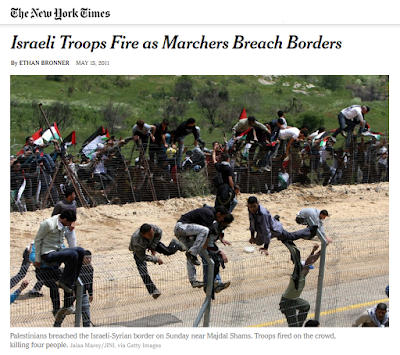
Familiar scenes - from seven years ago [
Image Source]
In a punchy New York Times column published this past Friday ["
Jewish Power at 70 Years"], Bret Stephens starts out talking about a hate crime - with an intriguing twist - in today's Germany. But then he heads off in the direction of the Middle East and the challenges posed to Israelis by the people on the far side of our borders.
Here's a first extract:
On Friday, Palestinians in Gaza returned for the fourth time to the border fence with Israel, in protests promoted by Hamas. The explicit purpose of Hamas leaders is to breach the fence and march on Jerusalem. Israel cannot possibly allow this — doing so would create a precedent that would encourage similar protests, and more death, along all of Israel’s borders — and has repeatedly used deadly force to counter it. The armchair corporals of Western punditry think this is excessive. It would be helpful if they could suggest alternative military tactics to an Israeli government dealing with an urgent crisis against an adversary sworn to its destruction. They don’t. It would also be helpful if they could explain how they can insist on Israel’s retreat to the 1967 borders and then scold Israel when it defends those borders. They can’t.He's right. We're old enough to remember the coordinated
Arab assaults on multiple Israeli bordersseven years ago in conjunction with
Naqba Day - May 14 and 15, 2011 and around the same time as the ill-fated and unfortunately-named Arab Spring.
A BBC report at the time [
"Palestinian protests: Arab spring or foreign manipulation?", BBC, May 15, 2011] said the not-so-peaceful "protestors"
undoubtedly embodied the same kind of risk-taking, confrontational people-power ethos that has fired the revolts in many parts of the Arab world.How did that risk-taking confrontation play out?
Lebanon
In Lebanon, some 30,000 people were pulled together by the organizers near Lebanon's Israel border and walked towards it just opposite the northern Israeli town of Avivim. Soldiers of the
Lebanese army first fired into the air to deter them. But then, as they headed recklessly into and across a border minefield throwing stones towards the Israeli and shouting into the hills for a "right of return", the Lebanese forces shot at them with assault rifles and tear gas. Before the retreat was completed,
11 participants were dead and about 100 injured.
Egypt
On the Egyptian border, thousands were reported to about to make their way from Cairo, Alexandria, Suez and other points of origin toward the Rafah crossing with Gaza. But the military regime then in power intervened, warning bus companies not to answer the convoy organizers' requests. The few buses that did set off were stopped by the military and in the end, according to
Ma'an, only some 80 individuals equipped with flags and an arsenal of angry demands and slogans got to the border.
Fatahland
According to
Wikipedia, around 300 West Bank "protesters" assembled at the Qalandiya Crossing - a busy crossing point - to demonstrate, forming human chains, staging sit-downs, hurling rocks. About 120 were said to be affected by tear gas, stink-spray and other crowd-dispersal means.
BBC: "Clashes at the Qalandiya checkpoint in Ramallah continued for hours, with dozens of Palestinians injured. Palestinian protesters threw stones at Israeli security forces, who fired tear gas and rubber bullets."
Jordan
In Jordan, about 500 Palestinian Arab Jordanians were prevented by Jordanian army and police forces from doing harm at the Allenby Bridge, the major crossing point into the West Bank and Israel. They used tear gas and other similar tools and some 25 people were reported injured, including 11 Jordanian police. A
Ma'an report said the Hamas-aligned Jordanian Muslim Brotherhood and what Ma'an called "the powerful Islamic Action Front" termed this "shocking" and turning reality on its end demanded "an end to such policies that have harmed Jordan's image".
(full article online)
This Ongoing War: A Blog: 23-Apr-18: Bret Stephens on Israel's robust willingness to defend itself


 uh hum