billyerock1991
Gold Member
- Apr 24, 2012
- 7,106
- 506
- 140
- Thread starter
- #461
The estimates of the net costs for 2014 stem almost entirely from spending for subsidies that are to be provided through insurance exchanges (often called marketplaces) and from an increase in spending for Medicaid. For the 2015–2024 period, the projected net costs consist of the following:you have nothing to counter what I posted so you have two strategiesdo you have any source any information any link of any kind or are you fascinated by your clever use of "left drone" Einstein ?..... you are just another Blow hard no information right wing laughing stock repeating meme s...
See the irony impaired far left drone (that supports Obama's illegal wars) believes the CBO here, but ignores the CBO when it comes to Obamacare.
Typical far left drone..
change the subject to claims about Obamacare...
and of course the brilliant "left drone" ...you have it going on there Einstein...I am laughing at you....you are struggling....
Just point out that the far left drone uses the CBO in this case, but ignores it when it comes to anything that speaks bad of the messiah.
So did you believe the CBO when it showed that Obamacare was not really going to fix any problems except spend trillions of dollars?
See how the far left drones want it to be a valid source here, but not when it runs up against their programmed narrative. Especially as they support Obama's illegal wars.
So if the CBO is a valid source now then it should be when it says that we sill spend trillions on Obamacare that will not really do any good. Or did the far left drone not understand the word Trillions?
Of Couse you truly do not understand the source that you posted, it just fit the programmed narrative..
I understand that you are a low information no information right wing nut bag repeating meme s no sources no nothing ...
Yes the far left drones show that the CBO is only valid prior to 2009..
- Gross costs of $1,839 billion for subsidies and related spending for insurance obtained through the exchanges, Medicaid, the Children’s Health Insurance Program (CHIP), and tax credits for small employers ($165 billion less than the previous projection); and
- A partial offset of $456 billion in receipts from penalty payments, additional revenues resulting from the excise tax on high-premium insurance plans, and the effects on income and payroll tax revenues and associated outlays arising from projected changes in employer coverage ($61 billion less than the previous projection).
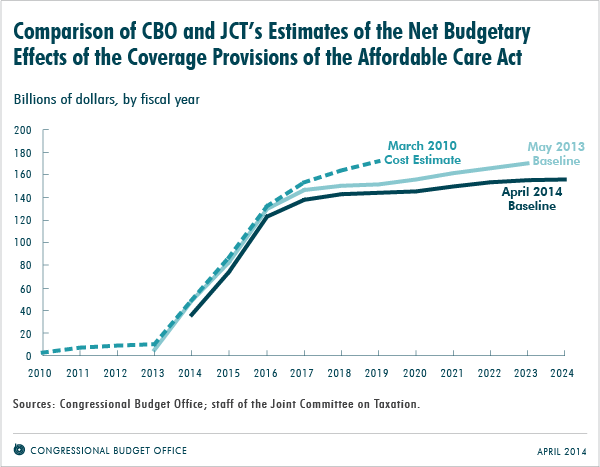
CBO and JCT have updated their baseline estimates of the budgetary effects of the ACA’s insurance coverage provisions many times since that legislation was enacted in March 2010. As time has passed, the period spanned by the estimates has changed. But a year-by-year comparison shows that CBO and JCT’s estimates of the net budgetary impact of the ACA’s insurance coverage provisions have decreased, on balance, over the past four years (see the figure below). That net downward revision is attributable to many factors, including changes in law, revisions to CBO’s economic projections, judicial decisions, administrative actions, new data, numerous improvements in CBO and JCT’s modeling, and lower projected health care costs for both the federal government and the private sector.