You don't seem to be able to wrap your mind around the numbers.
How many fish do you think there are in the ocean?
Answer: if each fish weighed 10 pounds, there would be 2 trillion of them.
And "most" fish (the vast majority) are nowhere near 10 pounds, they're tiny little things. Sardines weigh a couple of ounces.
But let's use 2 trillion to be generous. The numbers say that each fish has an average of 400 hereditary genetic mutations during its lifetime. That means the probability of 2 fish having identical mutations is 99.999999999 %.
For all practical purposes, that equals 100%. EVERY GENERATION will have at least two identical mutations.
If instead of fish we're talking bacteria, the numbers changes from 2x10^12 to 4x10^23.
So your likelihood becomes 99.99 with 21 more 9's after it. And your average number of identical.mutations per generation becomes about 10^15, which is 1000 trillion.
That's why it's called combinatorial EXPLOSION. In simple terms the key word is "redundancy". Do the math. If you have 1000 coins and you flip each one, what are the chances of getting 500 identical heads? You can look up the answer on Google. AI is good for stuff like that.
If that doesn't work, here are some links to help you:
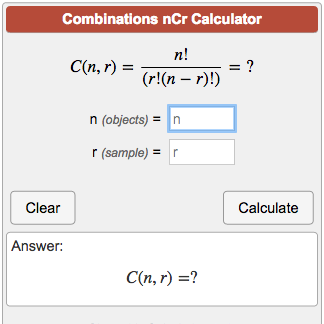
Find the number of ways of choosing r unordered outcomes from n possibilities as nCr (or nCk). Combinations calculator or binomial coefficient calcator and combinations formula. Free online combinations calculator.

www.calculatorsoup.com
This free calculator can compute the number of possible permutations and combinations when selecting r elements from a set of n elements.

www.calculator.net
Calculate combinations with forumlas, diagrams and working out

www.statskingdom.com
Combinatorial calculator – compute permutations, combinations and variations with or without repetition online. Step-by-step solution with formulas and examples.

www.hackmath.net
(the last one is the best, in spite of the title)

pmc.ncbi.nlm.nih.gov