Above are some of the idiotic comments from those far right reactionary retard so-called Republicans who lost us the elections in 2008 and 2012.
romney is as moderate as milktoast
What's wrong with a reasonable moderate? Maybe cutting the shit out of everything isn't the right path to take....Ever thought of that!
Above are some of the idiotic comments from those far right reactionary retard so-called Republicans who lost us the elections in 2008 and 2012.
romney is as moderate as milktoast
What's wrong with a reasonable moderate? Maybe cutting the shit out of everything isn't the right path to take....Ever thought of that!
I look at historical results.
History says you are wrong and leftist are wrong.
considering that leftist preach about education, they must know this. So why do you support ideas that you know will make our economy worse and lie to people about it?
Get off hate talk radio and grow a fukkn brain dummy!
Harding (R) had to deal with a depression, he cut Fed taxes and spending in 1/2, the depression ended in 18 month and lead to the Roaring 20's.
fdr (D) had to deal with a depression, he upped Fed spending and increased taxes, the depression turned into the Great Depression and lasted 10 years, there was no economic boom.
you can look up all this yourself, and then you can explain why you still support fdr-obamas bad ideas.
ANOTHER right wing talking point about to get demolished:
1921 and All That
Every once in a while I get comments and correspondence indicating that the right has found an unlikely economic hero: Warren Harding. The recovery from the 1920-21 recession supposedly demonstrates that deflation and hands-off monetary policy is the way to go.
But have the people making these arguments really looked at what happened back then? Or are they relying on vague impressions about a distant episode, with bad data, that has been spun as a confirmation of their beliefs?
OK, I’m not going to invest a lot in this. But even a cursory examination of the available data suggests that 1921 has few useful lessons for the kind of slump we’re facing now.
Brad DeLong has
recently written up a clearer version of a story I’ve been telling for a while (actually since before the 2008 crisis) — namely, that there’s a big difference between inflation-fighting recessions, in which the Fed squeezes to bring inflation down, then relaxes — and recessions brought on by overstretch in debt and investment. The former tend to be V-shaped, with a rapid recovery once the Fed relents; the latter tend to be slow, because it’s much harder to push private spending higher than to stop holding it down.
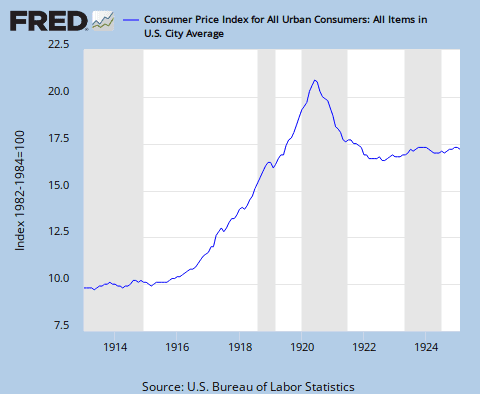
And the 1920-21 recession was basically an inflation-fighting recession — although the Fed was trying to bring the level of prices, rather than the rate of change, down. What you had was a postwar bulge in prices, which was then reversed:
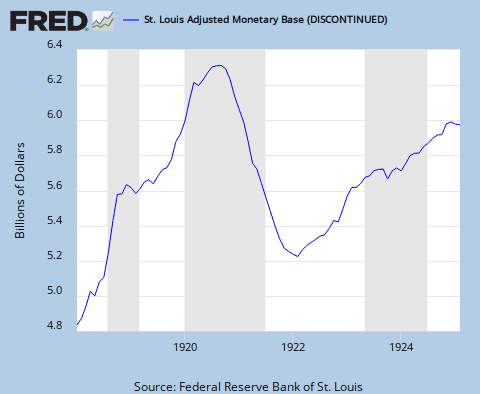
Money was tightened, then loosened again:
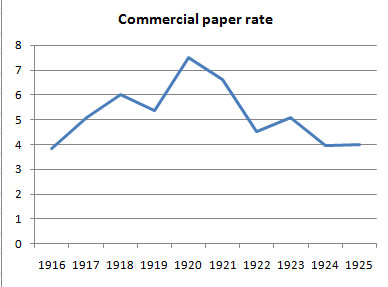
Discount rates are a problematic indicator, but here’s what happened to commercial paper rates:
Historical statistics, Millennial edition
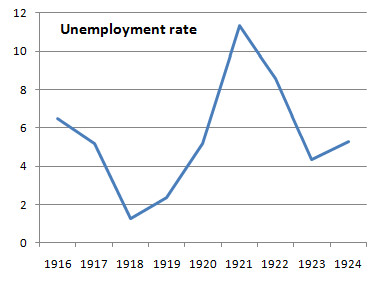
And so there was a V-shaped recovery:
The deflation may have helped by increasing the real money supply — at least
Meltzer thinks so (pdf) — but if so, the key point was that the economy was nowhere near the zero lower bound, so there was plenty of room for the conventional monetary channel to work.
All of this has zero relevance to an economy in our current situation, in which the recession was brought on by private overstretch, not tight money, and in which the zero lower bound is all too binding.
So do we have anything to learn from the macroeconomics of Warren Harding? No.
http://krugman.blogs.nytimes.com/2011/04/01/1921-and-all-that/?_r=0
Harding/Coolidge handled the 1920's so well, they allowed the credit bubble to explode (like the 1870's, Ronnie's S&L And Dubya's subprime) Weird right Bubs?