
jacksonlamb
Platinum Member
- Feb 3, 2026
- 7,619
- 3,670
- 893
www.msn.com/en-us/news/politics/a-decades-long-plan-to-abolish-the-electoral-college-may-finally-pay-off/ar-AA22qrwV#comments
You folks on the right will go beserk if it happens.
The National Popular Vote Act may be in position to jump the shark this fall.
That means that it could put an end to the Electoral College and the excess of power that a minority of Americans have in several of the small states thwarting the will of the majority in the larger states.
The Electoral College — our nation’s bizarre system that hands a few narrowly-divided states the privilege to choose our presidents — has been entrenched for two centuries.
But a long-game effort from reformers, which has played out quietly in blue states across the country over the past 20 years, has gotten it surprisingly close to toppling.
Throughout the 20th century, it was believed that the only chance for nationwide Electoral College reform was a constitutional amendment, and there was a real bipartisan push to do so after the 1968 election, endorsed by President Richard Nixon. Third-party candidate George Wallace’s strength in the South had risked depriving Nixon of his electoral vote majority, meaning the Democrat-controlled House of Representatives would have determined the outcome. Despite initial momentum in Congress for a popular vote, a trio of segregationist Southerners filibustered the proposed amendment to death in 1970 with help from senators in smaller states.
The 2000 election, in which Al Gore won the popular vote but George W. Bush was declared the winner in the decisive state of Florida after much controversy, rejuvenated interest in reform. Democrats were of course furious that Bush won, but much of the country believed it was absurd that a 537-vote margin in a single state determined the outcome. Polls showed a large majority of respondents supporting a move to a popular vote system by constitutional amendment. But amending the Constitution is toweringly difficult; ratification requires the backing of 38 states.
An alternative route was that the states could do it themselves — states could simply pledge their own electoral votes to the popular vote winner. The problem there was that if states stuck their necks out to go first, they’d be throwing away their influence under the current system. So several experts and thinkers batted around the idea of a trigger mechanism — a state law that wouldn’t go into effect until the 270-electoral-vote threshold was reached.
After the 2004 election once again came down to a single swing state, John R. Koza had had enough. A computer scientist who had become wealthy from a lottery ticket business (he co-invented the scratch-off ticket), Koza told me he “got all agitated about the fact that Ohio was the key state that reelected George W. Bush, and the rest of the country was basically ignored, including California” — his home state.
In the 1970s and 1980s, Koza had gone from state to state trying to get state lotteries established; if multiple states wanted to work together on a single lottery, they’d create an interstate compact. Koza believed the same device — a binding agreement — could work for Electoral College reform. So in 2006, he launched National Popular Vote Inc., which was (and remains) the major group lobbying for the National Popular Vote Interstate Compact around the country.
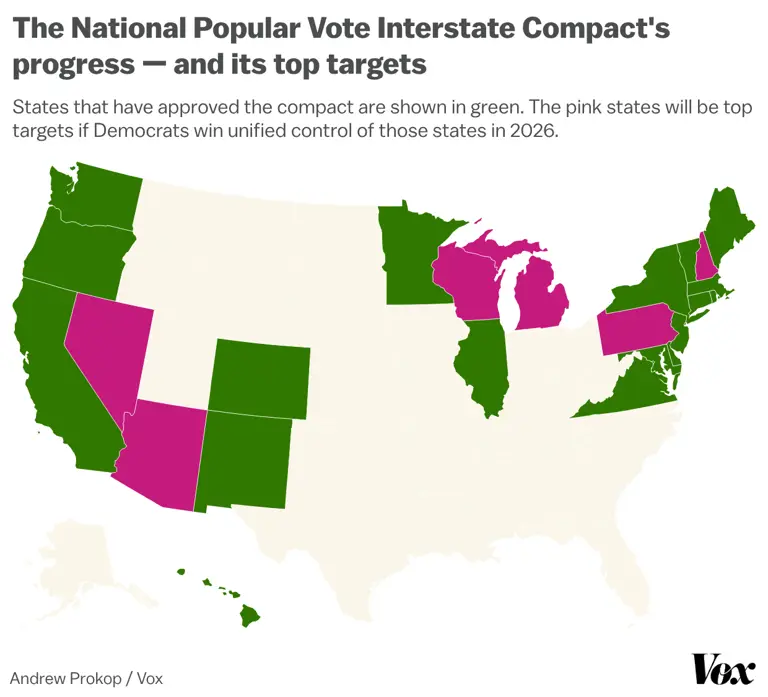
And a blue wave in the 2026 midterms could finish the job.
How it works is that each participating state agrees that their electors will go to the candidate who wins the highest number of votes nationwide — if, and only if, enough other states agree so that the outcome will be determined that way.
And, if so, yowza!!!
You folks on the right will go beserk if it happens.
The National Popular Vote Act may be in position to jump the shark this fall.
That means that it could put an end to the Electoral College and the excess of power that a minority of Americans have in several of the small states thwarting the will of the majority in the larger states.
The Electoral College — our nation’s bizarre system that hands a few narrowly-divided states the privilege to choose our presidents — has been entrenched for two centuries.
But a long-game effort from reformers, which has played out quietly in blue states across the country over the past 20 years, has gotten it surprisingly close to toppling.
Throughout the 20th century, it was believed that the only chance for nationwide Electoral College reform was a constitutional amendment, and there was a real bipartisan push to do so after the 1968 election, endorsed by President Richard Nixon. Third-party candidate George Wallace’s strength in the South had risked depriving Nixon of his electoral vote majority, meaning the Democrat-controlled House of Representatives would have determined the outcome. Despite initial momentum in Congress for a popular vote, a trio of segregationist Southerners filibustered the proposed amendment to death in 1970 with help from senators in smaller states.
The 2000 election, in which Al Gore won the popular vote but George W. Bush was declared the winner in the decisive state of Florida after much controversy, rejuvenated interest in reform. Democrats were of course furious that Bush won, but much of the country believed it was absurd that a 537-vote margin in a single state determined the outcome. Polls showed a large majority of respondents supporting a move to a popular vote system by constitutional amendment. But amending the Constitution is toweringly difficult; ratification requires the backing of 38 states.
An alternative route was that the states could do it themselves — states could simply pledge their own electoral votes to the popular vote winner. The problem there was that if states stuck their necks out to go first, they’d be throwing away their influence under the current system. So several experts and thinkers batted around the idea of a trigger mechanism — a state law that wouldn’t go into effect until the 270-electoral-vote threshold was reached.
After the 2004 election once again came down to a single swing state, John R. Koza had had enough. A computer scientist who had become wealthy from a lottery ticket business (he co-invented the scratch-off ticket), Koza told me he “got all agitated about the fact that Ohio was the key state that reelected George W. Bush, and the rest of the country was basically ignored, including California” — his home state.
In the 1970s and 1980s, Koza had gone from state to state trying to get state lotteries established; if multiple states wanted to work together on a single lottery, they’d create an interstate compact. Koza believed the same device — a binding agreement — could work for Electoral College reform. So in 2006, he launched National Popular Vote Inc., which was (and remains) the major group lobbying for the National Popular Vote Interstate Compact around the country.
And a blue wave in the 2026 midterms could finish the job.
- Since 2006, a plan to change the US presidential elections to a popular vote — by getting states controlling 270+ electoral votes to pledge their electors to the popular vote winner — has been gaining support in blue states.
- The 2026 midterms could sweep Democrats to power in enough swing states to cross that threshold, potentially putting a popular vote system in place for 2028.
- But there are legal, practical, and political questions about what, exactly, would replace the Electoral College — and whether carrying out this reform without GOP support could doom it to failure.
How it works is that each participating state agrees that their electors will go to the candidate who wins the highest number of votes nationwide — if, and only if, enough other states agree so that the outcome will be determined that way.
And, if so, yowza!!!


 Oh brother


