Dude, you find me one person on the planet who will describe a $916M operating loss of their own money as "not devastating."
Donald Trump.
Losses are severe based on the context of the finances of the person who suffered the loss.
If I lost $ten thousand it would be devastating to me, but for a spoiled baby NFL football "star" it would NOT amount to a fart in a hurricane.
Trump would have lost about one tenth of his total operating capital, or at worst one quarter of it.
Meanwhile most Americans are deeply in debt with home mortgages and college loans as our political leadership continues to pile more tax obligations on us and small businesses while clearing the decks for multinational corporations and reliving them of even minor contributions.
You have lost sight of the forest for all the trees in the way.
Blue:
Ah, no.
Not at all.
Red:
I agree with that, but remember, the losses we are talking about with
operating losses is the net sum of cash spent in excess of cash received. (Did you check the links I provided earlier that identify what an operating loss is?)
Yes, but lets say that Trump had bought some HUGE project for pennies on the dollar that he was going to turn around and it would take 3 years to do so.
The first year of the purchase is a huge loss with no gains to show for it till the project is complete and profit to be made from it.
If Trump had bought several such projects I could see him being in the red very easily at the start.
Red:
Yes, a company can experience an operating loss and have sufficient cash flows to remain a going concern. But line of thought -- not one to be ignored in financial analysis -- gets into financing a business not the actual operations of the business. EBITDA goes to the analysis of a company's (thus its managers') profitability thus the sagacity of their business management decisions as goes the business they are trying to run, to operate and make profitable.
EBITDA, operating gain/loss, does not address the cash flows needed to keep a company going. That's what cash flows enable, and an income statement, which is essentially what a tax return is, does not at all address that at all.
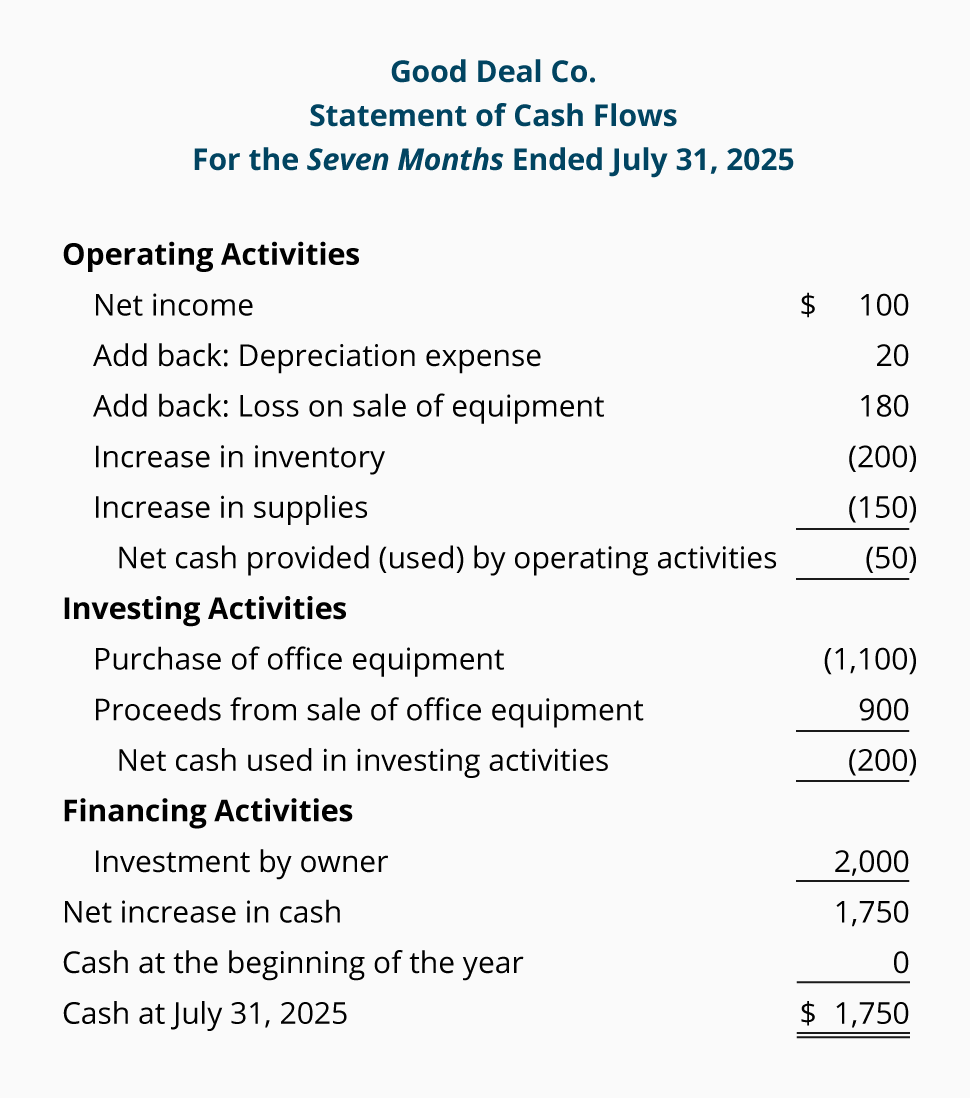
Sample statement of cash flows:
The operating cash flows of a business pertain to the actual cash spent in excess of the cash the operations produce. If there is sufficient cash from investing and financing, the business can continue to exist. If you'd like some examples of companies that ran operating losses for years on end, take a look at
airlines or
GM for that matter.
I do not know which of Trump's business operations gave rise to his having lost nearly a billion dollars. It may be that those companies no longer exist or it may be they do still exist. It could also be that they exist and he doesn't own them any longer. I don't know. There's no question that there's a lot more to discover. What is very clear, however, is that the man had a net loss among all his businesses combined of $916M and that only happens at the end of an accounting period when over the course of the accounting period in question one spends $916M more than one receives.
The fact of the matter is also that there are many kinds of things that can give rise to Trump's NOL. It could be tax shelters. It could be his actual businesses. We don't know. It could be money he borrowed and did not pay back. It could even be something that was in fact fully illegal and that the IRS accepted a fine payment as the penalty. Such an agreement/settlement would not generally be disclosed, particularly if Trump agreed with the IRS' findings. The IRS does not in any way want to put people in jail over tax matters because people in jail do not generate tax revenue at anything close to what people who are actively working do. The IRS will send folks to jail if they have no alternative, but the IRS is very amenable to settling without having to take folks to court.
I'm not trying to assert what gave rise to Trump's NOL and its size. At this time, neither I nor anyone else -- aside from Trump, his accountant, the IRS and state taxation authorities -- can say for sure. At the end of the day, all business transactions and businesses overall resolve to cash, and if a losing business/businessperson has enough cash coming in, it/they can continue in business and hopefully recover. That doesn't make it strange that in the middle of the 1990s, when everyone was making money "hand over fist" if they just breathed regularly, Trump managed to lose money. That he did so as a well funded casino owner is all the more curious. (That it was casinos he owned at the time may well be why he survived his losses. Few businesses generate the huge volumes of cash that casinos do.)