Libertarians Are The True Political Moderates

There is not a single home buyer in America who signed a mortgage and said to themselves "Oh, I have no risk, the government will save me from financial ruin"

The reason the banks were bailed out was to protect our economy from ruin and to protect INNOCENT citizens who had nothing to do with the housing crisis, who would have lost their 401Ks and life savings.

PLEASE tell me your ideology would not demand INNOCENT citizens being destroyed?

You are the idiot that said no one was protected from financial ruin, yet you admit the banks were bailed out. I am sure that has something to do with my lack of cognitive ability, but it really doesn't make sense.

By the way, it is crap that TARP was needed to protect the economy, it just made things worse. That explains why the Democrats were for it, and Bush had to finagle the Republicans on board.

Let's recap, and see where your cognitive ability failed you.

Quantum Windbag: That doesn't change the fact that multiple thousands of people made bad decisions, does it?

Bfgrn: I guess it is impossible to reason with a dogmatic mind. Let's lay it out.

1) There was a housing bubble.

Then

2) Property values plummeted.

3) The people you say caused the crisis (CRA and lower income buyers) continued to pay their mortgage. Why? Because although the value dropped, they were buying a homestead. And those who lost their jobs probably kept paying even when foreclosure was inevitable.

If these were the only buyers affected, there would have been a slow deflation of the housing market.

4) But speculators and wealthy buyers trying to make a fast buck flipping houses made a cold, hard business decision...walk away and cut your loses. Speculators comprised up to 50% of buyers in the 'hot' markets where the massive foreclosures occurred.

So the ONLY way there could be a bust, is for the market to be instantly flooded with foreclosures.

Quantum Windbag: The only reason to foreclose on a loan is if somene isn't paying it. Given all the regulations, both federal and state, that make kicking people out of their house all but impossible, your claim that there was a massive conspiracy by banks to burst the housing bubble is so absurd I don't even think a rational person could possibly consider it as reality.

BS

The bundled trash bets and bid them up up and away. The bets weren't worth the paper they were written on, but they kept betting anyway. Playing a game of hot potato with the bets. Not wanting to be the one burned in the end.

4 banks were the major players in it, and they control most of the nations deposits. 20 banks virtually control all deposits in the United States. EVERY ONE OF THEM got bailed out to keep from going under except Lehman...................

TARP was nothing more than a smoke screen, as the Federal Reserve gave loans from the discount window to a tune of 16.1 TRILLION DOLLARS. I've proved this data from the GAO many times.

Margin Trading and Margin loans went up up and away. Which is the same thing we have right now.

We allowed the Too Big to Fail to SELF REGULATE, and they created a bubble from hell, and they tied the American Taxpayers to their bets.

I've just done 2 threads associated with this showing some of this data. Lets look at Goldman Sachs............0.2% ASSETS to bets, aka Derivatives. They only have 114 Billion in Assets via the OCC reports. They have 48 TRILLION IN DERIVATIVES.

The big boys jacked up the markets and pulled the rug out leaving the DOLLAR and the American people on the hook for their BS. Which is why they need to be put on a dang leash.
 
This thread is about Libertarians being moderate.

I don't agree with everything on their agenda, but I agree with a return to more of the traditional forms of the Constitution. We have found that we can take from the Federal Dole and pay for pretty much anything we want. The only problem with that is that there aren't enough taxpayers left to pay for it. We are destroying our currency, and our Standard of living because we REFUSE TO DO WHAT IS NECESSARY to save the REPUBLIC............

The Republic...................too much of that is gone replaced by pure Democracy. And it is failing as we refuse to live within our means. We allow BS on the Markets to take us down even further and the ending is not pretty.

I stand with the Libertarians on issues. Limited Gov't and more State's Rights. And that's it for now.
 
You are the idiot that said no one was protected from financial ruin, yet you admit the banks were bailed out. I am sure that has something to do with my lack of cognitive ability, but it really doesn't make sense.

By the way, it is crap that TARP was needed to protect the economy, it just made things worse. That explains why the Democrats were for it, and Bush had to finagle the Republicans on board.

Let's recap, and see where your cognitive ability failed you.

Quantum Windbag: That doesn't change the fact that multiple thousands of people made bad decisions, does it?

Bfgrn: I guess it is impossible to reason with a dogmatic mind. Let's lay it out.

1) There was a housing bubble.

Then

2) Property values plummeted.

3) The people you say caused the crisis (CRA and lower income buyers) continued to pay their mortgage. Why? Because although the value dropped, they were buying a homestead. And those who lost their jobs probably kept paying even when foreclosure was inevitable.

If these were the only buyers affected, there would have been a slow deflation of the housing market.

4) But speculators and wealthy buyers trying to make a fast buck flipping houses made a cold, hard business decision...walk away and cut your loses. Speculators comprised up to 50% of buyers in the 'hot' markets where the massive foreclosures occurred.

So the ONLY way there could be a bust, is for the market to be instantly flooded with foreclosures.

Quantum Windbag: The only reason to foreclose on a loan is if somene isn't paying it. Given all the regulations, both federal and state, that make kicking people out of their house all but impossible, your claim that there was a massive conspiracy by banks to burst the housing bubble is so absurd I don't even think a rational person could possibly consider it as reality.

BS

The bundled trash bets and bid them up up and away. The bets weren't worth the paper they were written on, but they kept betting anyway. Playing a game of hot potato with the bets. Not wanting to be the one burned in the end.

4 banks were the major players in it, and they control most of the nations deposits. 20 banks virtually control all deposits in the United States. EVERY ONE OF THEM got bailed out to keep from going under except Lehman...................

TARP was nothing more than a smoke screen, as the Federal Reserve gave loans from the discount window to a tune of 16.1 TRILLION DOLLARS. I've proved this data from the GAO many times.

Margin Trading and Margin loans went up up and away. Which is the same thing we have right now.

We allowed the Too Big to Fail to SELF REGULATE, and they created a bubble from hell, and they tied the American Taxpayers to their bets.

I've just done 2 threads associated with this showing some of this data. Lets look at Goldman Sachs............0.2% ASSETS to bets, aka Derivatives. They only have 114 Billion in Assets via the OCC reports. They have 48 TRILLION IN DERIVATIVES.

The big boys jacked up the markets and pulled the rug out leaving the DOLLAR and the American people on the hook for their BS. Which is why they need to be put on a dang leash.

There is a LOT wrong with HOW TARP was administered. You will get no argument from me on that issue. BUT, it saved the American financial system from collapse. And it was an opportunity for government to change the structure and the incentives of Wall Street when it had the chance. They failed on that front.

But anyone who says the government should have just allowed our economy to crash is a moron. The problem with these whack-o 'laissez-faire' libertarians is they are extreme ideologues. There is NEVER any learning that goes on in their dogmatic minds. And learning is the key to moderation. They are not moderates.

Bush and Paulson deserve credit for putting aside their 'ideology' and getting tarp passed, along with people from both sides of the aisle who did the right thing. EVERYONE had to hold their nose while passing TARP, but it was absolutely necessary.

Thank God Bush and Paulson didn't listen to these whack-o 'laissez-faire' libertarians and just do nothing.

Hoover made the mistake 85 years ago of listening to the whack-o 'laissez-faire' libertarians of the day. It turned a deep recession into the GREAT depression.

People who are opposed to bailouts of any kind like to argue that TARP was not really necessary. Banks could have been allowed to fail and the economic fallout around the world would not have been so dramatic.

This was, of course, the view taken by policy makers in 1929-31, after the Great Crash. Top people at the Federal Reserve and Treasury argued that the United States had experienced a financial mania (true), that a fall in asset prices was long overdue (quite likely, at least for stocks), and that the right approach was to stand back and – in the unforgettable words of Treasury Secretary Andrew Mellon, let the private sector “liquidate labor, liquidate stocks, liquidate the farms, liquidate real estate.”

The result was the Great Depression. No responsible policy maker would want to run that risk again. ref

What NEVER works is what Herbert Hoover and Andrew Mellon did to bring on the Great Depression...liquidate, and austerity. They listened to the 'Austrian' school. Unless you also believe Medieval blood letting save lives?

Economic Policy Under Hoover

Throughout this decline—which carried real GNP per worker down to a level 40 percent below that which it had attained in 1929, and which saw the unemployment rise to take in more than a quarter of the labor force—the government did not try to prop up aggregate demand. The only expansionary fiscal policy action undertaken was the Veterans’ Bonus, passed over President Hoover’s veto. That aside, the full employment budget surplus did not fall over 1929–33.

The Federal Reserve did not use open market operations to keep the nominal money supply from falling. Instead, its only significant systematic use of open market operations was in the other direction: to raise interest rates and discourage gold outflows after the United Kingdom abandoned the gold standard in the fall of 1931.

This inaction did not come about because they did not understand the tools of monetary policy. This inaction did not come about because the Federal Reserve was constrained by the necessity of defending the gold standard. The Federal Reserve knew what it was doing: it was letting the private sector handle the Depression in its own fashion. It saw the private sector’s task as the “liquidation” of the American economy. It feared that expansionary monetary policy would impede the necessary private-sector process of readjustment.

Contemplating in retrospect the wreck of his countryÂ’s economy and his own presidency, Herbert Hoover wrote bitterly in his memoirs about those who had advised inaction during the downslide:

The ‘leave-it-alone liquidationists’ headed by Secretary of the Treasury Mellon…felt that government must keep its hands off and let the slump liquidate itself. Mr. Mellon had only one formula: ‘Liquidate labor, liquidate stocks, liquidate the farmers, liquidate real estate’.…He held that even panic was not altogether a bad thing. He said: ‘It will purge the rottenness out of the system. High costs of living and high living will come down. People will work harder, live a more moral life. Values will be adjusted, and enterprising people will pick up the wrecks from less competent people’.


The Federal Reserve took almost no steps to halt the slide into the Great Depression over 1929–33. Instead, the Federal Reserve acted as if appropriate policy was not to try to avoid the oncoming Great Depression, but to allow it to run its course and “liquidate” the unprofitable portions of the private economy.

In adopting such “liquidationist” policies, the Federal Reserve was merely following the recommendations provided by an economic theory of depressions that was in fact common before the Keynesian Revolution and was held by economists like Friedrich Hayek, Lionel Robbins, and Joseph Schumpeter.
 
Let's recap, and see where your cognitive ability failed you.

Quantum Windbag: That doesn't change the fact that multiple thousands of people made bad decisions, does it?

Bfgrn: I guess it is impossible to reason with a dogmatic mind. Let's lay it out.

1) There was a housing bubble.

Then

2) Property values plummeted.

3) The people you say caused the crisis (CRA and lower income buyers) continued to pay their mortgage. Why? Because although the value dropped, they were buying a homestead. And those who lost their jobs probably kept paying even when foreclosure was inevitable.

If these were the only buyers affected, there would have been a slow deflation of the housing market.

4) But speculators and wealthy buyers trying to make a fast buck flipping houses made a cold, hard business decision...walk away and cut your loses. Speculators comprised up to 50% of buyers in the 'hot' markets where the massive foreclosures occurred.

So the ONLY way there could be a bust, is for the market to be instantly flooded with foreclosures.

Quantum Windbag: The only reason to foreclose on a loan is if somene isn't paying it. Given all the regulations, both federal and state, that make kicking people out of their house all but impossible, your claim that there was a massive conspiracy by banks to burst the housing bubble is so absurd I don't even think a rational person could possibly consider it as reality.

BS

The bundled trash bets and bid them up up and away. The bets weren't worth the paper they were written on, but they kept betting anyway. Playing a game of hot potato with the bets. Not wanting to be the one burned in the end.

4 banks were the major players in it, and they control most of the nations deposits. 20 banks virtually control all deposits in the United States. EVERY ONE OF THEM got bailed out to keep from going under except Lehman...................

TARP was nothing more than a smoke screen, as the Federal Reserve gave loans from the discount window to a tune of 16.1 TRILLION DOLLARS. I've proved this data from the GAO many times.

Margin Trading and Margin loans went up up and away. Which is the same thing we have right now.

We allowed the Too Big to Fail to SELF REGULATE, and they created a bubble from hell, and they tied the American Taxpayers to their bets.

I've just done 2 threads associated with this showing some of this data. Lets look at Goldman Sachs............0.2% ASSETS to bets, aka Derivatives. They only have 114 Billion in Assets via the OCC reports. They have 48 TRILLION IN DERIVATIVES.

The big boys jacked up the markets and pulled the rug out leaving the DOLLAR and the American people on the hook for their BS. Which is why they need to be put on a dang leash.

There is a LOT wrong with HOW TARP was administered. You will get no argument from me on that issue. BUT, it saved the American financial system from collapse. And it was an opportunity for government to change the structure and the incentives of Wall Street when it had the chance. They failed on that front.

But anyone who says the government should have just allowed our economy to crash is a moron. The problem with these whack-o 'laissez-faire' libertarians is they are extreme ideologues. There is NEVER any learning that goes on in their dogmatic minds. And learning is the key to moderation. They are not moderates.

Bush and Paulson deserve credit for putting aside their 'ideology' and getting tarp passed, along with people from both sides of the aisle who did the right thing. EVERYONE had to hold their nose while passing TARP, but it was absolutely necessary.

Thank God Bush and Paulson didn't listen to these whack-o 'laissez-faire' libertarians and just do nothing.

Hoover made the mistake 85 years ago of listening to the whack-o 'laissez-faire' libertarians of the day. It turned a deep recession into the GREAT depression.

People who are opposed to bailouts of any kind like to argue that TARP was not really necessary. Banks could have been allowed to fail and the economic fallout around the world would not have been so dramatic.

This was, of course, the view taken by policy makers in 1929-31, after the Great Crash. Top people at the Federal Reserve and Treasury argued that the United States had experienced a financial mania (true), that a fall in asset prices was long overdue (quite likely, at least for stocks), and that the right approach was to stand back and – in the unforgettable words of Treasury Secretary Andrew Mellon, let the private sector “liquidate labor, liquidate stocks, liquidate the farms, liquidate real estate.”

The result was the Great Depression. No responsible policy maker would want to run that risk again. ref

What NEVER works is what Herbert Hoover and Andrew Mellon did to bring on the Great Depression...liquidate, and austerity. They listened to the 'Austrian' school. Unless you also believe Medieval blood letting save lives?

Economic Policy Under Hoover

Throughout this decline—which carried real GNP per worker down to a level 40 percent below that which it had attained in 1929, and which saw the unemployment rise to take in more than a quarter of the labor force—the government did not try to prop up aggregate demand. The only expansionary fiscal policy action undertaken was the Veterans’ Bonus, passed over President Hoover’s veto. That aside, the full employment budget surplus did not fall over 1929–33.

The Federal Reserve did not use open market operations to keep the nominal money supply from falling. Instead, its only significant systematic use of open market operations was in the other direction: to raise interest rates and discourage gold outflows after the United Kingdom abandoned the gold standard in the fall of 1931.

This inaction did not come about because they did not understand the tools of monetary policy. This inaction did not come about because the Federal Reserve was constrained by the necessity of defending the gold standard. The Federal Reserve knew what it was doing: it was letting the private sector handle the Depression in its own fashion. It saw the private sector’s task as the “liquidation” of the American economy. It feared that expansionary monetary policy would impede the necessary private-sector process of readjustment.

Contemplating in retrospect the wreck of his countryÂ’s economy and his own presidency, Herbert Hoover wrote bitterly in his memoirs about those who had advised inaction during the downslide:

The ‘leave-it-alone liquidationists’ headed by Secretary of the Treasury Mellon…felt that government must keep its hands off and let the slump liquidate itself. Mr. Mellon had only one formula: ‘Liquidate labor, liquidate stocks, liquidate the farmers, liquidate real estate’.…He held that even panic was not altogether a bad thing. He said: ‘It will purge the rottenness out of the system. High costs of living and high living will come down. People will work harder, live a more moral life. Values will be adjusted, and enterprising people will pick up the wrecks from less competent people’.


The Federal Reserve took almost no steps to halt the slide into the Great Depression over 1929–33. Instead, the Federal Reserve acted as if appropriate policy was not to try to avoid the oncoming Great Depression, but to allow it to run its course and “liquidate” the unprofitable portions of the private economy.

In adopting such “liquidationist” policies, the Federal Reserve was merely following the recommendations provided by an economic theory of depressions that was in fact common before the Keynesian Revolution and was held by economists like Friedrich Hayek, Lionel Robbins, and Joseph Schumpeter.

The bail out was not about TARP. TARP was not needed as the real bail out was through the Federal Reserves back door. TARP was a smoke screen.

We have re-inflated the bubble because the Notional values of the bets on Wall Street are Insane. We are now at a point were Margin loans are higher than the first crash, so what have we repaired or fixed by bailing them out......................

We are headed for another crash...........so what will be the price tag on the next set of bail outs under Keynes.................

The Federal Reserves QE program is nothing more than an artificial bubble machine. You can only inflate it so far and it will burst again. The higher the bubble the longer the fall.

All we have bought is time. We never fixed the root problem of the crash, and our answer to fix it is the same solution that broke it.
 
zombie-banks-excerpt.jpg
 
BOOK EXCERPT: Zombie Banks, By Bloomberg's Yalman Onaran - Business Insider

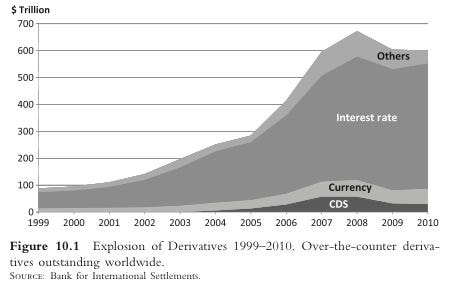
CDS and other derivatives, financial contracts that are based on the prices of stocks, bonds, commodities, and other assets or securities, exacerbated the 2008 crisis because the losses from the U.S. housing market woes were multiplied by bets on that market.

Derivatives started out as useful instruments to shift risk: A farmer can lock in the price of corn before harvest so he doesn’t have to worry about declin- ing prices by then, and a carmaker exporting most of its output can make sure it doesn’t get burned by swings in exchange rates. Yet the explosion in the derivatives market in the last decade, especially the contracts that are traded over the counter (OTC derivatives) and not on exchanges, wasn’t the result of this kind of use, but financial- market players betting on everything from weather patterns to platinum prices.

The OTC market grew eightfold in a decade, peaking at $673 trillion in mid-2008 (Figure 10.1). During that same time frame, the world’s economic output only doubled to $61 trillion, and the market value of companies listed on stock exchanges grew by a paltry one- third to $45 trillion. Nonfinancial users of the contracts account for less than 10 percent of the total market.1 The bottom line is that derivatives aren’t serving the economy’s needs: They’ve been turning the financial system to a great big casino.

Zombie Banks Excerpt

The growth in OTC derivatives was partly thanks to the hands-off approach by the authori- ties in the past decade leaving it completely unchecked worldwide—no regulation, no transparency.
Although the 2008 meltdown exposed the derivatives’ contribu- tion to the increased riskiness of the financial system, their role since then hasn’t diminished much.

The OTC market has shrunk by only 11 percent while U.S. banks’ holdings of derivatives have grown by 15 percent.2 Even though there are new regulations in the works, both in Europe and the United States, to bring some order to this market, they won’t reduce the risks enough. The chances of the next big financial blowup having ripple effects as wide as the 2008 crisis remain high.
 
But anyone who says the government should have just allowed our economy to crash is a moron. The problem with these whack-o 'laissez-faire' libertarians is they are extreme ideologues. There is NEVER any learning that goes on in their dogmatic minds. And learning is the key to moderation. They are not moderates.

.

I agree.

It is the US responsibility to encourage mismanagement and irresponsibility.

In a nation that is sinking in a sea of debt, it is commendable for Congress to consider measures that would add billions to that debt.

Socialists , on the other hand, are not morons or extreme ideologues. Since they are so smart I am proud to state that I am a member in good standing of the Karl Marx School of Economics.

.
 
BS

The bundled trash bets and bid them up up and away. The bets weren't worth the paper they were written on, but they kept betting anyway. Playing a game of hot potato with the bets. Not wanting to be the one burned in the end.

4 banks were the major players in it, and they control most of the nations deposits. 20 banks virtually control all deposits in the United States. EVERY ONE OF THEM got bailed out to keep from going under except Lehman...................

TARP was nothing more than a smoke screen, as the Federal Reserve gave loans from the discount window to a tune of 16.1 TRILLION DOLLARS. I've proved this data from the GAO many times.

Margin Trading and Margin loans went up up and away. Which is the same thing we have right now.

We allowed the Too Big to Fail to SELF REGULATE, and they created a bubble from hell, and they tied the American Taxpayers to their bets.

I've just done 2 threads associated with this showing some of this data. Lets look at Goldman Sachs............0.2% ASSETS to bets, aka Derivatives. They only have 114 Billion in Assets via the OCC reports. They have 48 TRILLION IN DERIVATIVES.

The big boys jacked up the markets and pulled the rug out leaving the DOLLAR and the American people on the hook for their BS. Which is why they need to be put on a dang leash.

There is a LOT wrong with HOW TARP was administered. You will get no argument from me on that issue. BUT, it saved the American financial system from collapse. And it was an opportunity for government to change the structure and the incentives of Wall Street when it had the chance. They failed on that front.

But anyone who says the government should have just allowed our economy to crash is a moron. The problem with these whack-o 'laissez-faire' libertarians is they are extreme ideologues. There is NEVER any learning that goes on in their dogmatic minds. And learning is the key to moderation. They are not moderates.

Bush and Paulson deserve credit for putting aside their 'ideology' and getting tarp passed, along with people from both sides of the aisle who did the right thing. EVERYONE had to hold their nose while passing TARP, but it was absolutely necessary.

Thank God Bush and Paulson didn't listen to these whack-o 'laissez-faire' libertarians and just do nothing.

Hoover made the mistake 85 years ago of listening to the whack-o 'laissez-faire' libertarians of the day. It turned a deep recession into the GREAT depression.

People who are opposed to bailouts of any kind like to argue that TARP was not really necessary. Banks could have been allowed to fail and the economic fallout around the world would not have been so dramatic.

This was, of course, the view taken by policy makers in 1929-31, after the Great Crash. Top people at the Federal Reserve and Treasury argued that the United States had experienced a financial mania (true), that a fall in asset prices was long overdue (quite likely, at least for stocks), and that the right approach was to stand back and – in the unforgettable words of Treasury Secretary Andrew Mellon, let the private sector “liquidate labor, liquidate stocks, liquidate the farms, liquidate real estate.”

The result was the Great Depression. No responsible policy maker would want to run that risk again. ref

What NEVER works is what Herbert Hoover and Andrew Mellon did to bring on the Great Depression...liquidate, and austerity. They listened to the 'Austrian' school. Unless you also believe Medieval blood letting save lives?

Economic Policy Under Hoover

Throughout this decline—which carried real GNP per worker down to a level 40 percent below that which it had attained in 1929, and which saw the unemployment rise to take in more than a quarter of the labor force—the government did not try to prop up aggregate demand. The only expansionary fiscal policy action undertaken was the Veterans’ Bonus, passed over President Hoover’s veto. That aside, the full employment budget surplus did not fall over 1929–33.

The Federal Reserve did not use open market operations to keep the nominal money supply from falling. Instead, its only significant systematic use of open market operations was in the other direction: to raise interest rates and discourage gold outflows after the United Kingdom abandoned the gold standard in the fall of 1931.

This inaction did not come about because they did not understand the tools of monetary policy. This inaction did not come about because the Federal Reserve was constrained by the necessity of defending the gold standard. The Federal Reserve knew what it was doing: it was letting the private sector handle the Depression in its own fashion. It saw the private sector’s task as the “liquidation” of the American economy. It feared that expansionary monetary policy would impede the necessary private-sector process of readjustment.

Contemplating in retrospect the wreck of his countryÂ’s economy and his own presidency, Herbert Hoover wrote bitterly in his memoirs about those who had advised inaction during the downslide:

The ‘leave-it-alone liquidationists’ headed by Secretary of the Treasury Mellon…felt that government must keep its hands off and let the slump liquidate itself. Mr. Mellon had only one formula: ‘Liquidate labor, liquidate stocks, liquidate the farmers, liquidate real estate’.…He held that even panic was not altogether a bad thing. He said: ‘It will purge the rottenness out of the system. High costs of living and high living will come down. People will work harder, live a more moral life. Values will be adjusted, and enterprising people will pick up the wrecks from less competent people’.


The Federal Reserve took almost no steps to halt the slide into the Great Depression over 1929–33. Instead, the Federal Reserve acted as if appropriate policy was not to try to avoid the oncoming Great Depression, but to allow it to run its course and “liquidate” the unprofitable portions of the private economy.

In adopting such “liquidationist” policies, the Federal Reserve was merely following the recommendations provided by an economic theory of depressions that was in fact common before the Keynesian Revolution and was held by economists like Friedrich Hayek, Lionel Robbins, and Joseph Schumpeter.

The bail out was not about TARP. TARP was not needed as the real bail out was through the Federal Reserves back door. TARP was a smoke screen.

We have re-inflated the bubble because the Notional values of the bets on Wall Street are Insane. We are now at a point were Margin loans are higher than the first crash, so what have we repaired or fixed by bailing them out......................

We are headed for another crash...........so what will be the price tag on the next set of bail outs under Keynes.................

The Federal Reserves QE program is nothing more than an artificial bubble machine. You can only inflate it so far and it will burst again. The higher the bubble the longer the fall.

All we have bought is time. We never fixed the root problem of the crash, and our answer to fix it is the same solution that broke it.

I told you I agree that it was not handled properly and we never fixed the root problem of the crash. But are you saying the government and Federal Reserve should have done nothing?

My concern is not about bank executives, Wall Street gangsters or bureaucrats. My concern is about how doing nothing would have brought harm to every day working folks.
 
But anyone who says the government should have just allowed our economy to crash is a moron. The problem with these whack-o 'laissez-faire' libertarians is they are extreme ideologues. There is NEVER any learning that goes on in their dogmatic minds. And learning is the key to moderation. They are not moderates.

.

I agree.

It is the US responsibility to encourage mismanagement and irresponsibility.

In a nation that is sinking in a sea of debt, it is commendable for Congress to consider measures that would add billions to that debt.

Socialists , on the other hand, are not morons or extreme ideologues. Since they are so smart I am proud to state that I am a member in good standing of the Karl Marx School of Economics.

.

Thank you for proving my point. If you are not a 'whack-o 'laissez-faire' libertarian', then you can only be a 'member in good standing of the Karl Marx School of Economics'
 
But anyone who says the government should have just allowed our economy to crash is a moron. The problem with these whack-o 'laissez-faire' libertarians is they are extreme ideologues. There is NEVER any learning that goes on in their dogmatic minds. And learning is the key to moderation. They are not moderates.

.

I agree.

It is the US responsibility to encourage mismanagement and irresponsibility.

In a nation that is sinking in a sea of debt, it is commendable for Congress to consider measures that would add billions to that debt.

Socialists , on the other hand, are not morons or extreme ideologues. Since they are so smart I am proud to state that I am a member in good standing of the Karl Marx School of Economics.

.

Thank you for proving my point. If you are not a 'whack-o 'laissez-faire' libertarian', then you can only be a 'member in good standing of the Karl Marx School of Economics'[/QUOTE]

But you knew that already since you are an instructor there.

.
 
I agree.

It is the US responsibility to encourage mismanagement and irresponsibility.

In a nation that is sinking in a sea of debt, it is commendable for Congress to consider measures that would add billions to that debt.

Socialists , on the other hand, are not morons or extreme ideologues. Since they are so smart I am proud to state that I am a member in good standing of the Karl Marx School of Economics.

.

Thank you for proving my point. If you are not a 'whack-o 'laissez-faire' libertarian', then you can only be a 'member in good standing of the Karl Marx School of Economics'[/QUOTE]

But you knew that already since you are an instructor there.

.

Interesting, because I never read any writing of Karl Marx. But I am not an 'ideologue' like you. I have an adult brain that believes in pragmatism and moderation.

And I am in line with our founding fathers who were not 'whack-o 'laissez-faire' libertarians'.

They heavily regulated corporations and demanded that any corporation had to provide a service that benefited the public good.
 
Thank you for proving my point. If you are not a 'whack-o 'laissez-faire' libertarian', then you can only be a 'member in good standing of the Karl Marx School of Economics'[/QUOTE]

But you knew that already since you are an instructor there.

.

Interesting, because I never read any writing of Karl Marx. But I am not an 'ideologue' like you. I have an adult brain that believes in pragmatism and moderation.

And I am in line with our founding fathers who were not 'whack-o 'laissez-faire' libertarians'.

They heavily regulated corporations and demanded that any corporation had to provide a service that benefited the public good.


HUH?

Heavy fascistic regulation began around the early 1900's when socialists , then known as "progressives" began the manipulation Congress and the states to stick it to entrepreneurs for the hell of it. Theodore Roosevelt was among those scumbags.


See also the US SUpreme Court case styled as

UNITED STATES v. E.C. KNIGHT COMPANY., 15 S. Ct. 249, 156 U.S. 1 (U.S. 01/21/1895)
 
Last edited:
Interesting, because I never read any writing of Karl Marx. But I am not an 'ideologue' like you. I have an adult brain that believes in pragmatism and moderation.

And I am in line with our founding fathers who were not 'whack-o 'laissez-faire' libertarians'.

They heavily regulated corporations and demanded that any corporation had to provide a service that benefited the public good.


HUH?

Heavy fascistic regulation began around the early 1900's when socialists , them known as "progressives" began the manipulation Congress and the states to stick it to entrepreneurs for the hell of it. Theodore Roosevelt was among those scumbags.


See also the US SUpreme Court case styled as

UNITED STATES v. E.C. KNIGHT COMPANY., 15 S. Ct. 249, 156 U.S. 1 (U.S. 01/21/1895)

Why am I not surprised you don't know shit?

Contumacious: "The manipulation Congress and the states to stick it to entrepreneurs for the hell of it."

For the hell of it? E. C. Knight Company and others had a 98% monopoly of the American sugar refining industry. No one will ever accuse you of being a 'Marxist', you are the twin cousin, a 'Marketist'...cut from the same cloth, but with the same results. One would have government control and the other would create a corporatocracy.

If you want to research Supreme Court decisions, look into Santa Clara County v. Southern Pacific Railroad (1886). It was the beginning of the corporate takeover of America and lead to the progressive movement.

The progressive movement was a huge BIPARTISAN ground swell of reforms that addressed corporations gaining power over the years in direct conflict to our founder's intent. It was called the Gilded Age for a reason.

Debate and argument over the Constitution, the Bill of Rights and the Federalist papers has been going on for over 200 years by and between citizens, scholars, theologians and polemics. It is nothing new, and our founder's true intent on many issues has not become any closer to being resolved.

So when we have an example of how those same men applied all those principles, beliefs and ideas to actual governing, it serves as the best example of how they put all those principles, beliefs and ideas to use. Their actions carry the most weight.

Our founding fathers did not subscribe to Adam Smith's 'invisible hand'. They believed in very heavy regulations and restrictions on corporations. They were men who held ethics as the most important attribute. They viewed being paid by the American people for their services as a privilege not a right. And they had no problem closing down any corporation that swindled the people, and holding owners and stockholder personally liable for any harm to the people they caused.

Early laws regulating corporations in America

*Corporations were required to have a clear purpose, to be fulfilled but not exceeded.

*CorporationsÂ’ licenses to do business were revocable by the state legislature if they exceeded or did not fulfill their chartered purpose(s).

*The state legislature could revoke a corporationÂ’s charter if it misbehaved.

*The act of incorporation did not relieve corporate management or stockholders/owners of responsibility or liability for corporate acts.

*As a matter of course, corporation officers, directors, or agents couldn’t break the law and avoid punishment by claiming they were “just doing their job” when committing crimes but instead could be held criminally liable for violating the law.

*Directors of the corporation were required to come from among stockholders.

*Corporations had to have their headquarters and meetings in the state where their principal place of business was located.

*Corporation charters were granted for a specific period of time, such as twenty or thirty years (instead of being granted “in perpetuity,” as is now the practice).

*Corporations were prohibited from owning stock in other corporations, to prevent them from extending their power inappropriately.

*CorporationsÂ’ real estate holdings were limited to what was necessary to carry out their specific purpose(s).

*Corporations were prohibited from making any political contributions, direct or indirect.

*Corporations were prohibited from making charitable or civic donations outside of their specific purposes.

*State legislatures could set the rates that some monopoly corporations could charge for their products or services.

*All corporation records and documents were open to the legislature or the state attorney general.

The Early Role of Corporations in America

The Legacy of the Founding Parents
-----------------------------------------------------------------------------------------------------
What caused the Progressive movement

We tried unregulated corporations in America. The closest experiment to total deregulation in this country occurred between the end of the Civil War and the beginning of the 19th century...it was called the Gilded Age; an era where America was as far from our founder's intent of a democratic society and closest to an aristocracy that our founder's were willing to lay down their lives to defeat.

It was opposition to that same Gilded Age that was the genesis of the Progressive movement in this country. When you study history, almost always just cause is behind it.

The only enemies of the Constitution are those who try to wield it as a weapon against the living, by using the words of the dead.
Me
 
[/B]

HUH?

Heavy fascistic regulation began around the early 1900's when socialists , them known as "progressives" began the manipulation Congress and the states to stick it to entrepreneurs for the hell of it. Theodore Roosevelt was among those scumbags.


See also the US SUpreme Court case styled as

UNITED STATES v. E.C. KNIGHT COMPANY., 15 S. Ct. 249, 156 U.S. 1 (U.S. 01/21/1895)

Why am I not surprised you don't know shit?

Contumacious: "The manipulation Congress and the states to stick it to entrepreneurs for the hell of it."

For the hell of it? E. C. Knight Company and others had a 98% monopoly of the American sugar refining industry.


Be that as it may:

1- No one was complaining about exorbitant prices

2- there are two kinds of monopolies . Coercive which is caused by the power of the state. NON-COERCIVE which may happen in a free market environment

3- An honest SCOTUS REFUSED to grant relief under the anti-trust laws

4- So much for the Founding Fathers wanted to create a socialist economy

.
 
Hey how are you libertarians liking that open border you guys wanted so bad?

They also want to get rid of all government subsidize. That way all those illegals can be living in the streets, stealing from our homes, etc. instead of living in community prisons.
 
15th post
There is not a single home buyer in America who signed a mortgage and said to themselves "Oh, I have no risk, the government will save me from financial ruin"

The reason the banks were bailed out was to protect our economy from ruin and to protect INNOCENT citizens who had nothing to do with the housing crisis, who would have lost their 401Ks and life savings.

PLEASE tell me your ideology would not demand INNOCENT citizens being destroyed?

You are the idiot that said no one was protected from financial ruin, yet you admit the banks were bailed out. I am sure that has something to do with my lack of cognitive ability, but it really doesn't make sense.

By the way, it is crap that TARP was needed to protect the economy, it just made things worse. That explains why the Democrats were for it, and Bush had to finagle the Republicans on board.

Let's recap, and see where your cognitive ability failed you.

Quantum Windbag: That doesn't change the fact that multiple thousands of people made bad decisions, does it?

Bfgrn: I guess it is impossible to reason with a dogmatic mind. Let's lay it out.

1) There was a housing bubble.

Then

2) Property values plummeted.

3) The people you say caused the crisis (CRA and lower income buyers) continued to pay their mortgage. Why? Because although the value dropped, they were buying a homestead. And those who lost their jobs probably kept paying even when foreclosure was inevitable.

If these were the only buyers affected, there would have been a slow deflation of the housing market.

4) But speculators and wealthy buyers trying to make a fast buck flipping houses made a cold, hard business decision...walk away and cut your loses. Speculators comprised up to 50% of buyers in the 'hot' markets where the massive foreclosures occurred.

So the ONLY way there could be a bust, is for the market to be instantly flooded with foreclosures.

Quantum Windbag: The only reason to foreclose on a loan is if somene isn't paying it. Given all the regulations, both federal and state, that make kicking people out of their house all but impossible, your claim that there was a massive conspiracy by banks to burst the housing bubble is so absurd I don't even think a rational person could possibly consider it as reality.

Are you having fun running around in circles trying to reconcile your contradictory posts? Have you considered not delving into whackdoodle space?
 
Hey how are you libertarians liking that open border you guys wanted so bad?

They also want to get rid of all government subsidize. That way all those illegals can be living in the streets, stealing from our homes, etc. instead of living in community prisons.

Like that matters to the criminals and terrorists pouring through

Tapatalk
 
You are the idiot that said no one was protected from financial ruin, yet you admit the banks were bailed out. I am sure that has something to do with my lack of cognitive ability, but it really doesn't make sense.

By the way, it is crap that TARP was needed to protect the economy, it just made things worse. That explains why the Democrats were for it, and Bush had to finagle the Republicans on board.

Let's recap, and see where your cognitive ability failed you.

Quantum Windbag: That doesn't change the fact that multiple thousands of people made bad decisions, does it?

Bfgrn: I guess it is impossible to reason with a dogmatic mind. Let's lay it out.

1) There was a housing bubble.

Then

2) Property values plummeted.

3) The people you say caused the crisis (CRA and lower income buyers) continued to pay their mortgage. Why? Because although the value dropped, they were buying a homestead. And those who lost their jobs probably kept paying even when foreclosure was inevitable.

If these were the only buyers affected, there would have been a slow deflation of the housing market.

4) But speculators and wealthy buyers trying to make a fast buck flipping houses made a cold, hard business decision...walk away and cut your loses. Speculators comprised up to 50% of buyers in the 'hot' markets where the massive foreclosures occurred.

So the ONLY way there could be a bust, is for the market to be instantly flooded with foreclosures.

Quantum Windbag: The only reason to foreclose on a loan is if somene isn't paying it. Given all the regulations, both federal and state, that make kicking people out of their house all but impossible, your claim that there was a massive conspiracy by banks to burst the housing bubble is so absurd I don't even think a rational person could possibly consider it as reality.

Are you having fun running around in circles trying to reconcile your contradictory posts? Have you considered not delving into whackdoodle space?

Hey pea brain, I never claimed that there was a massive conspiracy by banks to burst the housing bubble.

You made it up in your tiny brain.
 
Why am I not surprised you don't know shit?

Contumacious: "The manipulation Congress and the states to stick it to entrepreneurs for the hell of it."

For the hell of it? E. C. Knight Company and others had a 98% monopoly of the American sugar refining industry.


Be that as it may:

1- No one was complaining about exorbitant prices

2- there are two kinds of monopolies . Coercive which is caused by the power of the state. NON-COERCIVE which may happen in a free market environment

3- An honest SCOTUS REFUSED to grant relief under the anti-trust laws

4- So much for the Founding Fathers wanted to create a socialist economy

.

And there are two extremes of ideologues...

The closest twin we have in America today to the communists and Marxists in Russia are the 'Marketists'; conservatives, libertarians and 'free marketeers' who have turned government nonintervention and 'laissez faire' into a religion. It has created 'malaise faire'

Blind Faith

For a country that has prided itself on its resourcefulness, the inability to address our problems suggests something deeper at work. There is something, powerful but insidious, that blinds us to the causes of these problems and undermines our ability to respond. That something is a set of beliefs, comparable to religious beliefs in earlier ages, about the nature of economies and societies. These beliefs imply the impropriety of government intervention either in social contexts (libertarianism) or in economic affairs (laissez faire).

The faithful unquestioningly embrace the credo that the doctrine of nonintervention has generated our most venerated institutions: our democracy, the best possible political system; and our free market economy, the best possible economic system. But despite our devotion to the dogmas that libertarianism and free market economics are the foundation of all that we cherish most deeply, they have failed us and are responsible for our present malaise.

The pieties of libertarianism and free markets sound pretty, but they cannot withstand even a cursory inspection. Libertarianism does not support democracy; taken to an extreme, it entails the law of the jungle. If government never interferes, we could all get away with murder. Alternatively, if the libertarian position is not to be taken to an extreme, where should it stop? What is the difference between no government and minimal government? Attempts to justify libertarianism, even a less than extreme position, have failed. Laissez faire, or free market economics, characterized by minimal or no government intervention, has a history that is long but undistinguished. Just as the negative effects of a high fever do not certify the health benefits of the opposite extreme, hypothermia, the dismal failure of communism, seeking complete government control of the economy, does not certify the economic benefits of the opposite extreme, total economic non-intervention.

It may seem odd, given the parabolic arc of our financial markets and the swelling chorus of paeans to free market economics, but despite the important role of the market, purer free market economies have consistently underperformed well-focused mixed economies. In the latter part of the nineteenth century the mixed economies of Meiji Japan and BismarckÂ’s Germany clearly outperformed the free market economies of Britain and France. Our own economy grew faster when we abandoned the laissez faire of the 1920s and early 1930s for the proto-socialist policies of Franklin D. Roosevelt. It has become increasingly sluggish as we have moved back to a purer free market. Data of the past few decades show that our GNP and productivity growth have lagged those of our trading partners, who have mixed economies characterized by moderate government intervention.

The persistently mediocre track record of laissez faire casts doubt on the claim that an economy free from government interference invariably maximizes the wealth of society. In fact, there are sound reasons the pure free market must underperform well-focused mixed economies.

But despite laissez faireÂ’s mediocre track record and despite powerful arguments that it cannot possibly provide what it promises, the notion of the unqualified benefit of the free market has become deeply embedded in our mythology. Apologists have exulted in claims that glorify free market mythology at the expense of reality, and also at the expense of society. Free market principles, even though they have failed in economics, have been eagerly applied to sectors ranging from politics to education, where they have contributed to societal dysfunction.

One politically popular myth, that free market economics and government non-intervention provide the basis for true democracy, flies in the face of history.

As we moved toward an ideology driven 'free market' ONLY belief economically, and away from a mixed economy, the results have been disastrous.

Over the past half-century we have seen lower tax rates and less government interference. We have come a long way toward free enterprise from the proto-socialist policies of Franklin D. Roosevelt. Since the Kennedy Administration we have reduced the marginal tax rate on our highest incomes from the 91% that remained in effect from the 1940s into the mid-1960s (and a brief peak of 94% during World War II) to 28% in the 1986 tax code. Yet our economic growth has slowed.

Decade/Average Real GNP/per Capita GNP Growth
1960-1969 4.18% 2.79%
1970-1979 3.18% 2.09%
1980-1989 2.75% 1.81%
1990-1994 1.95% 0.79%
(Maddison, Monitoring the World Economy 1820-1992 p. .183, 197)

Despite our adoption of the most enlightened free market policies, our performance resembles that of a declining Great Britain in the late nineteenth century.

Free market apologists contend the closer we come to pure laissez faire, the better. But there is little evidence for even this position. The U.S. has come closer to laissez faire than most other countries, especially since the Reagan Administration. If free market policies are the best economic policies then we should have experienced the most robust growth in the world during this period. But this has not happened. We have been outstripped by our trading partners.

Myths Of The Free Market

The great enemy of truth is very often not the lie – deliberate, contrived and dishonest – but the myth – persistent, persuasive, and unrealistic. Too often we enjoy the comfort of opinion without the discomfort of thought.
President John F. Kennedy
 
Back
Top Bottom