Back it up....The math supporting the figures I cited is in the reports to which I linked.
He used statistical models, not actual figures. You want facts from an unbiased source, start here:
The Fiscal Burden of Illegal Immigration on United States Taxpayers (2013)
State Cost Studies | Federation for American Immigration Reform
You wouldn't ask that question if you'd read the reports or the source study that underpins them, or if you truly were among the country's leading immigration economists
Oh I get it, because the Fortune 500-loving WSJ claims he is "one of america's leading immigration experts..." that makes his claims legit? Are you ******* for real?
Providing something as comprehensive and rigorous as the content I linked to in the OP just one time would be sufficient. You have yet to do that.
Just did, see above.
You are a piece of work, dude. You really don't know the topic on which you've chosen to engage me. I guess I will give you credit for scouring the Internet and finding a document that confirms your point of view.
You cited a FAIR report and attempted to discredit George Borjas. It apparently is unbeknownst to you that FAIR saw fit to publish a 2014 lecture he gave. In doing so, FAIR recounts Borjas's following statement:
If we do the math, we find that the economic gains do exceed the costs by $35 billion per year.
In its editorial commentary about the lecture, FAIR tacitly grants the validity of Borjas' findings and it all but asserts that facts don't have much to with what it thinks should be U.S. immigration policy, writing:
What type of immigration policy should the U.S. pursue and should it be inspired by what immigration economics teaches us? The answer goes beyond mere facts....Economics does not tell us which path to pursue when it comes to immigration policies or what hat to wear. It just gives us facts and numbers relative to the costs and benefits of each different path.
because the Fortune 500-loving WSJ claims he is "one of america's leading immigration experts..." that makes [Borjas'] claims legit?
Number 1:
As a matter of fact, no, the legitimacy of Borjas' research findings have nothing to do with the
WSJ and
Business Week accolade, even though both have given it.
George J. Borjas has been described by both Business Week and the Wall Street Journal as “America’s leading immigration economist”. He is the
Robert W. Scrivner Professor of Economics and Social Policy at the Harvard Kennedy School. He is the recipient of the
2011 IZA Prize in Labor Economics. Professor Borjas is also a
Research Associate at the National Bureau of Economic Research and a Research Fellow at IZA. Professor Borjas is the
author of several books, including Heaven’s Door: Immigration Policy and the American Economy (Princeton University Press, 1999), and the
widely used textbook Labor Economics (McGraw-Hill, 2012), now in its sixth edition. He has published
over 125 articles in books and scholarly journals. He received his Ph.D. in economics from Columbia University in 1975.
It is also worth noting that the FAIR report you referenced specifically quotes a portion of an article Dr. Borjas published in 2003.
That is not the only instance in which FAIR has referenced Dr. Borjas' work; however, it like all the rest of FAIR's use of Borjas' research, cherry-picks only (1) the cost side and (2) direct tax impact aspects of his findings and analysis. I cannot find a single instance in which FAIR have comprehensively and with contextual completeness depicted any of Dr. Borjas' research.
The fact of the matter is that
Dr. Borjas, along with being recognized as the country's foremost immigration economist, is also a "darling" economist among conservatives. Part of why he is so often cited by conservatives is because he's done very fine work measuring and estimating the costs associated with immigration, legal immigrants, and illegal immigrants. The other part of that is because his work is highly comparmentalizable. That is, he isolates costs and gains in distinct sections of his published work such that never the twain do meet. There's nothing wrong with the fact that he publishes his findings that way. What's wrong is that organizations like FAIR, as well as their liberal opposites, can easily extract just the parts they want to present, in FAIR's case, just the costs.
Providing something as comprehensive and rigorous as the content I linked to in the OP just one time would be sufficient. You have yet to do that.
You want facts from an unbiased source...Just [shared them in the referenced report from the Federation for American Immigration Reform
Actually, you did not. What you did was cite a paper that did little but report Dr. Borjas' cost-side findings published in his book,
Immigration Economics. As for the scant credence FAIR's paper gives Borjas' gain-side findings, well, I've addressed that below....keep reading....Just remember that I asked you to "[provide] something
as comprehensive and rigorous as the content I linked to in the OP....
“
The Fiscal Burden of Illegal Immigration on United States Taxpayers” (The preceding link is to the full report and the following discussion is with regard to it.) by Jack Martin and Eric A. Ruark, quite frankly, is one of the most amateurish and error filled reports one can find. It's nearly 100 verbose pages of specious puffery that ignores the fiscal benefits of unauthorized immigration and uses dubious numbers and poor methodology to reach its conclusions.
Every human activity has both costs and benefits. People constantly weigh costs and benefits. If a given action’s benefits outweigh its costs, that action is worth taking -- but one must analyze both the costs and benefits first before one can come to that conclusion. The FAIR report counts the costs and assumes the sole revenue (benefit) impact accrues from direct taxes paid.
FAIR estimates that states and the federal governments spend $52 billion a year to educate unauthorized immigrants and their American-born children. FAIR doesn’t compare that figure with the increase in income that people experience after earning a high school degree or GED, about $7,208 over non-high school graduates. That’s $7,208 more of taxable income. On top of that,
between half and three-fourths of all undocumented immigrants file tax returns. The tax revenue gained from increasing education must be compared against the increased cost of public education when determining the net fiscal costs.
FAIR stops counting the tax payments of the children of unauthorized immigrants once they graduate from high school. Most children cost the government before the age of 18 because of the design of the U.S. public education system, so if one stops counting the costs and benefits of students upon their attaining majority, one'll conclude that children are always a fiscal loss for the government. If FAIR’s reasoning were applied to the rest of society, it would never make fiscal sense to have children, and the quicker we stopped procreating the better for the government’s fiscal balance.
Furthermore, FAIR ignores economic activity that produces tax revenue elsewhere. For instance, unauthorized immigrants (remember there are some 11M of them) purchase vast amounts of goods and services. Profits for those businesses, and hence tax revenues, would decrease if unauthorized immigrants were removed. Many unauthorized immigrants also own businesses, so if they were deported, their businesses would either disappear or lie dormant until acquired, or at least managed, by others.
The supply of jobs is not fixed. It depends on prevailing wages, marginal productivity of labor, supply and demand for inputs for goods and services produced, and numerous other factors. FAIR simplistically assumes that native and unauthorized workers are perfectly interchangeable, so, as FAIR’s reasoning goes, more deportations will just shift unemployed native workers into jobs formerly held by unauthorized immigrants. This is wrong for numerous reasons.
Almost all
jobs left vacant by deported unauthorized immigrants will not be filled by legal American workers. (watch the video at the link...I don't care if you read the rest of what you'll find there, but feel free to do so if it interests you.) Native-born and immigrant workers have different skills, strengths, and weaknesses that make them complementary rather than interchangeable. Most unauthorized immigrants have fewer skills than most native-born Americans, so the two groups generally work in different segments of the labor market. An unauthorized immigrant with poor English skills and less than a high school degree is not about to compete with a native-born American engineer for the same employment opportunity.
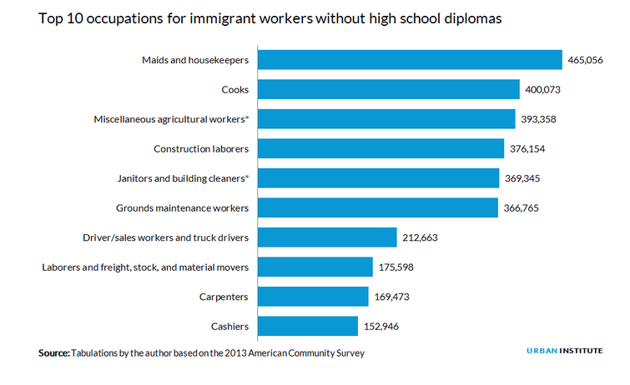
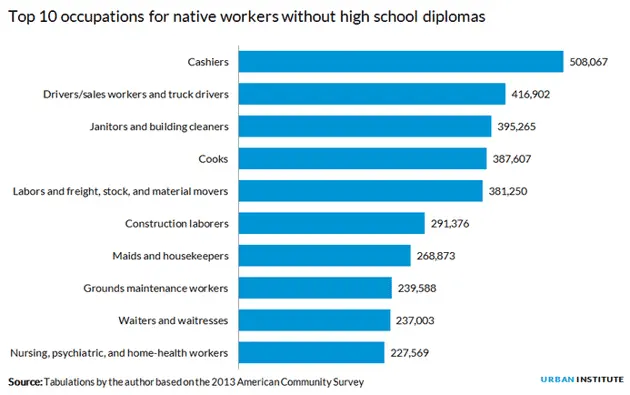
While there is some overlap, the most common occupations are different for native and immigrant workers—and that difference might widen in the future. Enchautegui mentions that while the number of U.S. natives without a high school degree is decreasing, the share of such immigrant workers with this level of education
has been climbing. By 2022,
4 million more jobs that don’t require high school degrees will be added to the U.S. job market. We’ll need low-skilled immigrants to do those jobs, as native-born workers graduate to higher-skill level positions.
(See also:
Immigration Economics: An Interview with Professor Giovanni Peri --
Giovanni Peri)
Deportations of otherwise peaceful people actually decrease the income of skilled American workers. The income of highly skilled Americans increases when there are more low skilled workers because members of the two groups can work together. A civil engineer can produce more if there are additional lower skilled surveyors for him to work with.
FAIR also gets the numbers wrong. FAIR estimates that the number of undocumented children in Texas in 2005 was
61 percent greater than that estimated by
Dr. Jeffrey Passel, the premier immigration demographer in the U.S. and supposed source for FAIR’s claims.
On a national level, FAIR estimates that there are 4.7 million school aged children who would not be in schools without undocumented immigration -- 1.3 million unauthorized children and 3.4 million child citizens of unauthorized immigrants. But
counting the 3.4 million child citizens as a cost of undocumented immigration is a methodology rejected by the Texas Comptroller’s Office in estimating the costs of undocumented immigration to Texas schools. (Texas! As "red" as state as any, and even they don't buy FAIR's BS.) After all, if one counts the first born generation of unauthorized immigrants as costs, why not also count all subsequent generations?
Furthermore, the real effect of U.S. deportation policies on families is to split them up, not move all members out of the U.S. As undocumented parents of American citizens are deported, numerous times their children are kept in the U.S. in foster care or with other relatives.
Estimating the fiscal costs and benefits of unauthorized immigration is very difficult. That doesn’t mean it’s not worth trying, but FAIR’s report is not a serious effort. It takes a snapshot in time using dubious methodology without acknowledging that undocumented children grow up to become taxpayers.
Earlier in this thread, in response to my statement that you have responded as though you "know more about the matter than do the economists" who performed the research underpinning the two papers I linked in my OP, you responded, " I clearly do." That cannot possibly be so, for if it were, you would not have cited the FAIR report for you'd have been well aware of all the problems with its so-called reporting of the facts of the matter of illegal immigration's net impact, the primary one being that FAIR's paper doesn't actually report
net impact.
I have had detailed discussions with finance professors, economists, think tanks, etc since the early 1980s on this topic - and NO ONE can counter what I wrote above. For the same reason that NO COUNTRY on earth accepts illegals as mentioned above for obvious reasons, the US should not be either.
Dude, blowing your own horn, so to speak, will do you no good, at least not with me. Maybe it works with others? I wouldn't know. Posting well thought through content will make very clear the nature and extent of your competence on the matter. So far, what you've shared gives the lie to everything you've said about yourself and the content you've had to share.


